

Advanced Octave A11 — Units and dimensional compatibility
Advanced GNU Octave with GX-TXT · Module 02
Converting seconds to milliseconds is sensible; converting seconds to volts is not. The GX-TXT drive log allows the Octave script to ask if a conversion is compatible and to apply the available rules in the version in use.
Objectives and prerequisites
After the introductory course and the Dataset lessons, we know that a scientific variable has a declared unit. Now we use UNIT_REGISTRY_API_v1 through the Bridge and distinguish dimensional control, value conversion and modification of a Dataset. The test uses GX-TXT dev112-P011-bis and Octave 9.4.0.
Check before converting
Import conversione_unita.m, record it in the Session and run it from the Runner.
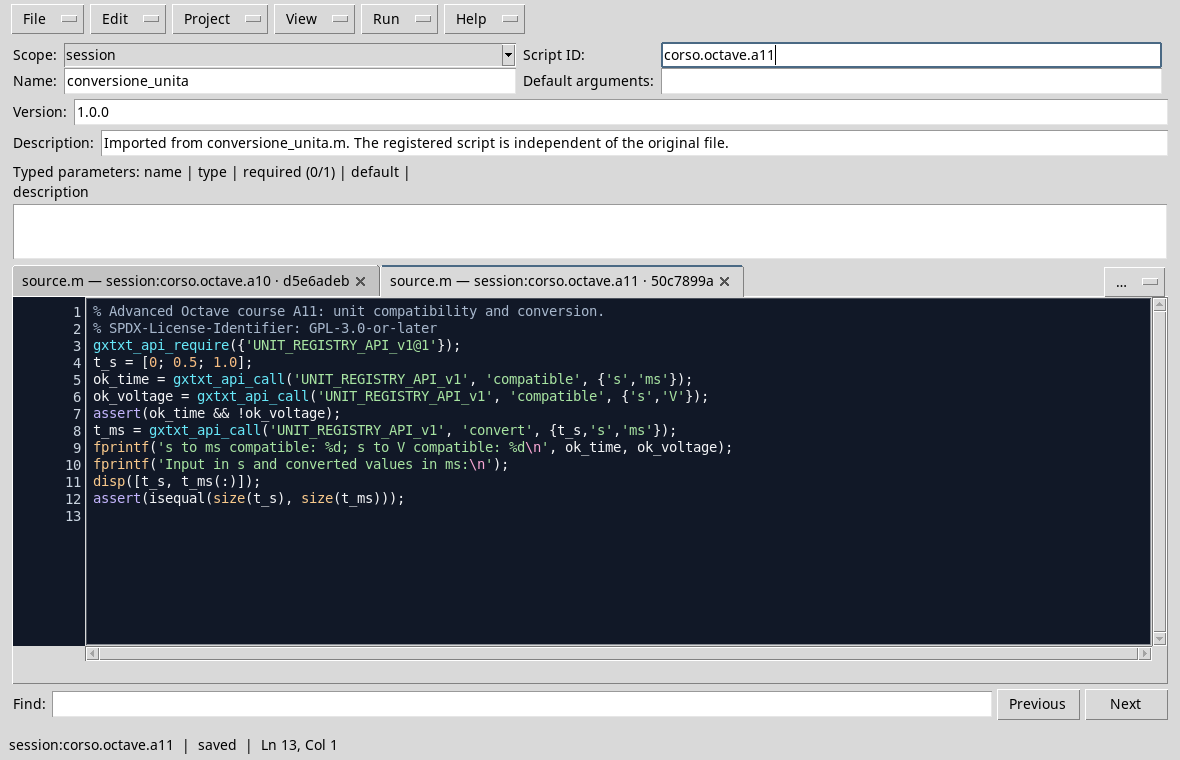
% Advanced Octave course A11: unit compatibility and conversion.
% SPDX-License-Identifier: GPL-3.0-or-later
gxtxt_api_require({'UNIT_REGISTRY_API_v1@1'});
t_s = [0; 0.5; 1.0];
ok_time = gxtxt_api_call('UNIT_REGISTRY_API_v1', 'compatible', {'s','ms'});
ok_voltage = gxtxt_api_call('UNIT_REGISTRY_API_v1', 'compatible', {'s','V'});
assert(ok_time && !ok_voltage);
t_ms = gxtxt_api_call('UNIT_REGISTRY_API_v1', 'convert', {t_s,'s','ms'});
fprintf('s to ms compatible: %d; s to V compatible: %d\n', ok_time, ok_voltage);
fprintf('Input in s and converted values in ms:\n');
disp([t_s, t_ms(:)]);
assert(isequal(size(t_s), size(t_ms)));
compatible returns a logical value for the required torque. Only after the control we convert the carrier; convert returns numerical values in the form of the input array. Here we use the s symbols, ms and V recognized by the test register.
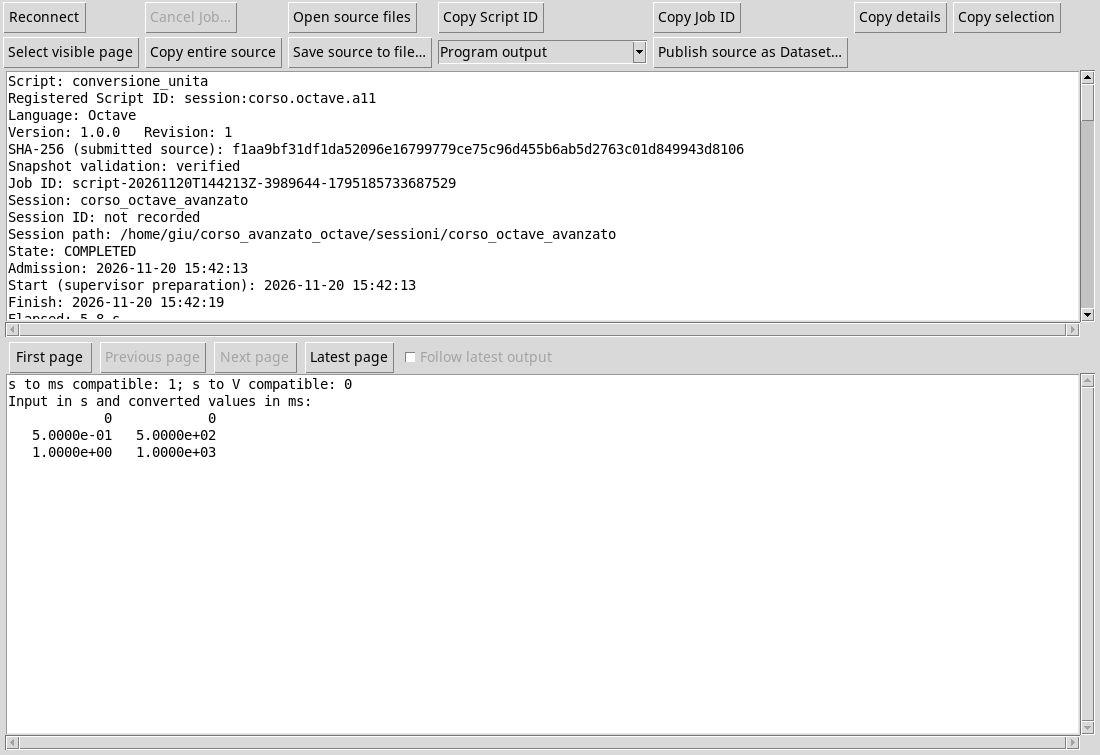
The result shows 1 for s → ms and 0 for s → V; 0,5 s becomes 500 ms and 1 s becomes 1000 ms. The shape control checks that the output remains a column vector. The conversion takes place in memory: the script does not change the data or units of a persistent Dataset.
What does not guarantee compatibility
dimensionally compatible units do not guarantee that two variables represent the same sensor or the same instant. Before comparing data, it also checks role, temporal reference and origin. Not all conversions are reduced to multiply by one factor: some relationships may include an offset or require a formula. Rely on the register contract and document the transformation actually applied.
Exercise
- How many milliseconds correspond to
2,5 s? - Why is a
s → Vconversion rejected? - Does the
convertcall automatically change the dataset units from which a carrier could come from?
Worked solution
2500 ms.- Time and tension have different dimensions.
- No: in the example only changes the value returned in memory; the persistent change would require an explicit appropriate operation.
Other steps of this project
- Advanced Octave A75 — Dynamical systems in phase space
- Advanced Octave A81 — Geography of the waves and a 3D surface
- Advanced Octave A82 — Age, sex and demographic inequalities
- Advanced Octave A83 — All-cause mortality, certified COVID deaths and surveillance
- Advanced Octave A84 — A reproducible public account
- Advanced Octave A73 — Optimization landscapes and 3D trajectories