

ELEC 04 — Kinetics, speciation and transport: from local reaction to reactor response
Bulk pH, equilibrium speciation and reaction times help distinguish rapid local chloramination from the slower response observed in the stirred reactor.
A fast first step is not rapid assay-N removal
Qiang and Adams study HOCl+NH₃ formation, not disappearance of the TNT830 response. The retained source covers pH 6–12 and 5, 15, 25 and 35 °C, with phosphate/borate buffers, 50 mM NaClO₄ and approximately 0.075 M ionic strength in the mixture. It is not a universal ionic-strength scan or an automatic representation of 84 mM NaCl in the reactor. At 25 °C the reported values are k=3.07×10⁶ L mol⁻¹ s⁻¹, pKa(HOCl)=7.537 and pKa(NH₄⁺)=9.251. The common monovalent-ion γ=0.78 is a reference for that source mixture; neutral species are assumed ideal. It is neither neutral-NH₃ activity nor a fitted reactor coefficient.
Using dimensionless proton activity H=10^(−pH), the adopted fractions are α_H=1/[1+10^(pH−pKaC)/γ] for HOCl in HOCl/OCl⁻, and α_N=1/[1+10^(pKaN−pH)/γ] for NH₃ in unchlorinated NH₃/NH₄⁺. Then k_app=kα_Hα_N. Little NH₃ is available at low pH and little HOCl at high pH, creating an intermediate maximum without invoking a stirring-dependent elementary rate constant.
The first native scenario uses initially unchlorinated N=10 mg N/L, converted natively to 0.00071394404106606124 mol/L. The quantity
is a local free-chlorine e-fold time for a small perturbation at frozen total unchlorinated N=[NH₃]+[NH₄⁺] and pH, at 25 °C. It is not nitrogen depletion time, batch completion or mixing time. Continuous source and transport still enter the reactor balances. A nitrogen-side reciprocal time would require a specified positive chlorine input; it cannot be obtained by silently exchanging the pools.
What Mathematics Explorer actually produced
The native model published nine components on 61 uniform pH points from 6 to 12. The following values are retained native rows; displayed rounding is editorial. dm³ mol⁻¹ s⁻¹ equals L mol⁻¹ s⁻¹.
| Scenario at pH 9 | α_H | α_N | k_app, L mol⁻¹ s⁻¹ | τ_F, s |
|---|---|---|---|---|
| Ideal γ=1 | 0.0332886970 | 0.359404698 | 36729.8303 | 0.0381343989 |
| Source-mixture reference γ=0.78 | 0.0261567429 | 0.304404645 | 24444.0586 | 0.0573010409 |
The declared grid has minimum τ_F at pH 8.4: 0.0306372774 s for γ=1 and 0.0476893466 s for γ=0.78. Grid maxima of k_app are 45717.8353 and 29370.7106 L mol⁻¹ s⁻¹. The analytical pH_peak=(pKaC+pKaN)/2 locates the continuous maximum at fixed γ; a grid point is not an experimentally estimated optimum. At pH 12 native τ_F values are 13.2735 and 17.0257 s. These are conditional sensitivities, not measured local reactor times. All nine native components.
Formation can therefore be fast compared with macroscopic times in some conditions without nitrogen disappearing from an inclusive assay equally fast. Subsequent chemistry, storage, transfer and the observation operator determine that fate. Substituting k_app for h would erase a distinction in both dimensions and interpretation.
Chlorine equilibrium: formulation and limits
A separate reusable definition describes Cl₂(aq)/HOCl/OCl⁻. It has now been evaluated natively on the ten acquired nitrogen-present pH rows. This is not Qiang’s formation model. It adopts aᵢ=γᵢcᵢ/c_std, fixed c_std=1 mol/L, ideal water and neutral species. For Cl₂+H₂O⇌HOCl+H⁺+Cl⁻, with the secondary quadratic-concentration K_h convention,
The fractions are φ_Cl2=r_Cl2/(1+r_Cl2+r_OCl), φ_HOCl=1/(1+r_Cl2+r_OCl), and φ_OCl=r_OCl/(1+r_Cl2+r_OCl). These relations explicitly distinguish proton activity from [H⁺]. K_h=0.0003944 mol²/L² comes from secondary Gendel–Lahav discussion with unresolved original reference temperature. Combining it with a 25 °C pKa is an explicit mixed-reference scenario, not a verified reactor equilibrium constant.
Chloride 84 mmol/L is a fixed reservoir assumption, not measured free chlorine. Changing the numerical standard c_std requires consistent constant definitions; it is not a physical sensitivity parameter. Zero chloride is only a formal clamped-reservoir limit, not initially chloride-free water in which hydrolysis generates Cl⁻. The model omits Cl₃⁻, chloramines and other oxidants; its fractions are not automatically DPD response.
The prepared theoretical pH 3–12, 91-point sweep is not declared executed. Actual native outputs concern ten measured-pH rows. Applying equilibrium below pH 6 does not extend validation of Qiang’s kinetic law. No gas flux was calculated. Source conventions.
Applying fractions to the actual pH trace
Native graph p0038 compares two acquired bulk-pH traces at 100 rpm, with and without added N. Each contains ten marker centres from Figure 3b. Equal selected image abscissae do not establish synchronized raw sampling or paired aliquots. The nitrogen-present trace starts at pH 5.1530, reaches 3.5244 in its sixth row and rises to 7.8504 in the last. These are bulk marker reconstructions, not an electrode diffusion-layer profile.
Native Dataset Expression evaluated the declared equilibrium definitions while preserving original time, pH, source row and point identity. At the first row φ_Cl2=0.0014888761 and φ_HOCl=0.9944033271; at the sixth, 0.0598505092 and 0.9400581670; at the last, φ_Cl2=9.82793×10⁻⁷ and φ_OCl=0.6729872761. They are model fractions at acquired pH values, not measured dissolved-Cl₂ concentrations, evaporated amounts or proof of gas loss. Exact native fraction table.
For the unchlorinated pool, the ideal NH₃/(NH₃+NH₄⁺) fraction with pKa_N=9.251 at 25 °C was also computed natively. First, sixth and last rows give 7.98016×10⁻⁵, 1.87685×10⁻⁶ and 0.0382393509. These are not fractions of the whole TNT830 signal, which may include chloramines. The native NH₃ table preserves exact values, times and UUIDs. No theoretical common time grid replaces the observations.
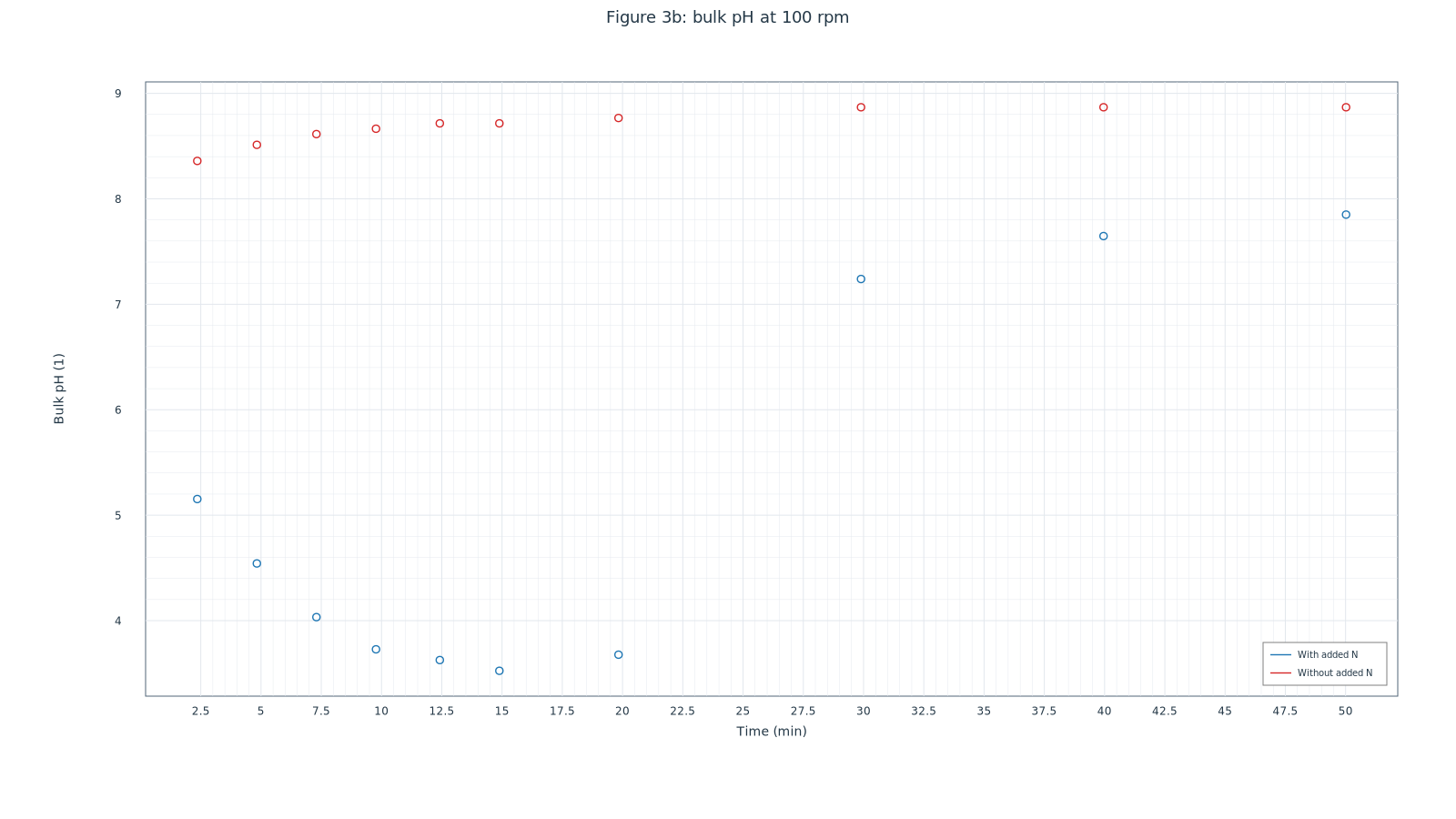
Native p0038: ten discrete centres per trace are shown as scatter, without connecting lines or interpolation. This is not an interfacial-pH measurement.
The result motivates distinguishing time-dependent species availability from an effective constant κ. It does not prove which species controls loss or whether one transfer coefficient is shared. Gendel discusses acidic chlorine/chloramine routes, but overall reactions and secondary relative-rate statements do not supply a closed absolute-rate mechanism. The pH-forced loss candidate remains unexecuted at the freeze.
Reaction–film reasoning and a negative control
The dimensionless ratio δ²/(D_Fτ_F) compares diffusion and local chemical times for D_F in m²/s and δ in m. No reactive δ or suitable diffusivity for the mixed pool was assigned, so no experimental Damköhler number is claimed. An anodic molar flux can be written J=ηj/(2F), j in A/m², where η is gross current allocation. It is not automatically S2 net-accumulation f. The capacity k_m,N N_bulk uses N in mol/m³ and k_m in m/s; zero surface N gives maximum supply, while finite surface concentration reduces it.
Atrashkevich’s FcMeOH/Pt limiting-current protocol yields m=i_lim/(nFAC) and δ=D/m for that tracer under its own KCl, potential and time conditions. It is not a Ti/IrO₂ chlorine-producing, bubble-generating surface. D, m and δ are not directly transferable to chlorine species, interfacial pH or h.
For a passive two-compartment control with fixed V_s,V_b, total V, a constant near-anode source Q in mol/s and exchange K in m³/s,
Exchange conserves total stock. From initially chlorine-free liquid, λ=K(1/V_s+1/V_b) gives F_b=(Q/V)[t−(1−e^(−λt))/λ]. For positive time, ∂F_b/∂λ=(Q/V)[1−(1+λt)e^(−λt)]/λ²>0. More passive exchange makes chlorine visible in the bulk sooner and all conditions approach Q/V. This restricted branch cannot explain less accumulation at stronger stirring with identical source, no loss and bulk sampling. It does not exclude transport generally: adding reaction, spatial loss, changed source or different sampling changes the question.
Formation plus internal exchange conserves ΣVᵢ(Nᵢ+Mᵢ) under unit recovery. A local aliquot can differ from the volume average. If the initially uniform pool has equal exchange coefficients for N and M, even that pool remains uniform. A sampling explanation therefore needs a specific spatial hypothesis, not the word mixing alone. Reviewed transport reasoning.
Datasets
Nine initial-pH components · Two acquired pH traces · Ideal NH₃ fraction · Three conditional chlorine fractions
Digitized Figure 3 observations (12 CSV files in a ZIP archive) · Native model and constraint results (27 CSV files in a ZIP archive)
Other steps of this project
- ELEC 02 — Model hierarchy: effective kinetics, transfer and identifiability
- ELEC 03 — From fits to constraints: what does the chlorine balance reveal?
- ELEC 01 — What does the experiment measure? Nitrogen, chlorine and pH
- ELEC 07 — Sources, conclusions and tests that could distinguish the mechanisms
- ELEC 06 — Where the numbers came from: GX-TXT, GNU Octave and reproducibility
- ELEC 05 — Gas loss, chloramines and the proton balance