

ELEC · Practical Guide 10 — Evaluate chlorine transfer with fixed parameters
Evaluate two fixed-parameter chlorine predictions at the actual sampling times of the nitrogen-free 100 rpm control.
ELEC project · Practical GX-TXT guide 10 of 16.
Reproduction target: GX-TXT DEV112-P013. The original screenshots and recorded results document the historical ELEC session. A rerun on P013 has yet to be verified.
Module: Curve Fitter
Learning objective: Evaluate a chlorine transfer with fixed parameters
Prerequisites / input: Normalized 100 rpm chlorine Dataset
Expected output: Two fixed-parameter prediction Datasets
Scientific background and reference results
A formula can be evaluated at Dataset times without estimating new parameters. Here H_P and H_L are hypotheses transferred to chlorine at 100 rpm, rather than new chlorine fits or direct measurements of gross production.
Step-by-step procedure
- In Curve Fitter, use Add Dataset curve to choose
hal_no_n_100rpm_transfer_current_bound_01, the normalized Dataset for the same stirring speed. Select x and y1 ing/m^3. - Set all rows, Output domain
sourceand disable translations. Values will be evaluated at original times, which are not stored chronologically. - Under Safe formula enter
f*pmax*x*exprel(-k*x), declaringf [1],k [1/min],pmax [g*m^-3*min^-1], x[min]and response[g/m^3]. For H_P setf=0.40786705489089287,k=0; for H_L usef=0.5124310708631978,k=0.16632963477398346. In both casespmax=13.228000276898461 [g*m^-3*min^-1]. - Set Fixed=True for all three effective parameters. Historical numerical bounds were
-Inf/+Inf: separately verify physical conditions0≤f≤1andk≥0; do not assume the bounds enforced them. - Press Preview fit, examine the comparison and use Accept. Publish each prediction with a new ID and compare it separately with observed
x/y1in Curve Viewer, addingfitted_x/fitted_yas a separate source.
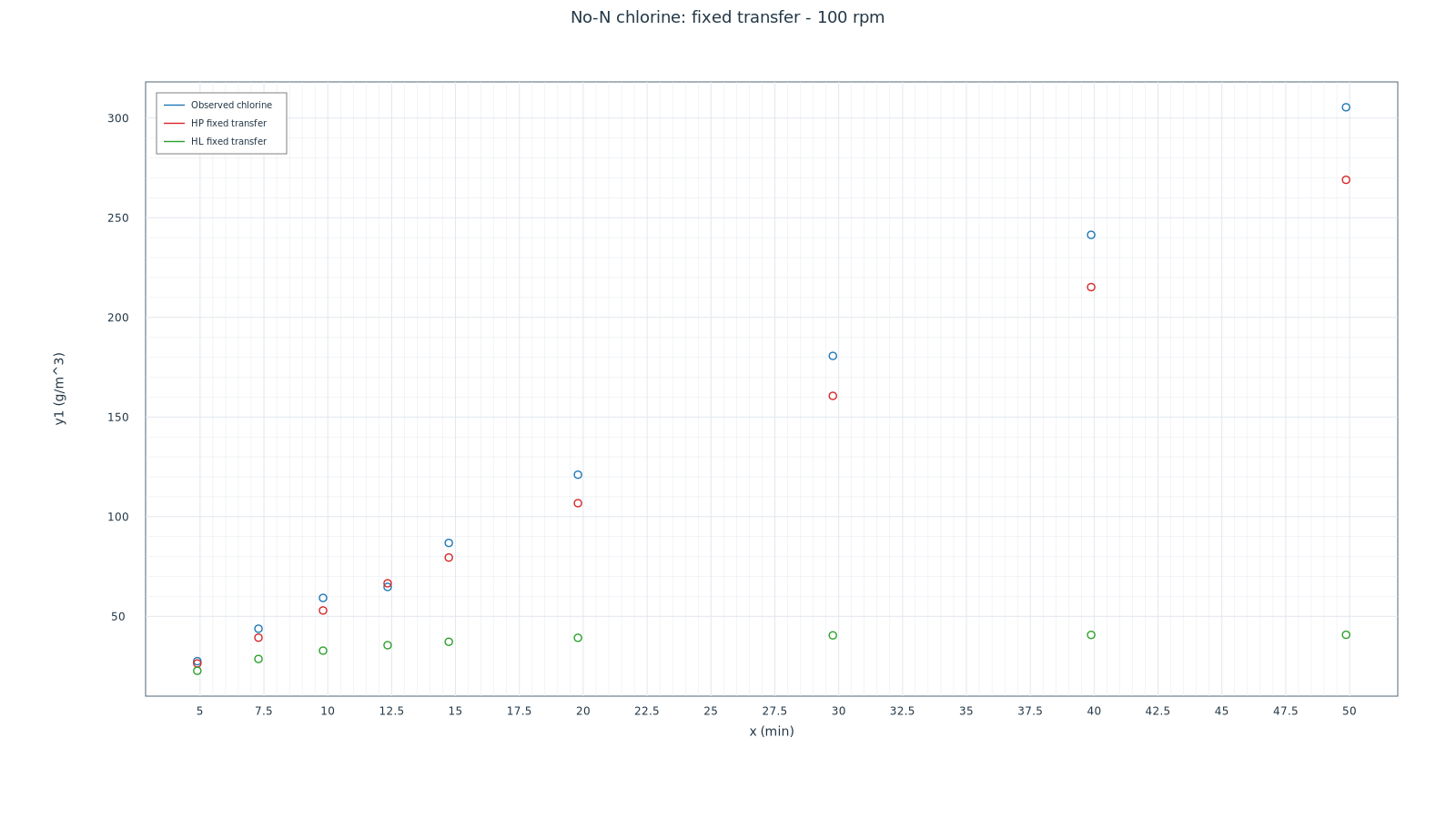
This procedure retains the source relationship and makes assumptions explicit. P013 remains NOT_RUN.
Working materials
Figure 3 digitized datasets (CSV) · Model and constraint datasets (CSV)
Other steps of this project
- ELEC 02 — Model hierarchy: effective kinetics, transfer and identifiability
- ELEC 03 — From fits to constraints: what does the chlorine balance reveal?
- ELEC 01 — What does the experiment measure? Nitrogen, chlorine and pH
- ELEC 07 — Sources, conclusions and tests that could distinguish the mechanisms
- ELEC 04 — Kinetics, speciation and transport: from local reaction to reactor response
- ELEC 06 — Where the numbers came from: GX-TXT, GNU Octave and reproducibility