

ELEC 03 — From fits to constraints: what does the chlorine balance reveal?
Two hypotheses can fit the same nitrogen signal and still predict very different chlorine levels. We test them against nitrogen-free controls, the Faradaic ceiling and the paired chlorine deficit.
A calibration error is not the sole measure of a model. A reaction or loss coefficient can compensate for an incorrect source. Nitrogen-free controls and charge inventories impose stronger tests with parameters held at their previously obtained values. These are comparisons of explicit closures, not statistical exclusions when uncertainty and recovery bounds are unavailable.
Transfer H_P and H_L without refitting
The native chlorine-control expression is C(t)=f p_max t exprel(−κt), where exprel(z)=(exp(z)−1)/z and exprel(0)=1. Thus κ=0 is the straight line f p_max t without a singular division. The native p_max=13.228000276898461 g Cl₂/m³/min is M_Cl₂I/(2FV), allocating all imposed current to the two-electron source. C is g/m³, numerically mg/L; t is min and κ is min⁻¹. This is the nitrogen-free pool equation, not another fitted model.
Six native all-fixed evaluations use the 25 genuinely acquired times, with H_P f or H_L κ and their original reference parameters. They do not reuse the earlier seven theoretical query times. The 100-rpm storage order is not chronological: its earliest point is stored last. Original-row mapping is preserved for observations and residuals; sorting a displayed curve is separate presentation.
| rpm | N RMSE H_P / H_L, mg N/L | Fixed chlorine RMSE H_P / H_L, mg Cl₂/L |
|---|---|---|
| 100 | 0.19949 / 0.25632 | 17.43327 / 125.14164 |
| 500 | 0.49165 / 0.31056 | 3.75218 / 88.89957 |
| 1300 | 0.50564 / 0.29951 | 38.48315 / 79.88110 |
The columns must not be added into a score: observables, chemical bases, sample counts and uncertainties differ. H_L fits nitrogen reasonably at 500/1300 rpm but predicts a nearly flat chlorine control far below observed accumulation. Near 50 min at 1300 rpm the control is 146.9154 mg Cl₂/L, against H_P 82.2633 and H_L 3.95215. At 500 rpm H_P follows the control much more closely, but late residuals, defined as observed minus predicted, remain negative. Agreement within experimental error has not been established. Complete six-case interpretation.
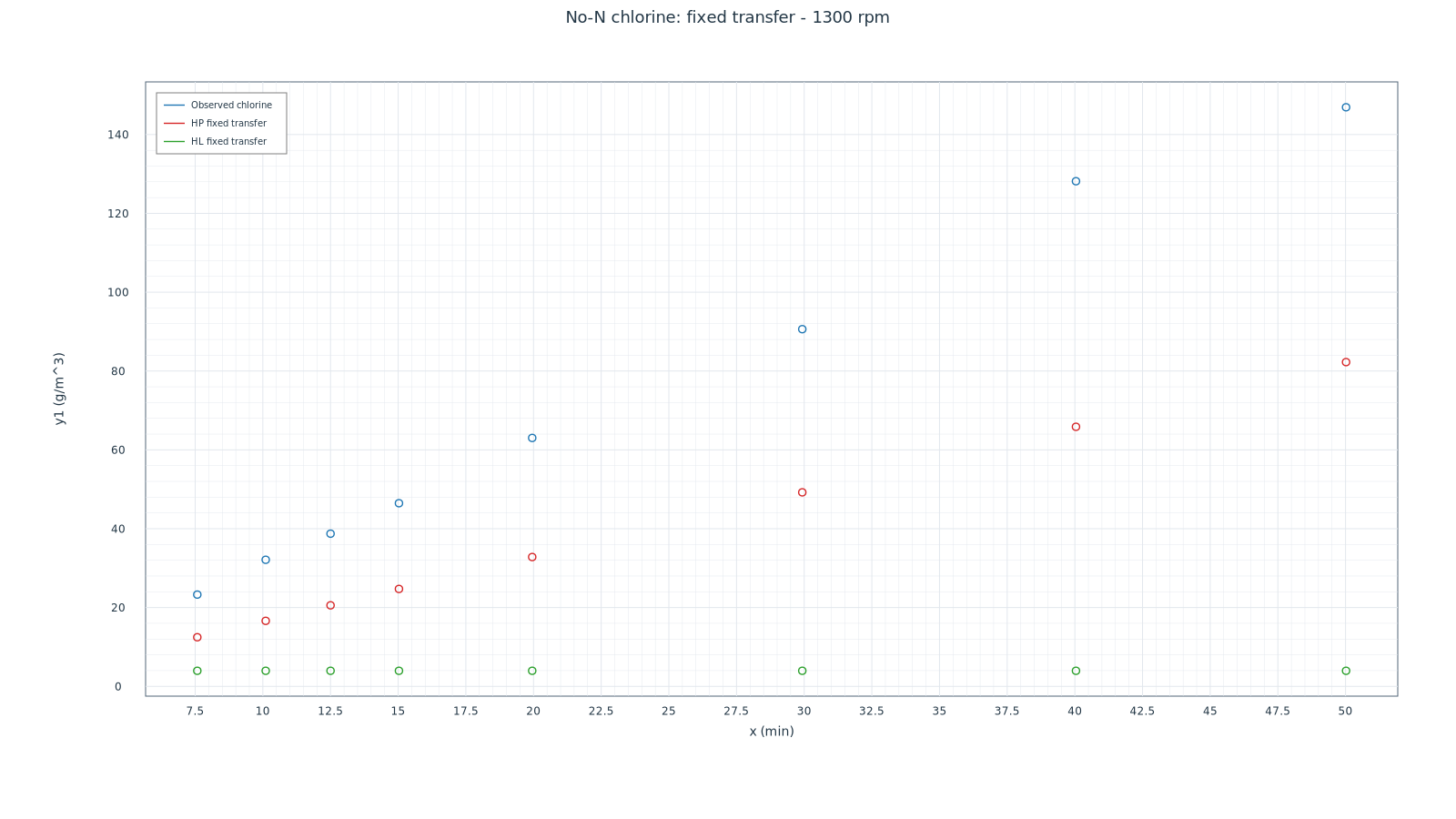
Native p0036: observations and fixed H_P/H_L predictions. This tests transferred restrictions; it is neither a new chlorine fit nor a plot of the later generic reaction-network runs.
Software query domain differs from calibration time range. The N fits covered 2.3743–19.8438 min at 100 rpm, 2.4346–29.9693 at 500, and 2.4880–50.0374 at 1300; chlorine queries extend to nearly 50 min. The last three chronological queries at 100 and 500 rpm exceed their N windows. At 1300 the discrepancy is inside the earlier window; at 100 it also appears before that window ends. A no-extrapolation software flag relative to the new query source does not erase temporal transfer beyond the earlier calibration.
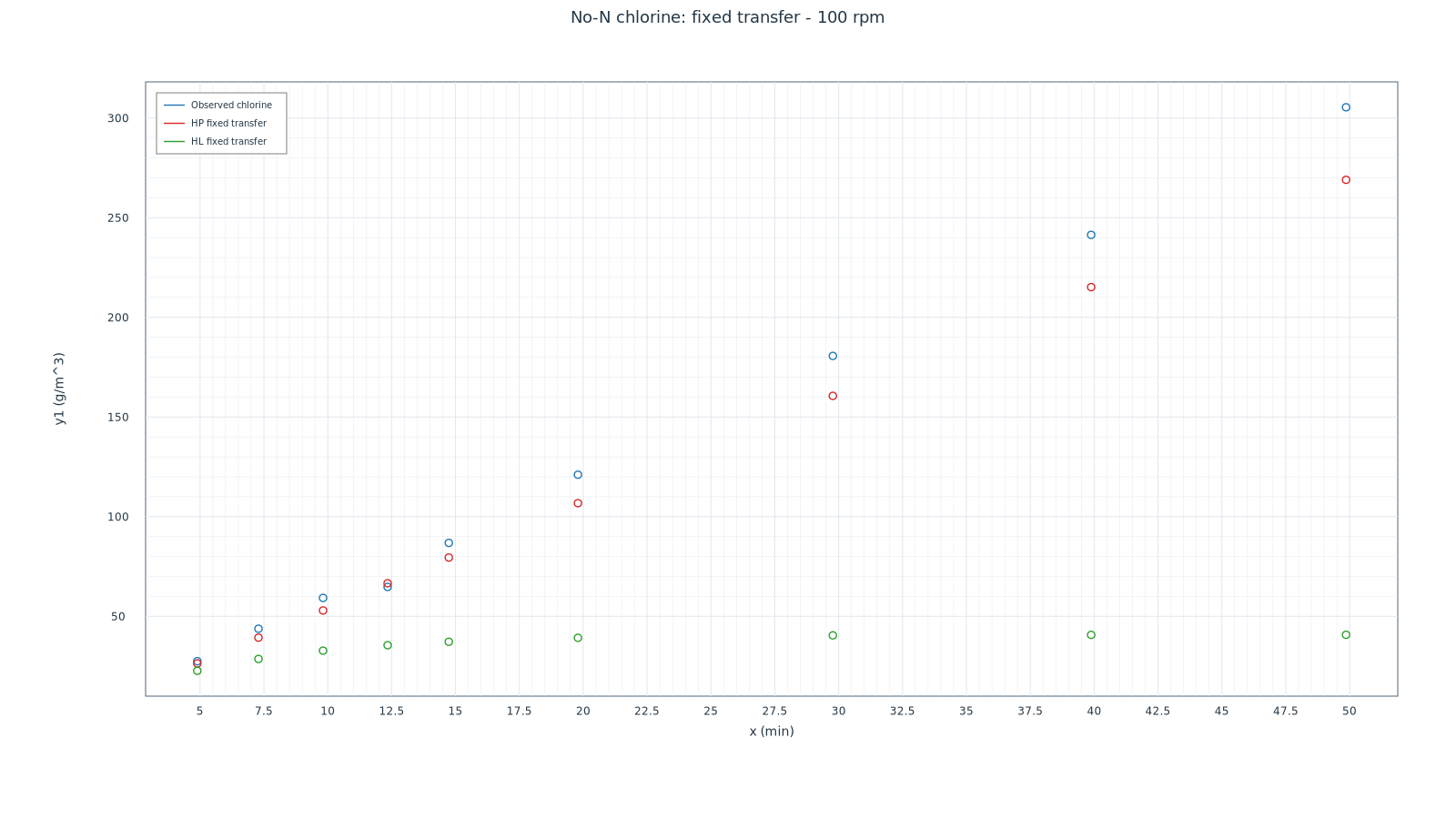
Native p0034 uses the same transferred formulations and actual acquired times, without chlorine refitting. Differences in shape remain distinct from error on the calibration N curve.
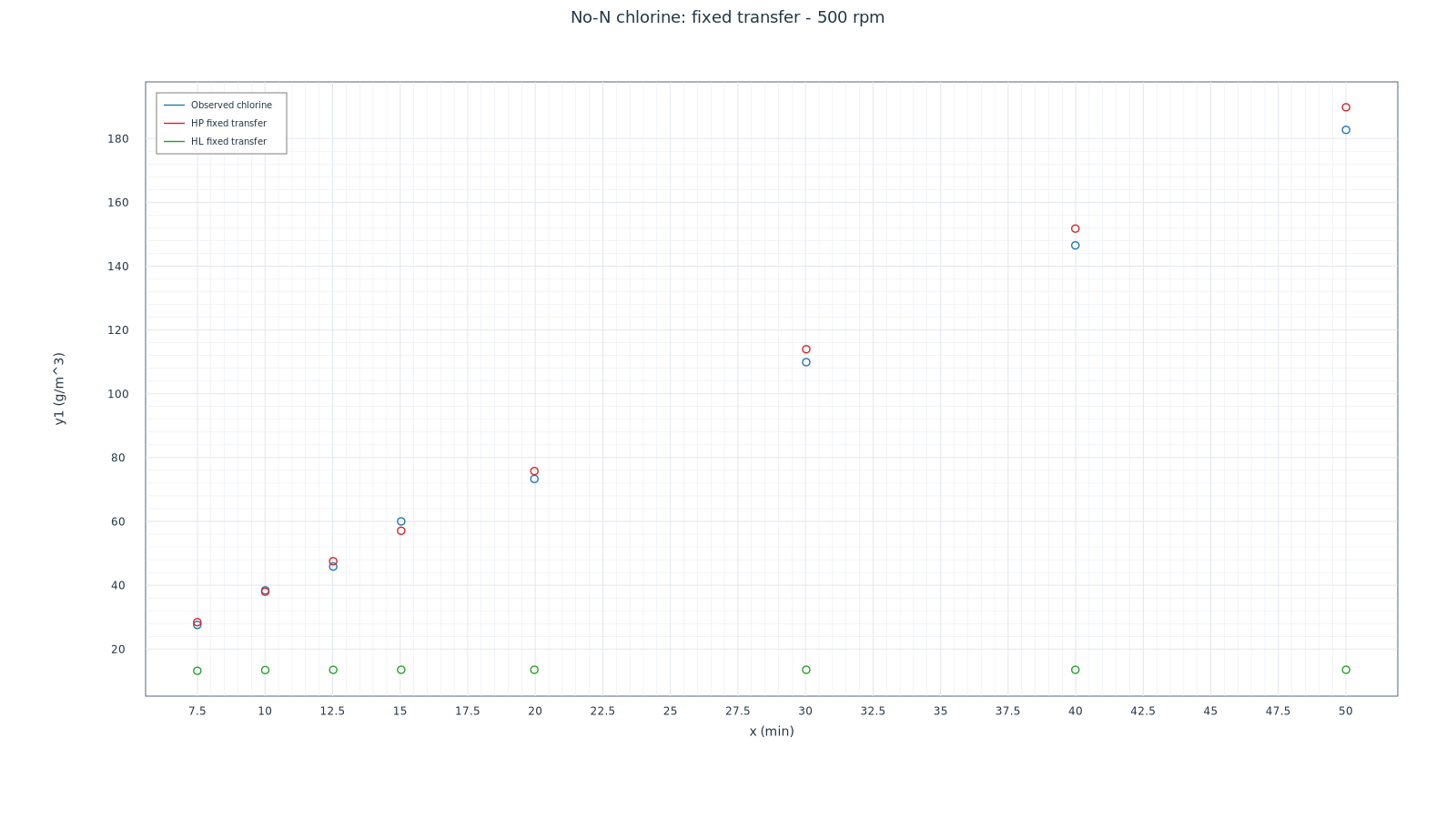
Native p0035 shows H_P’s better nominal agreement than H_L at 500 rpm, without declaring statistical compatibility or selecting a mechanism.
A source restriction for H_P
If C′=p(t)−L(t), p(t)≤P_HP and L(t)≥0, then E=C−P_HP t is non-increasing. No zero initial stock or first-order loss is required. Native residuals relative to the H_P straight line are the observed counterparts of E. They nominally increase from +1.1136 to +36.3947 mg Cl₂/L at 100 rpm, and +10.8203 to +64.6521 at 1300. Keeping the H_P source, adding only loss or changing only initial stock cannot repair that increase. Changing source between nitrogen-present and nitrogen-free trials, releasing another reservoir or revising the observation operator changes the tested assumptions and is not excluded by this argument.
A current restriction for H_L
For C′=p(t)−κC with 0≤p(t)≤p_max and constant positive κ, the integrating factor gives
With R=κC/p_max and q=e^(−κΔt),
An additional nonnegative sink lowers the ceiling. If initial stock is no greater than p_max/κ, R cannot exceed one. The observed-interval statement is more general: an unknown origin stock is allowed if a justified upper bound exists for the preceding observation.
| rpm | Transferred κ, min⁻¹ | Nominal R>1 | Native R range | R at last point |
|---|---|---|---|---|
| 100 | 0.16632963477398346 | 5/9 | 0.345839–3.840212 | 3.840212 |
| 500 | 0.5019009958243026 | 8/8 | 1.046307–6.931663 | 6.931663 |
| 1300 | 1.7151251513491201 | 8/8 | 3.018863–19.048858 | 19.048858 |
These 21 points are not 21 independent tests. The first 500-rpm value, about 1.0463, is particularly close to the threshold and is not resolved against uncertainty. Observed pairs also show increasing R from 0.3458 to 3.8402 at 100 rpm, 2.7818 to 6.9317 at 500, and 3.0189 to 19.0489 at 1300. The transferred branch does not permit these nominal increases. Two lower bounds alone would not establish an interval violation: an upper bound on the earlier stock and lower bound on the later stock are needed. Native bound · Interval argument.
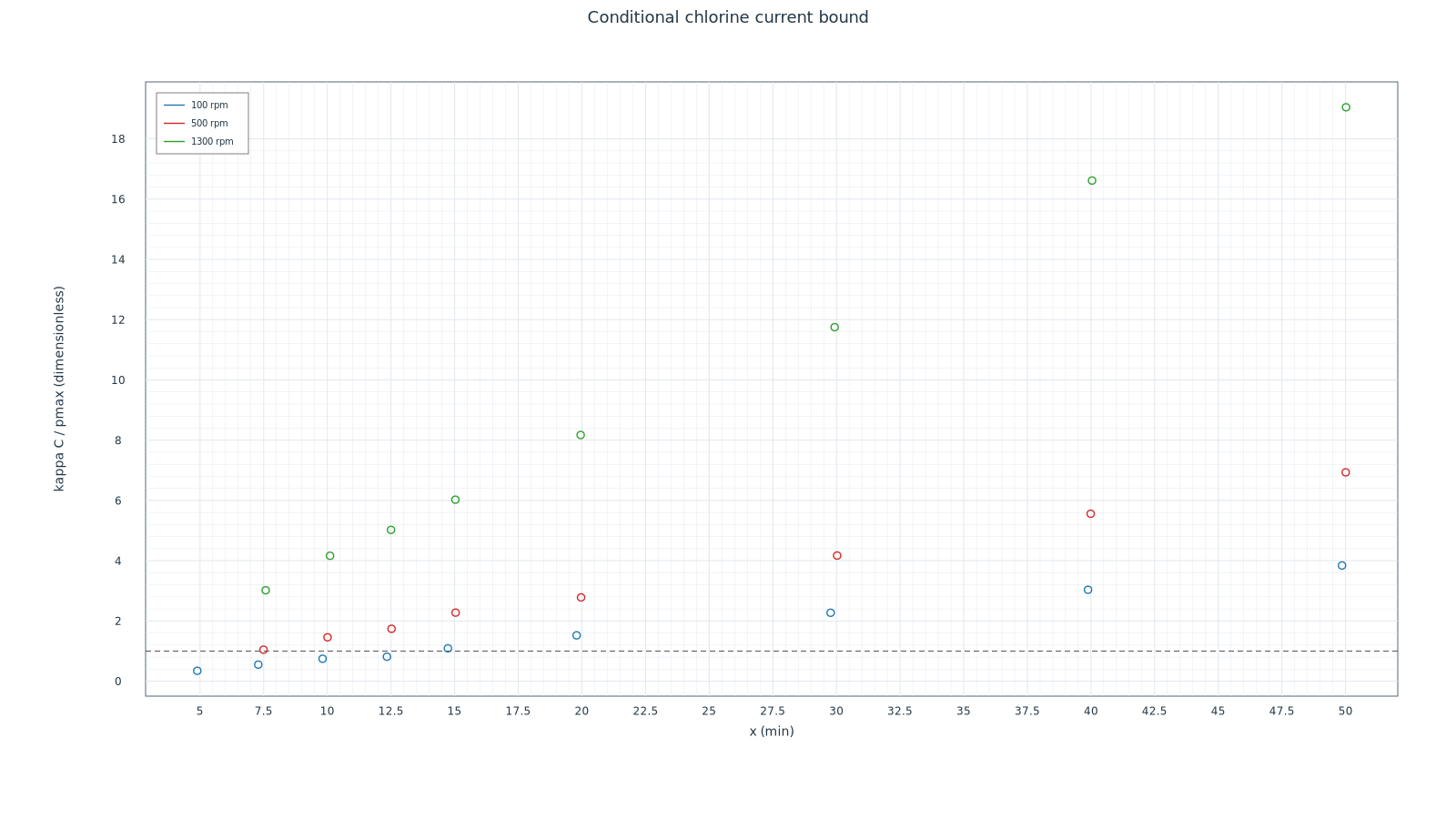
Graph p0033 shows κC/p_max for the 25 acquired centres. One is a limit under the stated hypotheses, not a confidence band. Chlorine observations and κ came from separate native productions; Worksheet calculated and published the ratios.
If all κC is cathodic reduction of this same pool, R is the required cathodic current fraction: values above one are impossible under imposed current alone. That reading does not require the production history, but does require the entirely cathodic assignment. It does not bound an arbitrary gas or chemical loss. Cathodic reduction is not declared absent; the particular transferred law and pool allocation fail this conditional check.
Deficit between nitrogen-present and nitrogen-free trials
With common source, loss and initial stocks, let D be control B minus nitrogen-present B. Then D′+κD=νr, D(0)=0. For nonnegative r and losses,
The mass ceiling is νM_Cl₂C_N,initial/M_N. Native Worksheet obtained about 75.9344 g Cl₂/m³ for 10 mg N/L and ν=1.5. This text performs no new conversion.
Three partial free-chlorine comparisons at 100 rpm give native deficits 126.46, 156.29 and 159.54 g Cl₂/m³ near nitrogen-present times 29.841, 39.901 and 49.919 min. The late total comparison uses 305.41 g/m³ in the control at 49.861 min and 159.65 with nitrogen at 49.919 min: total deficit 145.75 g/m³, about 69.82 g/m³ above the nominal ceiling. These are native results, not differences recalculated for this article. Total is one approximately located marker in an overlapping region, sharing the late control with free chlorine; it is not an independent replicate. No SD or directed timing/analytical error bounds are available. Interpretation.
An earlier control value can be conservative for a later time if that control is non-decreasing, as guaranteed by the constant nonnegative source/κ, zero-stock branch. The time ordering must survive uncertainty for an experimental exclusion. The control channel must also lower-bound the modeled pool and the nitrogen-present channel upper-bound it. The name total alone does not establish those relationships.
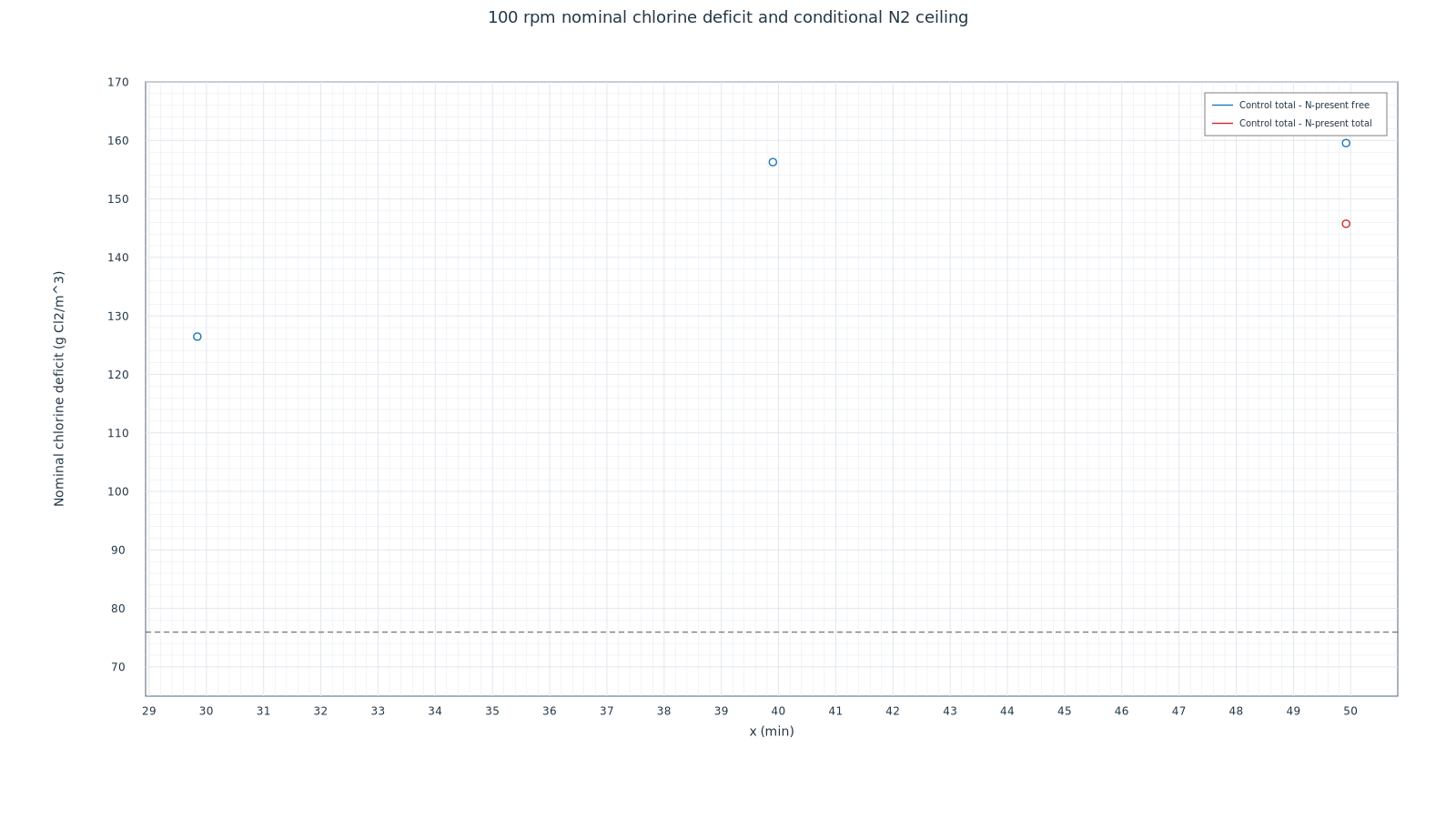
Native p0037 contains three free and one total comparison and the conditional 75.9344 g Cl₂/m³ reference. Late free and total share a control; the total marker is approximate. The plot does not contain measured chloramine storage Q or unacquired uncertainties.
Chloramine storage changes which deficit is bounded
If F is free chlorine and Q oxidant invested in chloramines, Q≤3A for mono-, di- and trichloramine with one N atom and at most three equivalents per molecule. Free deficit can satisfy D≤Q+νR_N: formation and storage consume free chlorine without removing assay N. With the N₂ endpoint and A+R_N+S=A₀, D≤1.5A₀+1.5A−1.5S≤3A₀. The earlier 1.5A₀ ceiling does not automatically apply to free chlorine when Q is omitted.
For a total operator covering F+Q, G=F₀−F−Q instead obeys G′+κG=νR_N′−κQ, hence G≤νR_N≤1.5A₀. Crediting Q again would double-count storage. This is why even one total comparison adds an important, although nominal and conditional, constraint. NH₃ stripping consumes nitrogen without direct chlorine demand and cannot raise the chemical ceiling. Different source/loss, a different endpoint demand or incomplete recovery changes the branch. The excess does not identify which change occurred, universally exclude N₂ or prove assay failure. Storage review.
Required source–removal discrepancy
Write F₀′=P₀−κF₀ and F′=P_N−Q′−νR_N′−κF−L. L is an additional sink, or a signed net difference from the reference. Here F₀,F,Q,G,X are mol Cl₂-equivalent/m³; A₀,R_N are mol N/m³. Initial chlorine stocks F₀(0)=F(0)=Q(0)=0 do not mean zero initial nitrogen. Subtraction gives
With w(u,t)=exp[−κ(t−u)] and X=∫w[P₀−P_N+L]du, G≤X+νA₀. Therefore X≥G−νA₀. On the mass basis,
The already native margin 69.8197991876387 g Cl₂-equivalent/m³ is a nominal requirement for X_mass=M_Cl₂X, not for molar X without conversion. It is necessary, not demonstrated attainable. Rearranging chemical-consumption timing does not increase the inventory ceiling νA₀.
X is neither gas mass nor lost current fraction nor a stripping coefficient. It combines reduced source and enhanced removal with a survival weight. An unweighted cumulative-loss statement additionally needs a sign condition, such as P₀−P_N+L≥0 throughout. NH₃ export is not directly L because it does not remove chlorine. A single approximate marker without error bounds supplies no experimental confidence lower bound. The combined Cl/N diagnostic was not executed at the freeze. Budget review.
Datasets
Current-ceiling scalar/context · Six fixed-parameter transfers · Current-bound ratios · Free/total deficits · Original nitrogen-free controls
Digitized Figure 3 observations (12 CSV files in a ZIP archive) · Native model and constraint results (27 CSV files in a ZIP archive)
Other steps of this project
- ELEC 02 — Model hierarchy: effective kinetics, transfer and identifiability
- ELEC 01 — What does the experiment measure? Nitrogen, chlorine and pH
- ELEC 07 — Sources, conclusions and tests that could distinguish the mechanisms
- ELEC 04 — Kinetics, speciation and transport: from local reaction to reactor response
- ELEC 06 — Where the numbers came from: GX-TXT, GNU Octave and reproducibility
- ELEC 05 — Gas loss, chloramines and the proton balance