

Advanced Octave A67 — Project protocol and requirements
Advanced GNU Octave with GX-TXT · Module 12
Before generating data and adapting models, we define demand, assumptions and requirements. In this module we will build a synthetic study of two dynamic responses, from the publication of data to the communication of results.
Question and Protocol
We compare two conditions, A and B, in which an dimensionless response grows according to 1-exp(-k*t). In the generator model we choose k = 0,5 s⁻¹ for A and k = 0,8 s⁻¹ for B. We expect 11 times from 0 to 5 s, at 0.5 s intervals, and independent Gaussian noise with standard deviation assumed by 0.02. The seed will be 2026.
The quantities and noise are chosen to teach the method: they are not measures and do not describe a real experiment. In subsequent lessons we will generate data, we will control series, estimate parameters and communicate uncertainties and limits.
Check dependencies
The test uses GX-TXT dev112-P011-bis and GNU Octave 9.4.0. Import protocollo.m, register it and run it in the Runner.
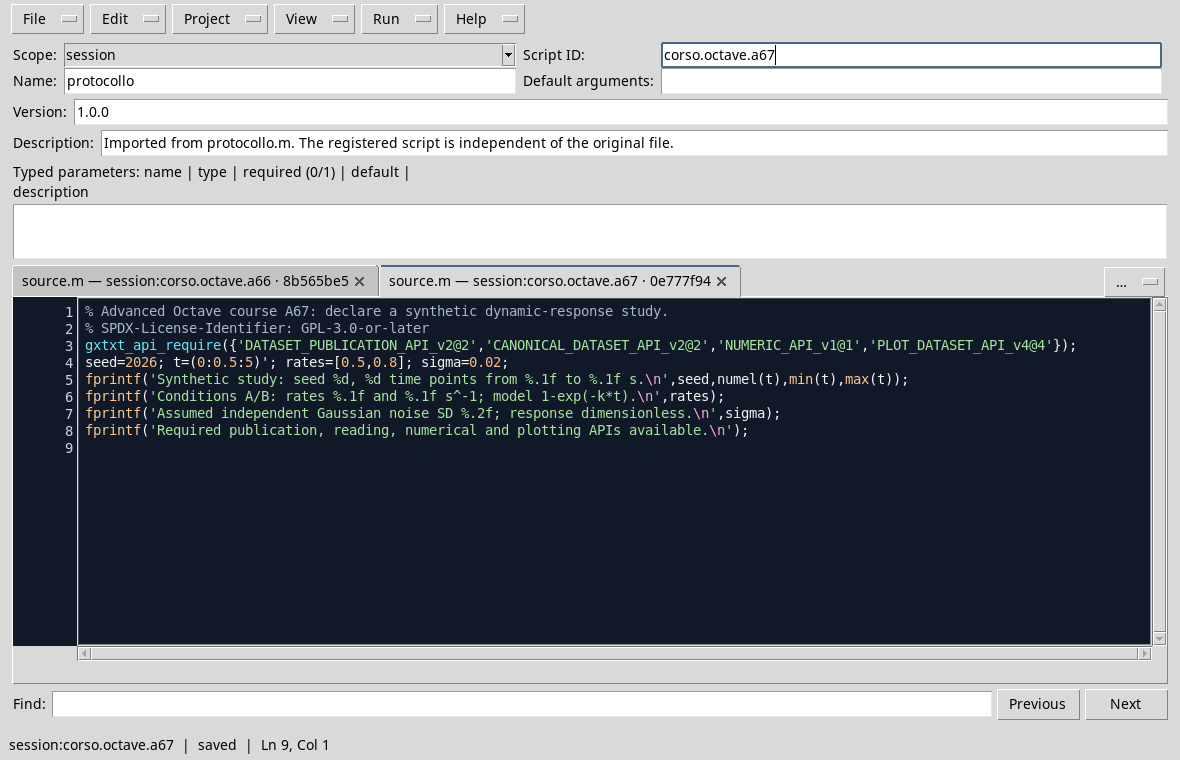
gxtxt_api_require requires public APIs to publish and read datasets, numerical and graphical calculations. If an addiction is not available, the execution should not pretend that the project is ready. In the test the requests were accepted and the program prints the parameters of the protocol:
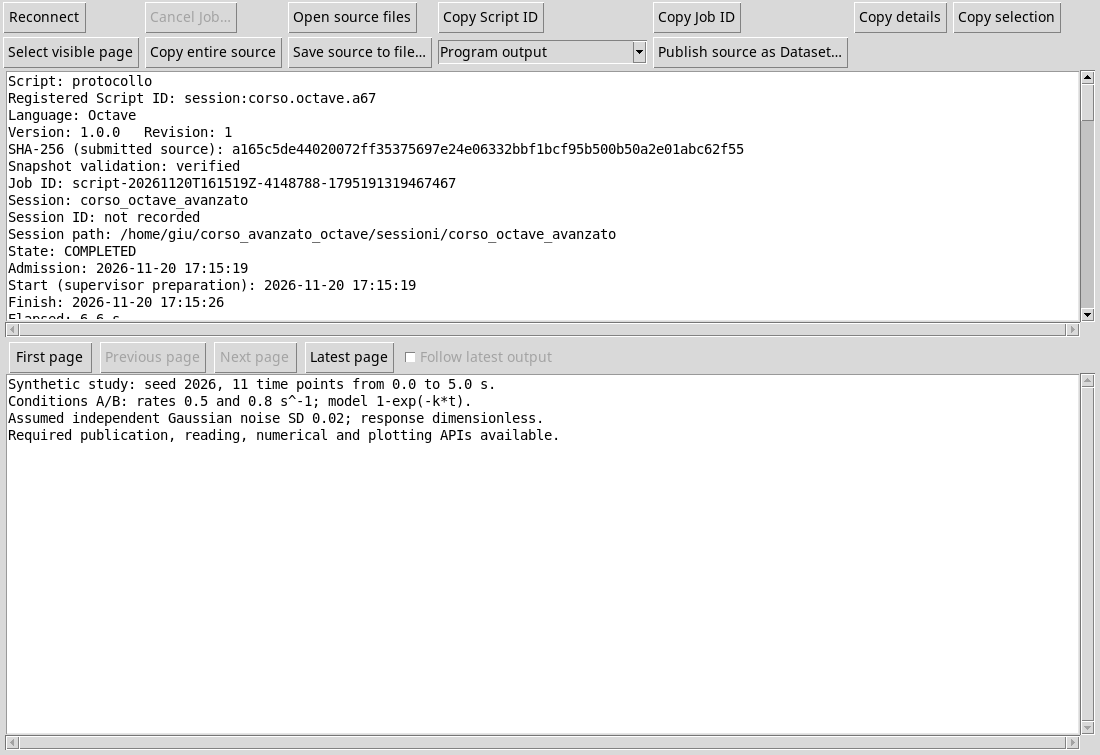
API availability does not show that the data has already been generated or that the model is suitable for a real phenomenon. Those are distinct stages of work.
Exercise
- What speeds characterize the conditions A and B in the generator?
- What is 0.02 in the protocol?
- Is API verification a scientific validation of the model?
Worked solution
- 0.5 and 0.8 s⁻¹.
- The standard deviation of synthetic noise, in the same dimensionless unit of the response.
- No: check availability of the required dependencies.
Other steps of this project
- Advanced Octave A75 — Dynamical systems in phase space
- Advanced Octave A81 — Geography of the waves and a 3D surface
- Advanced Octave A82 — Age, sex and demographic inequalities
- Advanced Octave A83 — All-cause mortality, certified COVID deaths and surveillance
- Advanced Octave A84 — A reproducible public account
- Advanced Octave A73 — Optimization landscapes and 3D trajectories