

Advanced Octave A80 — 2020 compared with previous years
Advanced GNU Octave with GX-TXT · Module 14
To understand the impact of pandemic on general mortality, we compare the monthly deaths of 2020 and 2021 with the same month of previous years. Each difference is about lives and families: the precision of comparison counts as much as the number shown.
Source and method
We use the Table ISTAT of monthly regional deaths, for all causes and resident population, prepared in A79. For each month we calculate the average of the five values 2015–2019; then we subtract this average to the values of 2020 and 2021. ISTAT describes its different sources in the page on mortality.
Run A79 first in the same session. The test uses GX-TXT dev112-P011-bis and GNU Octave 9.4.0. Import confronto.m, record it and execute it. Dataset istat_baseline_2015_2019, istat_deaths_2020 and istat_deaths_2021 are created-only: use a new session or change IDs to repeat.
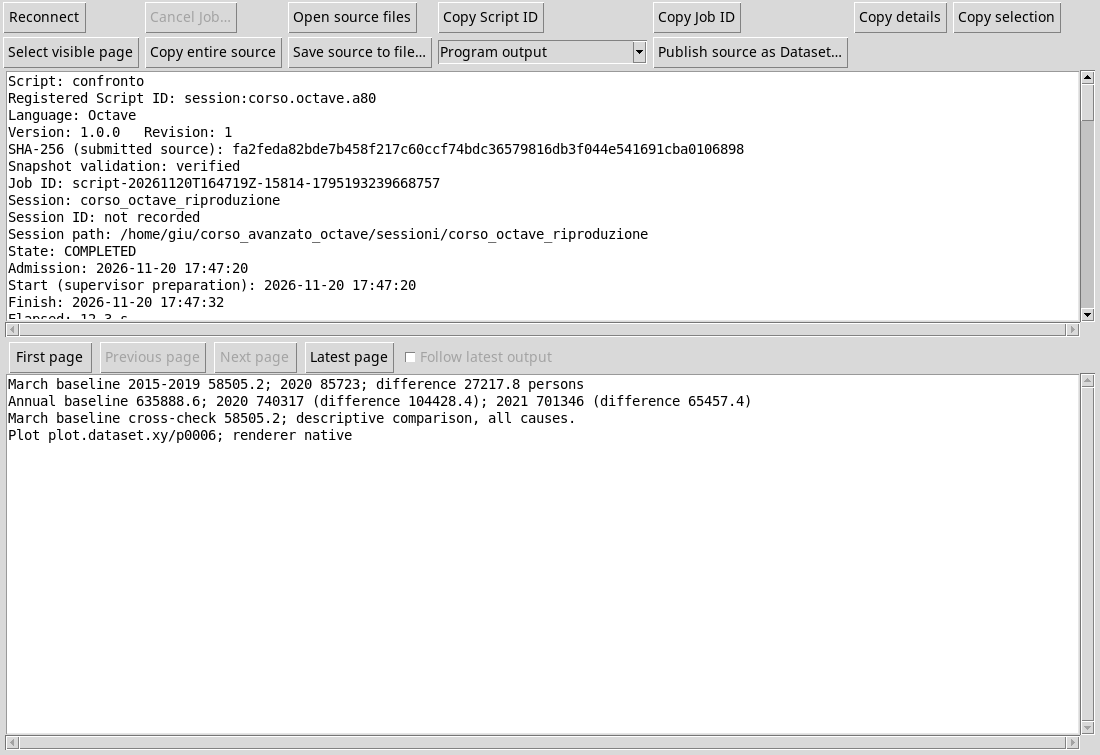
March and annual totals
For March, the 2015–2019 average is 58,505.2 deaths, compared to 85.723 in March 2020: the descriptive difference is 27.217.8. The decimal comes from the average of five whole counts: it does not represent a fraction of person.
The average annual totals 2015–2019 is 635,888,6; 2020 counts 740,317 deaths, i.e. 104,428.4 more than the average. The 2021 counts 701,346 deaths, with a difference of 65,457,4 compared to the same base. NUMERIC_API_v1/statistics separately verifies the average of the five months of March.
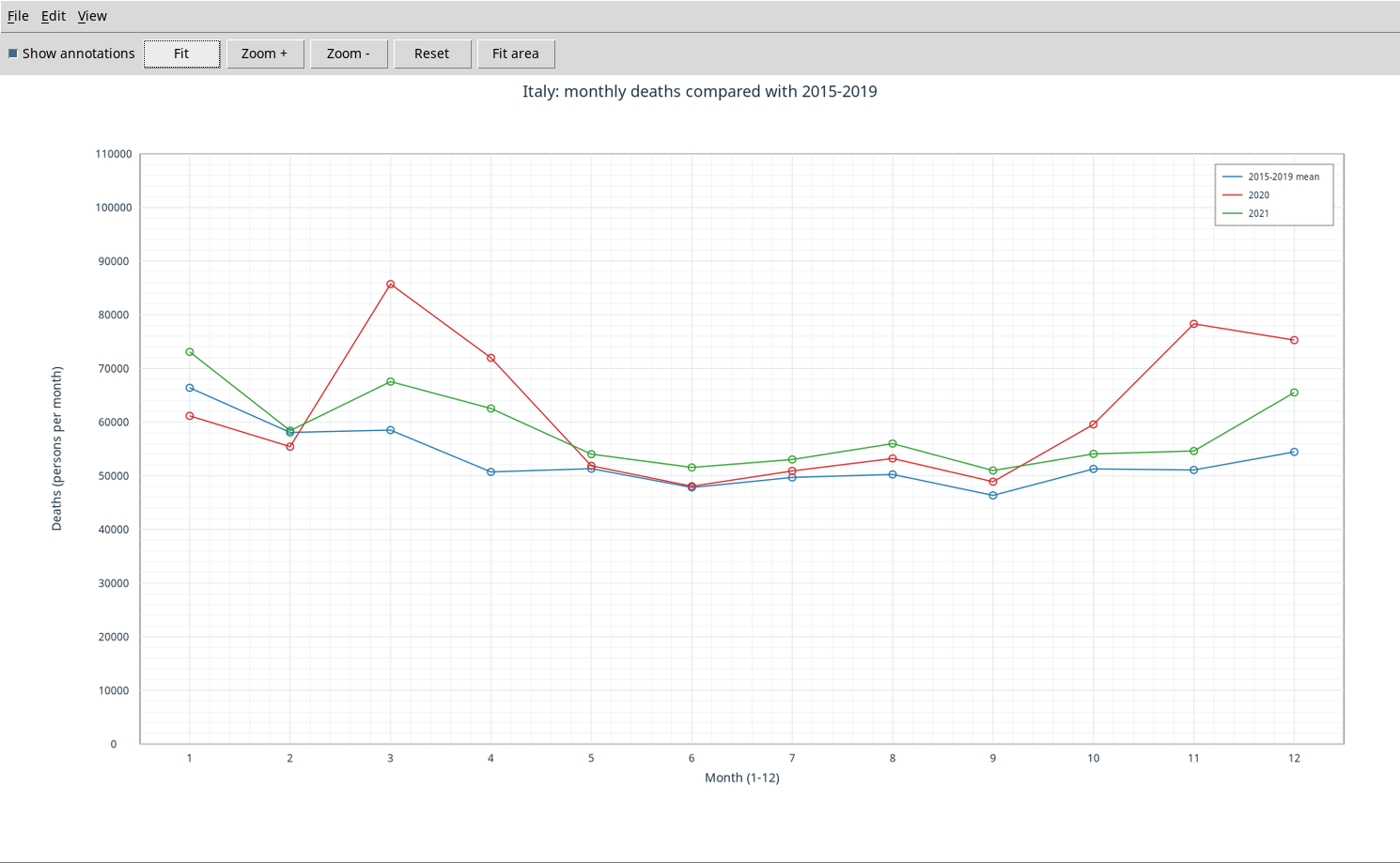
The chart shows the months from 1 to 12: March and the last part of the year in 2020. The comparison describes a variation of mortality for all causes compared to a historical base; it does not identify the COVID deaths causally. Demography, duration of months, other causes and changes over time can affect comparison. A broader analysis can use different bases and adjustments, expressing them.
Exercise
- How do you calculate the average of March 2015–2019?
- Why can an average have decimals even if deaths are whole counts?
- The annual difference is the number of deaths caused by COVID?
Worked solution
- The five values of March are summed up and divided by five.
- The average is a statistical value, not counting people in a single year.
- No: it is a descriptive difference between mortality for all causes and a historical average.
Other steps of this project
- Advanced Octave A75 — Dynamical systems in phase space
- Advanced Octave A81 — Geography of the waves and a 3D surface
- Advanced Octave A82 — Age, sex and demographic inequalities
- Advanced Octave A83 — All-cause mortality, certified COVID deaths and surveillance
- Advanced Octave A84 — A reproducible public account
- Advanced Octave A73 — Optimization landscapes and 3D trajectories