

Type Hints, Dataclasses and Domain Objects
Scientific Python in GX-TXT · Module 9 · Lesson 50
A small Python object can collect the identity of a Dataset and the variables to use, making the code clearer. The authoritative source of the scheme remains GX-TXT: the Python object describes a request, does not replace the Dataset.
Objectives
- Use type annotations and
dataclass. - Define runtime controlled variables in
__post_init__. - Ask the description of a real Dataset.
- Distinguish a type suggestion from validation of values.
Execution
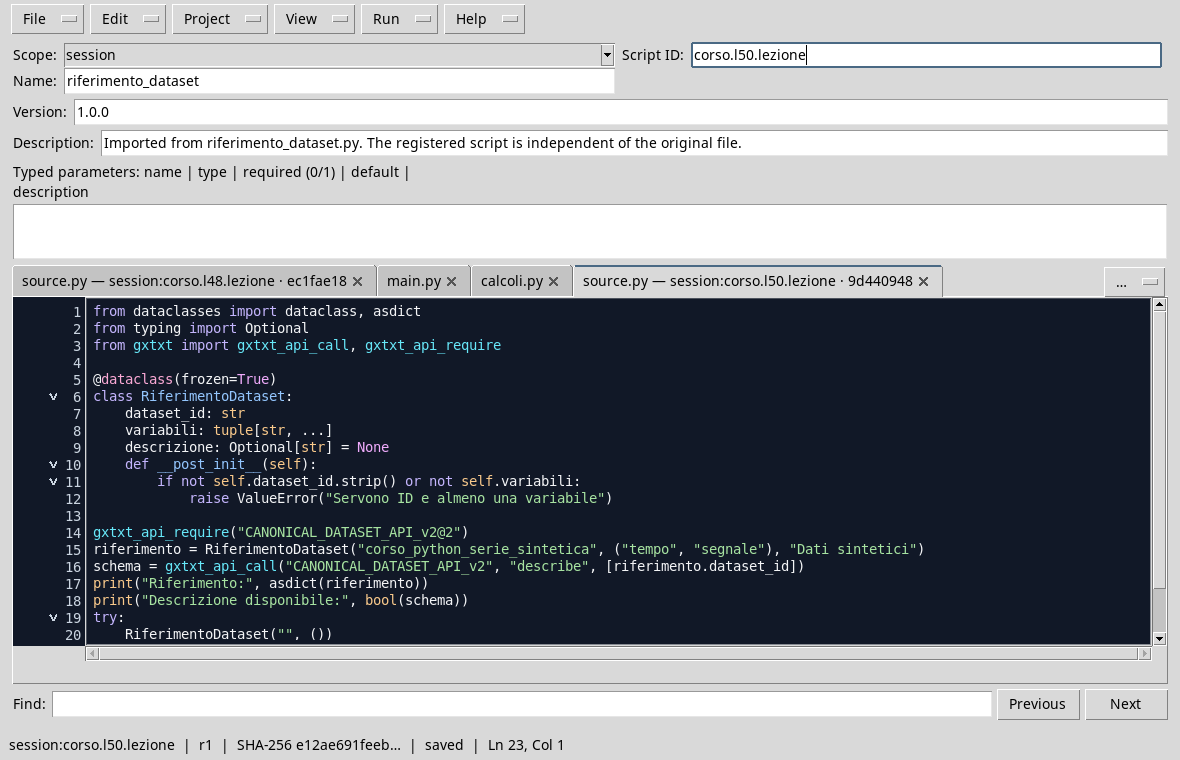
At the corso_python Session, import dataset_reference.py, save the script and run it in the Runner.
from dataclasses import dataclass, asdict
from typing import Optional
from gxtxt import gxtxt_api_call, gxtxt_api_require

@dataclass(frozen=True)
class DatasetReference:
    dataset_id: str
    variables: tuple[str, ...]
    description: Optional[str] = None
    def __post_init__(self):
        if not self.dataset_id.strip() or not self.variables:
            raise ValueError("Need ID and at least one variable")

gxtxt_api_require("CANONICAL_DATASET_API_v2@2")
reference = DatasetReference("corso_python_serie_sintetica", ("tempo", "segnale"), "Synthetic")
schema = gxtxt_api_call("CANONICAL_DATASET_API_v2", "describe", [reference.dataset_id])
print("Riferimento:", asdict(reference))
print("Description available:", bool(schema))
try:
    DatasetReference("", ())
except ValueError as caught_error:
    print("Input not valid refused:", caught_error)
@dataclass generates useful methods for a class that collects data; frozen=True prevents ordinary reassigning of fields after creation. dataset_id: str and variables: tuple[str, ...] describe the expected types. Optional[str] allows a text description or None. asdict produces a Python dictionary; for an exchange format it is necessary to choose and document an appropriate serialization.
The annotations do not automatically control the values during the execution. __post_init__ adds explicit control here: an empty ID or no variable raises ValueError. This does not verify that the IDs exist: to know the actual Dataset we use CANONICAL_DATASET_API_v2/describe and, in a complete program, we also compare the IDs of the variables required with the scheme.
Exercise
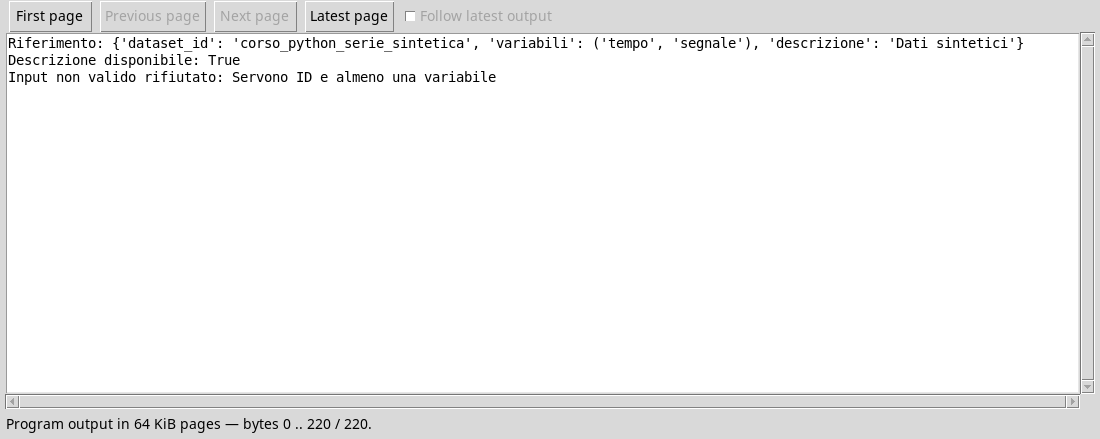
- What happens if you create a reference with empty ID?
- Does a
strannotation guarantee on its own that the ID exists in Session? - Why read the pattern from GX-TXT instead of assuming that the local object is the authoritative source?
Worked solution
- The control in
__post_init__raisesValueError. - No: describes an expected type, but does not question the catalog or automatically validate the value.
- The canon scheme and variables belong to the Dataset managed by GX-TXT; a local object can be incomplete or not updated.
In the next lesson, we will read block data through a stream.