

Find verifiable numerical data
Check the Generate Session catalog
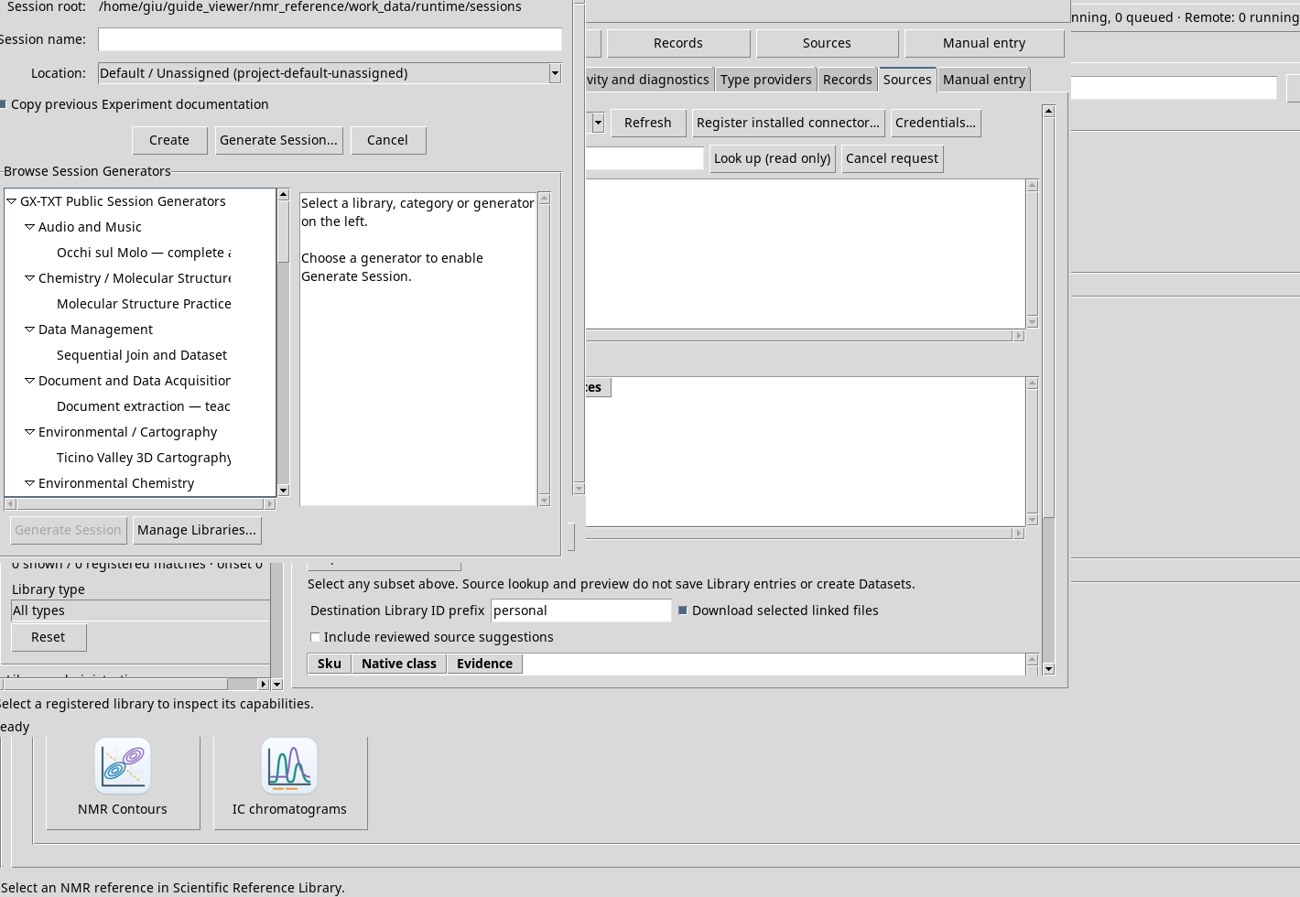
Open New Session and click Generate Session… to see the installed libraries and Generators. The tested catalog includes Molecular Structure Practice and Manchester MXene UV/Vis quantitative family, among others. The catalog tested here has no Generator that supplies a numerical NMR reference library. Install the exercise libraries from Scientific Libraries. You can open them without generating a session.
Distinguish a PubChem reference from a numerical trace
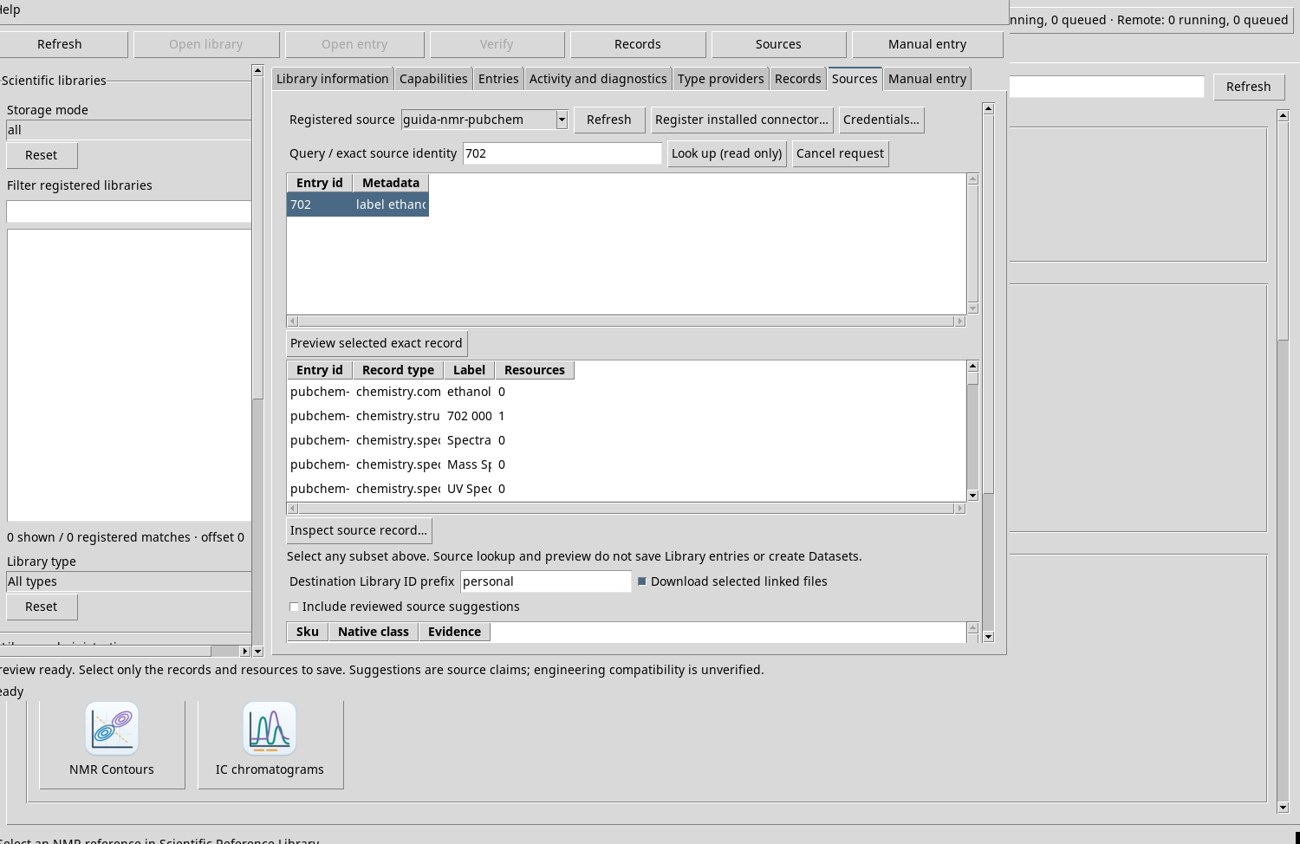
In Scientific Libraries → Sources, choose the PubChem connector. If it is missing, use Register installed connector… with source.pubchem. Look up CID 702 using Look up (read only), select the ethanol result, and click Preview selected exact record. The test returned the compound, a structure resource, and chemistry.spectrum_reference records without numerical spectrum files. Resources counts the record’s attachments. A structure SDF describes molecular geometry. Use experimental archives to obtain an intensity-versus-ppm trace.
Find the four Cambridge spectra
The Apollo deposit by Coady and colleagues contains measured NMR data that the depositors converted to JCAMP-DX. The exercise package contains four derived traces with CC BY 4.0 attribution. For each trace, Source and provenance records the JCAMP path and hash, archive identity, and processing parameters. The first trace was already in the frequency domain. The three FID examples use exponential weighting with 2 Hz line broadening, an FFT with a zero-filling factor of 1, and a phase of 0°. The plot shows the real part. Quantitative interpretation requires processing that is validated and documented for the experiment. Cambridge Apollo repository · CC BY 4.0.
To start from the originals, download Open Data.zip from the repository and extract prepare_references.py from its ZIP archive. Run it with Python and NumPy using the arguments --framework PERCORSO_GXTXT --cambridge "Open Data.zip" --output riferimenti. The script verifies hashes of the original bytes and generates the managed ZIP and CSV files for the resulting representation. The ready-to-use package selects the same four files.
Prepare the BMRB ethanol reference locally
On the bmse000297 page, find experiment 1: 1D 1H and download bmse000297_1.zip. The collection is publicly accessible. Build the derived BMRB package locally from the original files. Pass --framework PERCORSO_GXTXT --bmrb bmse000297_1.zip --output riferimenti to the preparation script after extracting the script from its ZIP archive. Install riferimenti/guida-bmrb-etanolo.zip from Scientific Libraries. BMRB ethanol entry · Data policy.
The script uses the real channel pdata/1/1r and the parameters in pdata/1/procs. The conversion for the sample at index i is OFFSET − i × SW_p / (SF × SI). It retains the original stored counts. The archive also contains raw data. The trace shown in the viewer comes from the already processed channel.