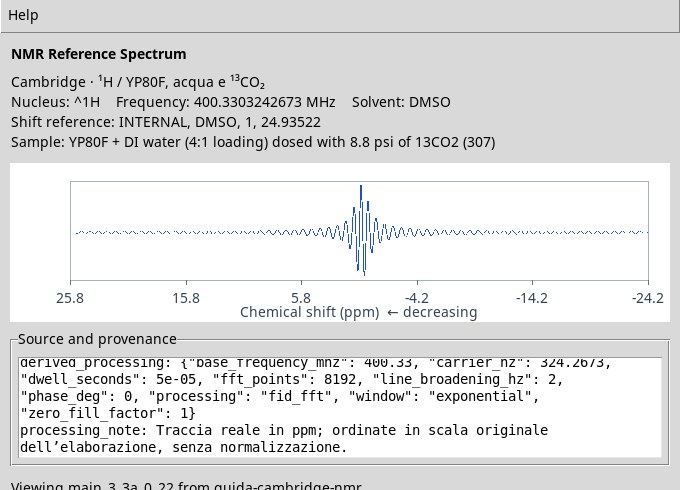
Read the plot, metadata, and provenance
Read the chemical shift
The Chemical shift (ppm) ← decreasing scale runs from higher values on the left to lower values on the right. Values in ppm express the relative frequency offset from the chemical reference. Frequency, in MHz, gives the observation frequency of the nucleus. Use it with the original calibration when interpreting the measurement. The plot’s horizontal axis uses ppm.
The plot shows the range of the trace and the relative shape of its signals. The height scales to the selected entry, and the vertical axis has no quantitative tick marks. Tall peaks in two successive views can represent very different numerical intensities. To compare amplitudes, use numerical data on a shared scale with the same representation and references. Resizing the window redraws the plot over the same range. Clicking, right-clicking, and scrolling over the plot left the scale unchanged in the test. You can compare traces by opening two library entries in succession.
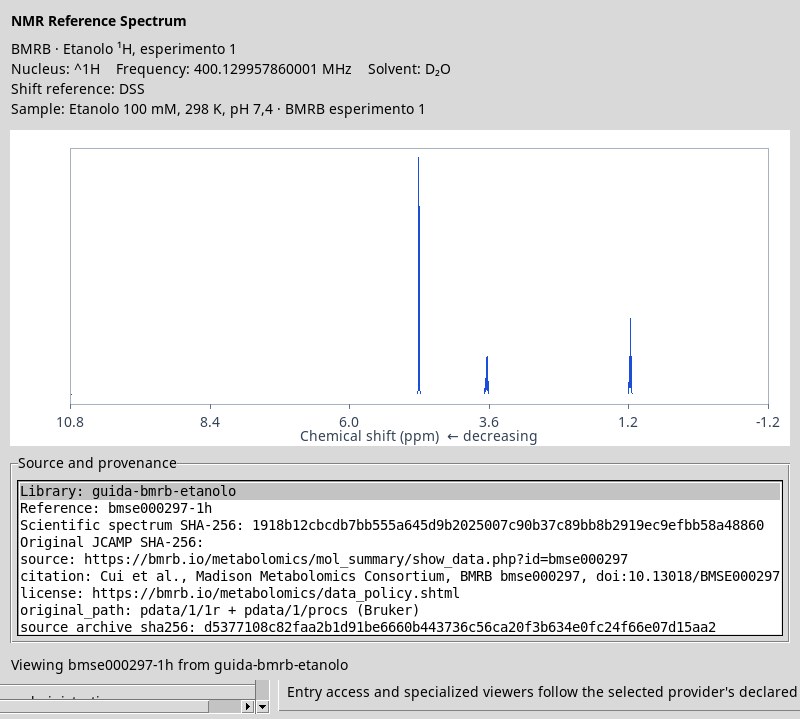
Check the nucleus, frequency, solvent, and reference
Check the selected entry’s label and Nucleus at the top. ^1H indicates the observed proton channel. ^13C indicates carbon-13. The nucleus and Frequency come from the measurement and can change between entries for the same sample.
Solvent shows the solvent reported by the source. Shift reference shows the chemical reference or the original reference text from the measurement. If it contains acquisition software parameters, check the original calibration notes before assigning a value to a compound. Sample identifies the sample, its preparation, and the reported conditions. In the two Cambridge water examples, the name includes the nominal 4:1 loading and 8.8 psi of ¹³CO₂. The BMRB ethanol measurement lists D₂O and DSS.
Identify the data and its original source
In Source and provenance, Library identifies the package and Reference the entry. Scientific spectrum SHA-256 identifies the numerical samples shown. Original JCAMP SHA-256 identifies the original JCAMP file when the repository uses that format. source_archive_sha256 is the hash of the complete archive. Each hash checks a different level. The JCAMP field is blank for the BMRB entry because it comes from a Bruker file. The hash of the original binary 1r is in processing_note.
Check source, citation, license, and original_path before reusing a trace. derived_processing records whether the data were already in the frequency domain or were obtained by processing a FID. processing_note describes the resulting numerical representation. If the text does not fit, scroll inside the provenance pane to see the last lines. Select the provenance text and copy it with Ctrl+C. The pane is read-only.