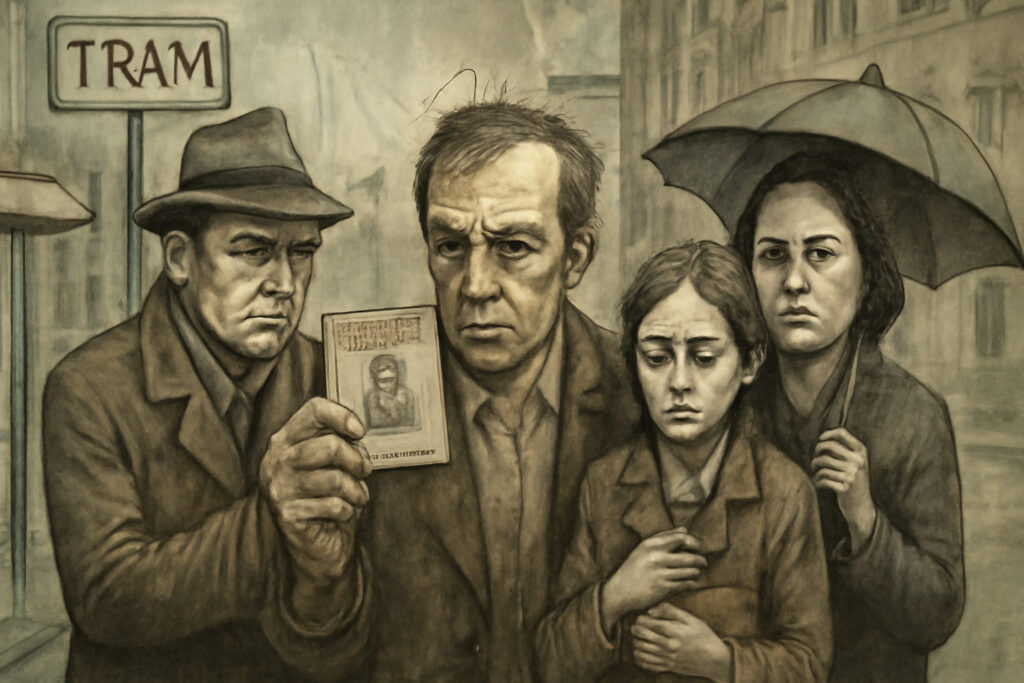

The Stolen Identity Card
A story for two tram stops.
I don’t remember the season, but it was certainly an afternoon in the middle of the COVID era. A problem required a solution: replacing the identity card that had been stolen from my former friend’s mother. In cases like this, when someone has no other documents proving their identity, they must appear with two people who can confirm it before the clerk handling the replacement; they asked me to go with them as the second guarantor, and I agreed.
Her entire handbag had been stolen while she was stopped at a traffic light, sitting in her car and waiting for it to turn green. A man approached the window and asked her for directions to somewhere in the city. While she was distracted explaining the route, she failed to notice an accomplice behind her opening the rear door and taking the bag from the seat. It contained money, house keys, her tax code card, and various other documents and belongings.
It was an afternoon and a light rain was falling when we went to the branch civil registry office at Via Sansovino 9, in Municipality 3. The place was packed; the queues stretched all the way down the outside stairs before we could even enter a hall lined with service counters and transparent plastic screens marked “open to the public”. It had all the familiar features of a minor public office: endless background chatter, rows of occupied chairs, a forlorn snack machine, the intermittent hum of tired fluorescent lights, and dusty grey walls.
Our turn came and we sat on three chairs in front of a clerk who, unlike those at the other counters, had no partition. He took my identity card and the daughter’s, the replacement application, the photographs and the theft report, and began entering all the information needed to issue the new document.
The clerk focused on one detail: the three passport photographs required for the application, no longer joined in a strip but cut apart from one another. He studied them carefully and compared them with the woman’s actual appearance. From where I was sitting I looked at one upside down and realized the pictures might have been as much as ten years old. Her features were clearly different from how she looked now; her hair was still brown and dyed at home, but her expression and the roundness of her face had changed completely. She was still unmistakably recognizable, even from her eyebrows alone: very sparse, and still darkened with mascara, clearly a habit she had had for many years.
Visibly doubtful, the clerk hesitated to proceed, pointing out that the photographs did not comply with the requirements. Perhaps the obvious disappointment on our faces at the thought of having to take new pictures and come back — my own near-disbelief at such an obvious oversight, accompanied by the faintest sigh — made him reconsider.
At that point the clerk paused over the woman’s age and said it aloud in a tone that was at once indulgent, disenchanted and resigned: “She’s 80 years old!” He seemed to imply — not knowing that she still drove — that by now the identity card would, at best, be needed for some hospital formality. Without saying anything more, he decided to issue the replacement using those photographs.
On the way home, I couldn’t help thinking about those passport photographs and the decision to use them. Perhaps they had simply ignored the possibility that someone might object, or perhaps it was the mother’s quiet wish, a way of holding on to an image of herself when she was younger, with fewer physical aches and more happy memories. She felt more beautiful in those pictures, and for her they may not have been merely a bureaucratic requirement but a small fragment of a preferred identity. Or perhaps the decision had been her daughter’s, to avoid expense or complications, dismissing the issue with a “Oh, they’re fine. You can tell it’s you — who’s ever going to look at them?”. And so that identity card, with its anachronistic photograph, became more than a document: a profound reflection of lives, steeped in nostalgia, bare pragmatism and the unexpected flexibility of administrative rules.