OpenFOAM 14 Case 04: Parametric Channel Mesh with the Gmsh Python API
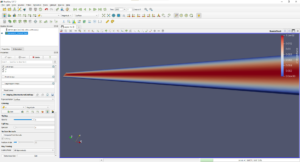
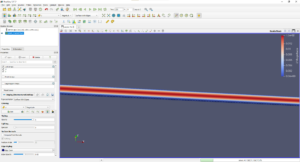
A Python script using the Gmsh API builds the channel from command-line parameters: same logic, different geometries and meshes, validated in OpenFOAM 14 against Poiseuille.
The laminar channel rebuilt with a structured Gmsh mesh imported through gmshToFoam: patches, changeDictionary and a comparison with blockMesh giving identical results.
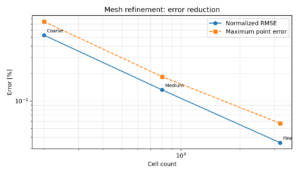
The same laminar channel on three meshes (2,000, 8,000, 32,000 cells): the error against Poiseuille scales with order about 2. How to set up and read a mesh convergence study in OpenFOAM.
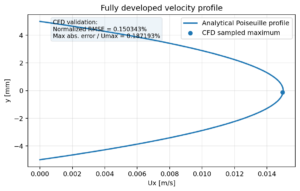
First case of the OpenFOAM 14 path: a laminar parallel-plate channel built from scratch with blockMesh, solved with foamRun and validated against the Poiseuille profile (0.15% error).
Starting from the characteristic curves published by General Electric, I digitized and analyzed the 2D21 thyratron grid current to build a reproducible compact mathematical model. In this article I describe the full process, from replicated digitizations and uncertainty estimation to family normalization, identification of common functions, and quantitative validation of the 2D21 Level-1 v0.1 model.
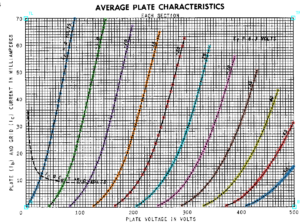
SPICE model of the 6BX7-GT derived from GE datasheet curves, with digitization, Koren fitting, independent validation and ngspice testing.
A study of the Koren triode model: equations, parameter meaning, limitations, 6BX7-GT fitting and independent LTspice validation.
From the 6BX7-GT datasheet to a SPICE model: Koren equations, global fitting, parameters, residuals, metrics, and model limits.
How a triode works, how to read plate curves, and how to choose the operating point, with numerical examples based on the 6BX7-GT.
From wired controls to visible light, ultrasonics and infrared: a short journey through the technological evolution of the television remote control.