

Bootstrap and permutations
Estimating with bootstrap or permutations
Choose analysis.statistics.resampling. For the first run set Group comparison method a bootstrap, First numeric sample a voltage, statistic mean, confidence 0.95, Replicates / permutations a 400 and seed 31. Use the prefix guide.resampling.baseline.
The provider’s initial output prefix is statistics.resampling. The exercise uses a dedicated name.
Configuration in the GUI
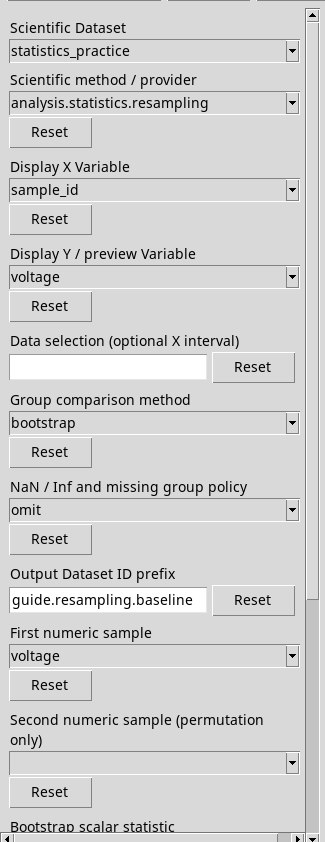
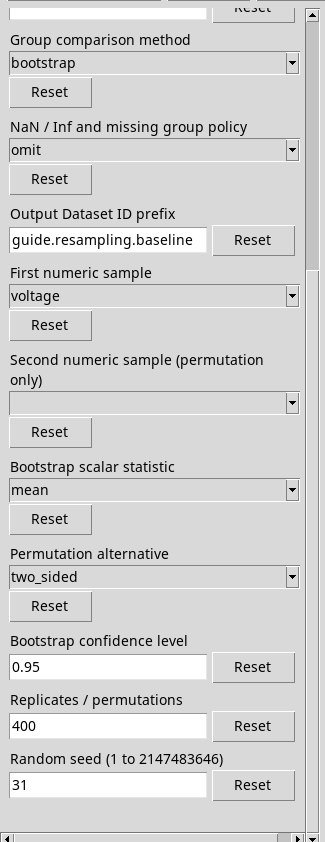
What is resampled
- bootstrap
- Initial choice. It draws with replacement from the first finite sample and requires at least two values. Bootstrap scalar statistic chooses
mean,medianosample_sdfor the mean, median or sample standard deviation. Bootstrap confidence level sets the central fraction of the empirical distribution, initially 0.95. The percentile interval is two-tailed. - permutation_independent
- Shuffles the labels of the two samples to build, under exchangeability, the distribution of the difference between the means. Select the second measurement column in Second numeric sample (permutation only). With
omitit removes non-finite values from each sample separately. - permutation_paired
- Flips the sign of the first − second differences within each pair. It uses rows valid in both columns and requires exchangeability of the signs under the null hypothesis. For an exercise on the paired relationship use
voltageeresponse. The second variable must be convertible into the unit of the first. - Permutation alternative
two_sided(initial) compares the absolute magnitude.greatercounts one tail towards larger differences andlessthe other. It always counts from the perspective of the first column minus the second. The selector concerns the permutations.
Choices of other providers. The shared menu may also show independent_t, iqr, mad, mann_whitney, one_sample_t, ordinary, paired_t, signed_rank, welch, welch_t. Each one is rejected before this method starts. Go back to one of the choices described here and press Run selected method.
Budget, seed and stability
- Replicates / permutations
- Positive integer, initially 1,000. The method allows at most 100,000 replicates and a budget of 10 million generated indices. More replicates improve the empirical resolution and take more time. The minimum Monte Carlo probability returned is 1/(B+1).
- Random seed (1 to 2147483646)
- Enter an integer in the indicated range. The initial value is 1. Use the same seed, rows, order, statistic and number of replicates to reproduce the distribution.
Interpreting the published Datasets
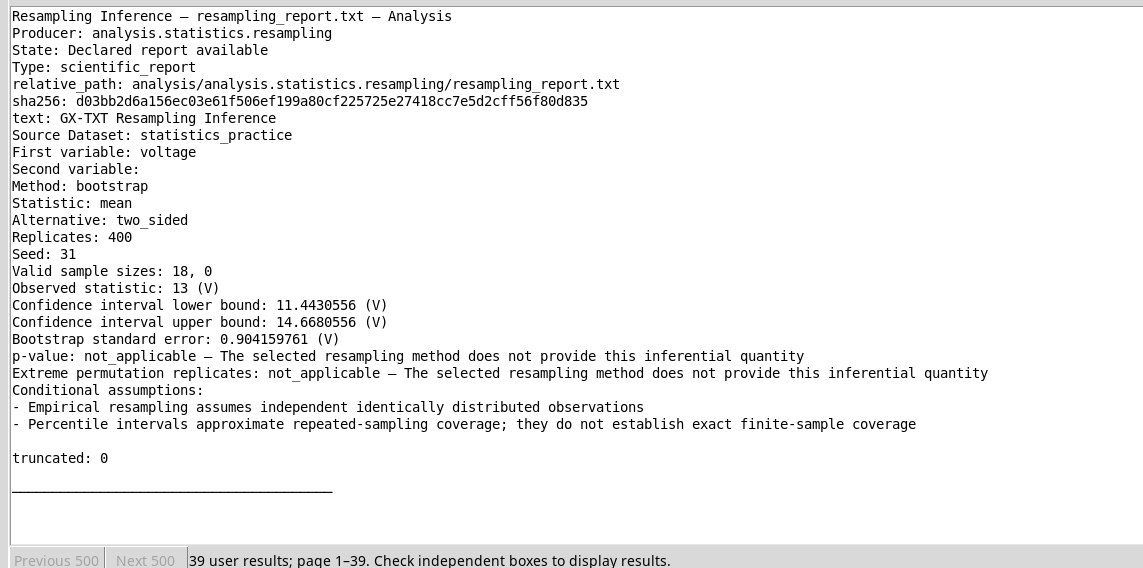
.distribution keeps every replicate. .summary keeps counts, estimate, configuration and the available inference. The bootstrap run gives an observed mean of 13 V, an interval from 11.443 to 14.668 V and a bootstrap standard error of about 0.904 V. The interval is an approximation of the sampling coverage and assumes independent and identically distributed observations.
With permutations read the difference in V, the number of extreme replicates (e), the direction and p = (e + 1)/(B + 1). With 400 permutations even zero extreme replicates gives a Monte Carlo p-value of about 0.00249. The validity of the inference depends on a permutation scheme compatible with the design. Confidence, estimate and p-value are exposed with their respective availability in resampling_report.txt.
Result in the GUI
For output IDs, selection and publishing criteria see Options shared by the providers. To look up or open the result go to Tables, reports and plots.