

The 2D21 Thyratron: From Historical Curves to SPICE Models
2. The predecessors of the 2D21 and the limits of comparing types
The literature groups under the name thyratron tubes with very different gases, geometries and purposes. The comparison is more instructive if it starts from the observable to be explained. A DC test on mercury-vapour tubes can show how the critical potential is measured. A test with small xenon tubes, on the other hand, can support a direct comparison of recovery in the same circuit. A hydrogen model with several discharge gaps suggests a structure for simulating the transient.
A specimen dated by its packaging
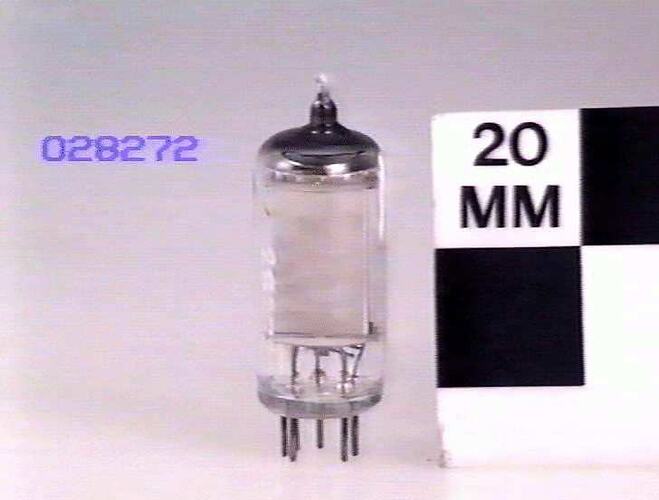
Museums Victoria holds the photographed bulb under number ST 28272 and records a length of 54 mm and an outside diameter of 20 mm. A second specimen, held at the National Museum of American History, bears the marking JRC-2D21 and still has its RCA packaging with US Navy acceptance in April 1945. This date ties the type to an identifiable period object ten years before the Flash-Matic was introduced. The RMA 378 release of April 1944 is noted in the Museo Edelpro record. The three clues are of different kinds: a museum measurement, an inscription on the packaging and a registration reference. Smithsonian, specimen 1986.0794.056 · Museo Edelpro, record 5727/2D21W.
1931–1933: the test circuit becomes part of the characteristic
Nottingham publishes DC and AC tests together on the GE types FG-17, FG-27 and FG-67. The AC supply makes it possible to see how control depends on the phase and on the history of the discharge. The work discusses two ways of controlling the tube with a photocell, acting on the phase or on reaching the critical potential. The author points out that the number of specimens examined is small and that the constructional evolution of the tube can alter its characteristics. This is an important distinction when moving from the curve of one specimen to a manufacturer’s average characteristic. Nottingham, full text, pp. 271–301.
In 1933 Seletzky and Shevki study grid and anode currents together in a mercury-vapour tube. The survey identifies this as a precedent for AC measurements and for the role of residual ionization between cycles. It is a step between the static reading of the threshold and the dynamic problem of what remains in the tube after conduction. Seletzky and Shevki, Journal of the Franklin Institute 215, 299–326.
884, 885, 2050, 3D22 and EN91
| Type | What the reference offers | Use in the comparison |
|---|---|---|
| 884 | Critical characteristic in handbooks and pulse-service data in Wittenberg. | Reference for reading local sensitivity and comparing recovery across geometries. |
| 885 | Puckle shows the static characteristics of the RCA 885 gas triode, fig. 3, in his study of time bases. | Precedent for threshold, capacitor discharge and extinction. |
| 2050 | RCA AN-131 treats it together with the 2D21 in timers. Wittenberg, fig. 37, uses the 2050 for the characteristics before discharge. | Links weak grid currents, drive impedance and anode voltage. |
| 3D22 | Wittenberg compares it with the 2050 and 2D21 in the pulse tests. | Useful for discussing electrode dimensions and the return of control with the same test circuit. |
| EN91 | Mullard collects firing curves with variable shield voltage and measurements before and during conduction. | Cross-check of the structure of the families published for small tetrodes, recording the measurement conditions. |
Puckle distinguishes two extinction mechanisms in time bases: the capacitor discharge can bring the current below the value that sustains the arc, or the circuit can provide external quenching. This explains why the charging segment seen on the oscilloscope and the duration of the discharge belong to two distinct circuit problems. The oscillator shown decades later by Zabb takes up the same kind of application. Puckle, Electronic Engineering, March 1942, pp. 664–666 · Wittenberg, RCA Review, 1949 · Mullard, 1954, EN91 plates.
Schure’s critical curve: 884 versus 2D21
In Gas Tubes (1958), figure 18 sets an argon 884 beside an average 2D21 tested with a grid resistance of 2 MΩ. For the 884 the handbook uses the reading of about 142 V on the anode when the grid is at −20 V. The 2D21 trace has a more pronounced curvature. The comparison shows where a description by a constant control ratio loses accuracy. Schure, Gas Tubes, §§ 22–23 and figure 18 · Bibliographic record of the monograph.
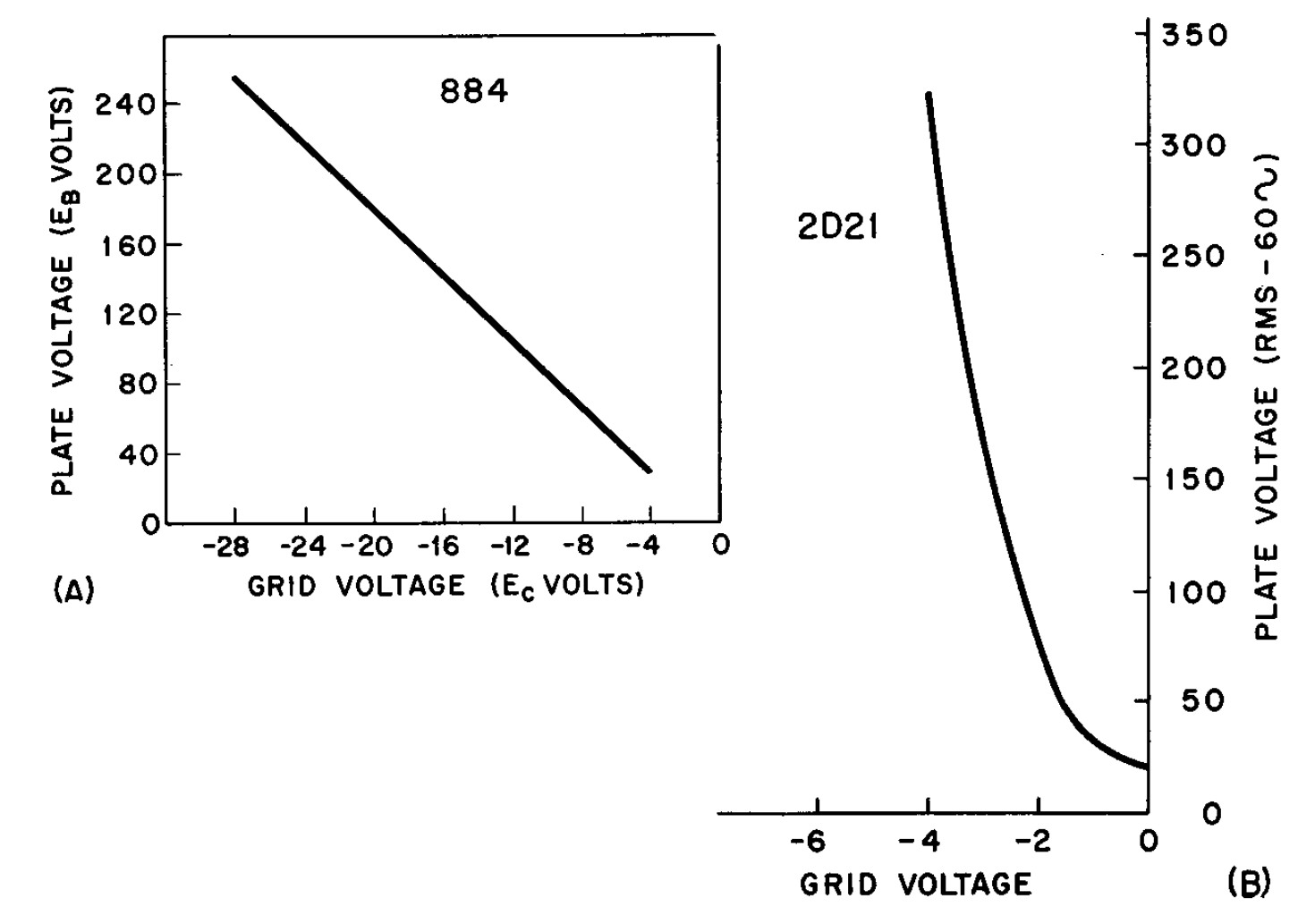
To compare the two panels, fix a plate voltage that appears in both and read the grid coordinate on the respective curve. The horizontal scales cover very different ranges. A slope estimated in pixels on the two panels would give a comparison without physical meaning. Even converting the axes to volts, the resulting ratio describes only that segment and, for the 2D21, the grid resistance given in the caption.