

The 2D21 Thyratron: From Historical Curves to SPICE Models
6. The grid immersed in the plasma
Mott-Smith and Langmuir’s theory of collectors in discharges provides the framework for interpreting electron and ion currents. In the 1962 RCA chapter, Wittenberg treats the grid of the conducting thyratron as a probe in the discharge and illustrates the saturation of the negative branch on a 5563A. Figures 36–38 instead discuss the components of the current before the discharge, including collection of electrons and ions, grid emission, leakage and capacitive currents. Figure 37 uses the 2050 to show the effect of the anode voltage on the pre-firing current. Mott-Smith and Langmuir, 1926 · Wittenberg, figures 36–40.
Local sheath law and saturation
For a planar ion sheath Wittenberg writes, in the unit convention given in equation 9, \[ j_i=5.23\times 10^{-8} M^{-1/2}d^{-2}V_s^{3/2}. \] Here \(j_i\) is the current density in A/cm², \(M\) is the relative atomic mass of the ion, \(d\) is the sheath thickness in cm and \(V_s\) is the drop across the sheath in volts. The sheath voltage is referred to the plasma. To move to the voltage measured between G1 and cathode one needs to know the relation between the two references.
The exponent \(3/2\) describes local transport at constant thickness. If the ion current available in the plasma is practically fixed for a given anode condition, a thickening sheath can compensate for the increase in \(V_s\): at constant current density the same equation gives \(d\propto V_s^{3/4}\). This explains how a local power law can coexist with a plateau of the collected current. The grid geometry, the effective area and the state of the plasma enter the step from current density to terminal current. Wittenberg, sheath law, eq. 9 · Wittenberg, discussion of saturation.
The electron branch in the Maxwellian theory of probes
For electrons with a Maxwellian distribution, when the probe presents a potential barrier, the fraction with sufficient energy falls exponentially with the barrier. The same theoretical structure appears in the work of Mott-Smith and Langmuir and in Wittenberg’s RCA treatment. Mott-Smith and Langmuir, 1926 · Wittenberg, Gas Tube Design, Probes section.
Denoting by \(\Delta\phi>0\) the retarding potential, by \(e\) the elementary charge and by \(A_e\) the prefactor, the collected electron current is \(I_e=A_e\exp[-e\Delta\phi/(k_B T_e)]\). On a semi-logarithmic plot the slope with respect to \(\Delta\phi\) is \(-e/(k_B T_e)\) when temperature and prefactor remain fixed. In a thyratron graph the G1 current is the net terminal current and its voltage is referred to the cathode. To compare a fitted exponential with the probe law one must identify the segment dominated by electrons, isolate any ion level and know the plasma potential.
What can be checked on the 2D21 data
If the current were separable as the product of a function of voltage and a function of anode current, a purely vertical normalization could align different families. On the GE curves published here, dividing by the anode current brings part of the negative branches closer together. Differences remain in the zero-crossing point and in the horizontal scale. This suggests checking position and local slope as well, in addition to the plateau value.
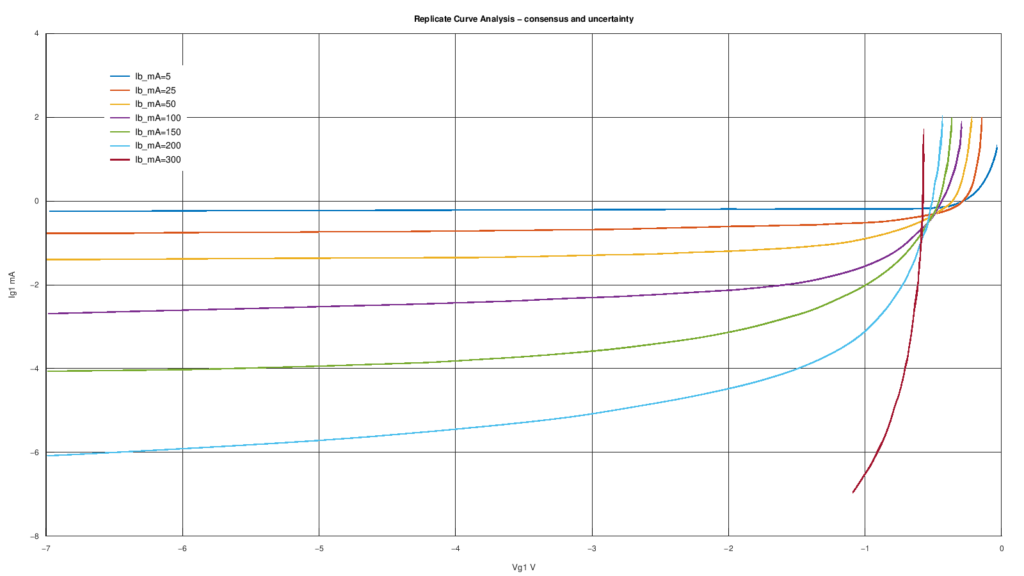
The spread between readings of the same sheet and the spread between tubes answer different questions. Repeating the digitization tells us how precisely the plate can be reconstructed. A measurement on other specimens or a comparison between manufacturers, under comparable conditions, is needed instead to estimate how far a parametrization represents more than the single source.
From plasma potential to measured current
The point \(V_0\) at which the net current vanishes represents, in the manufacturer’s graph, the balance of the contributions at the terminal. In a probe model this point must be distinguished from the plasma potential: the net current vanishes when contributions of opposite sign cancel out. Before comparing the exponent of an empirical law with Child’s, it is therefore also necessary to compare the modeled quantity, the voltage reference and the quantities held fixed. Mott-Smith and Langmuir, theory of collectors · Wittenberg, probes and grid currents.
From the net current to the ion branch of plate 119
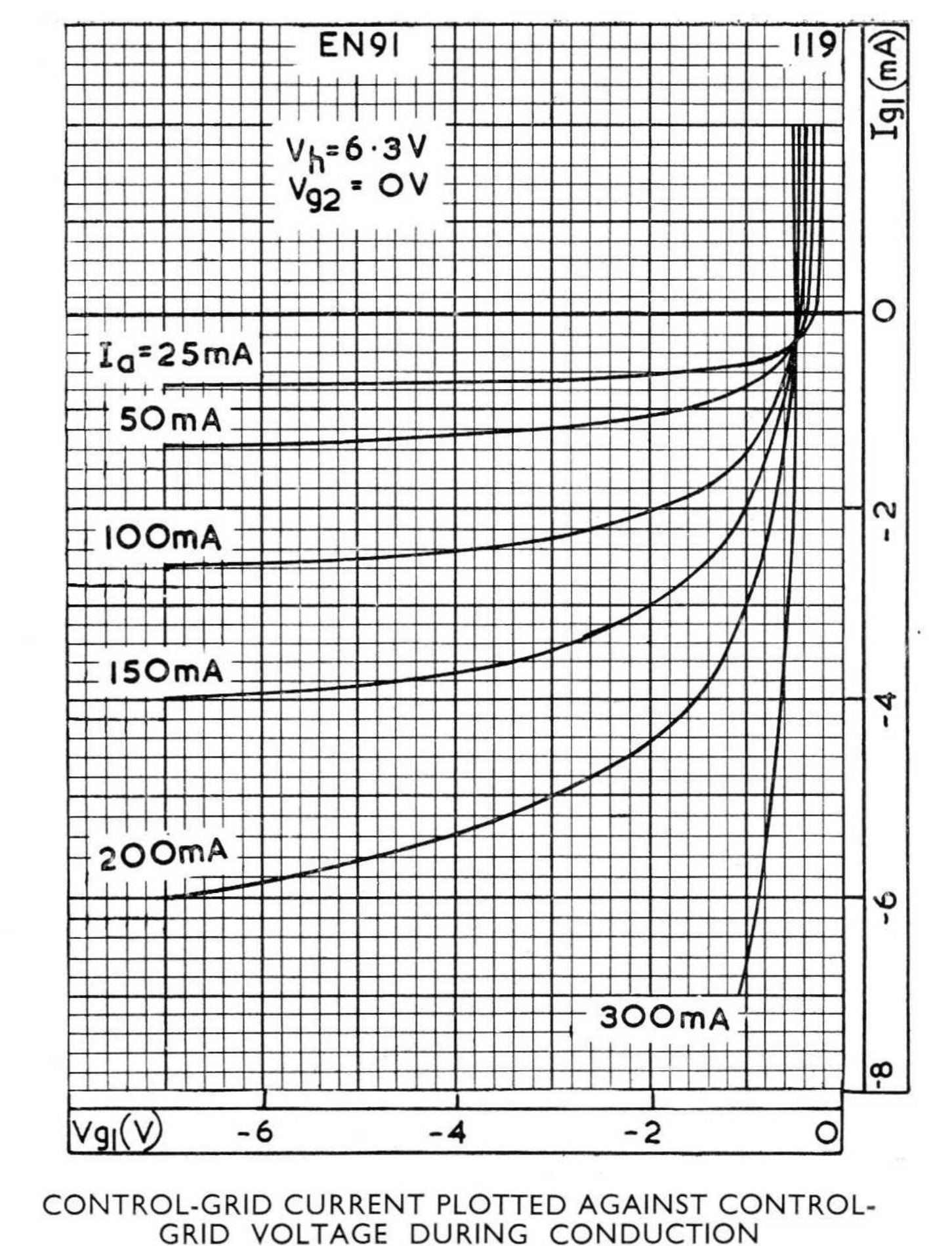
Mullard specifies 0 V on the shield and distinguishes the curves by anode current. Moving to the strongly negative bias side, the levels of collected current separate. Approaching the cathode in potential, one crosses a steep region instead. The point where the ammeter reads zero is particularly informative: it admits a balance between contributions of opposite sign. A two-terminal measurement alone does not assign independent values to the electron and ion currents. To derive an electron temperature from a slope one would need to isolate the electron branch, refer the potential to the plasma and justify the use of the probe model.