

OpenFOAM: advanced numerical methods, convergence and performance
Nineteenth guide of the Learning OpenFOAM 14 path and the third of the “Advanced transport and final project” module of the advanced course, after those on server and transfers, monitoring and convergence, quantitative analysis with ParaView, verification and validation, parameter sweeps, mesh generation, boundary conditions and models, transient simulations, turbulence and RANS models, heat transfer, conjugate heat transfer, species transport, VOF multiphase flows, porous media, rotating machinery, dynamic meshes, dispersed particles and chemical reactions. This one tackles numerical methods and performance with the official pitzDailySteady tutorial: convection schemes, solvers and tolerances, the SIMPLE loop and under-relaxation, the distinction between iterative and discretisation error, domain decomposition and MPI speedup measurement, with six isolated, comparable cases. The deep-dive and practical-tip boxes open with a click: they contain every script and file of the package, every tutorial file read from the OpenFOAM 14 source, the code of the bounded and linearUpwind schemes, of SIMPLEC, relaxation, tolerances and residualControl, the numbers of the case (12,225 cells, Re 25,400, upwind numerical diffusion up to 30 times the inlet eddy viscosity, about 3000 cells per process with 4 processes), the check in the source of what ExecutionTime and ClockTime measure (whole seconds), seven additional tested scripts (mesh estimates, residual history, physical observables with the reattachment point, repeated runs with median and speedup, Amdahl and Karp–Flatt laws, plus a test-data generator), a protocol to fill in and linked bibliographic references. The archive with all scripts and files is available for download at the end of the article.
OpenFOAM practical series · Windows workstation, Linux calculation server
Environment: OpenFOAM Foundation 14; ParaView 5.13.2 Windows client connected to pvserver; FileZilla/SFTP, PowerShell and Notepad++ for daily work.
Level: intermediate–advanced. Goal: controlled numerical comparisons and reproducible performance measurements.
Scientific principle. Faster computation does not automatically mean more accurate results. Always examine elapsed time alongside convergence, conservation and physical quantities of interest.
1. Learning objectives
By the end of this guide, you should be able to read and modify fvSchemes and fvSolution without inadvertently changing the physical problem; compare convection discretisations; distinguish iteration errors from spatial discretisation errors; measure serial and MPI execution time; compute speedup and parallel efficiency; and assemble an auditable benchmark table.
Prerequisites: OpenFOAM case structure, blockMesh, checkMesh, foamRun, tmux, ParaView and log analysis (Guides 1–9). Visual Studio Code is not required.
Deep dive · The case in numbers: mesh, Reynolds number, inlet turbulence and numerical diffusion
Before comparing schemes and timings it pays to know what is being computed. extra/case_estimates.py reads the resources/blockMesh/pitzDaily dictionary (the one used by run_case.sh), applies the blockMesh grading rules, including multi-section gradings such as $posY, and reads the inlet conditions of the case. The main numbers:
| Quantity | Value | Consequence |
|---|---|---|
| cells | 12 225 in 5 blocks, one cell in z | small 2D case: a few thousand cells per process with 2–4 processes |
| cell sizes | from 0.21 to 5.1 mm | aspect ratio up to about 25 in the last, tapered block |
| step height h | 25.4 mm (equal to the inlet channel) | the domain extends 11.4 h downstream of the step |
| Reh = U·h/ν | 10 × 0.0254 / 10⁻⁵ = 25,400 | turbulent flow, kEpsilon model with wall functions |
| inlet turbulence | k = 0.375 m²/s² → 5 % intensity; ε = 14.855 m²/s³ | scale l = Cμ3/4k3/2/ε = 2.54 mm (0.1 of the channel height); νt = 8.5·10⁻⁴ m²/s = 85 ν |
| upwind numerical diffusivity |U|Δx/2 | from 1.0·10⁻³ (Δx = 0.21 mm) to 2.6·10⁻² m²/s (5.1 mm) | from 1.2 to 30 times the inlet eddy viscosity: the first-order scheme adds diffusion of the same order as, or larger than, the physical one |
| cells per process | 6112 (2), 3056 (4) | low computation/communication ratio: speedup far from ideal already with 4 processes |
The script and its run on the prepared case are in the section 7 box (mesh quality); the tutorial inlet value of ω, 440.15 s⁻¹, equals ε/(Cμk): the inlet conditions of the different turbulence models are consistent with each other.
Practical tip · The campaign tools: what each one measures
| Script | When | What it produces |
|---|---|---|
scripts/prepare_campaign.py | first | six isolated cases and campaign_manifest.csv (section 11) |
extra/case_estimates.py | before the run | cells, sizes, Reynolds number, numerical diffusion, cells per process (section 7) |
extra/add_observables.py | on never-run copies | flow rates, pressures, probes and wall shear stress written during the run (section 11) |
scripts/run_case.sh | one run per case | logs and RUN_SUCCESS status (section 12) |
extra/benchmark_repeats.py | for speedup | repeated runs with millisecond timings per phase (section 10) |
scripts/analyze_campaign.py | after the runs | results_summary.csv and speedup.png (section 14) |
extra/residual_history.py | after the runs | residual history, iteration at which the tutorial would have stopped, linear-solver work (section 5) |
extra/observables.py | after the runs | pressure drop, flow balance, probes, reattachment point and their stability (section 15) |
extra/benchmark_stats.py | after the repetitions | medians, speedup, efficiency, Karp–Flatt, Amdahl (section 10) |
2. Official reference tutorial
We use the Foundation 14 tutorial tutorials/incompressibleFluid/pitzDailySteady, a steady incompressible flow through a duct with a sudden expansion. Its fields include kinematic pressure p and velocity U; kinematic viscosity is set in constant/physicalProperties and the turbulence model in constant/momentumTransport.
The tutorial uses solver incompressibleFluid in system/controlDict, a steadyState time scheme, bounded Gauss linearUpwind grad(U) for div(phi,U), and SIMPLE pressure–velocity coupling in its consistent SIMPLEC variant (consistent yes in fvSolution). Do not assume that older simpleFoam directory layouts apply unchanged to OpenFOAM 14.
source /opt/OpenFOAM-14/etc/bashrc
foamVersion
printf '%s\n' "$FOAM_TUTORIALS"
ls "$FOAM_TUTORIALS/incompressibleFluid/pitzDailySteady"
Adjust the installation path where necessary. Confirm the reported OpenFOAM version.
Deep dive · All the pitzDailySteady tutorial files, as they are in version 14
File contents (without headers), to be compared with the copy on the server. The complete case is in the version 14 repository. system/blockMeshDict is a copy of tutorials/resources/blockMesh/pitzDaily (as the comment in the file says): Allrun and run_case.sh use the resource version with -dict.
Allrun
#!/bin/sh
cd ${0%/*} || exit 1    # Run from this directory

# Source tutorial run functions
. $WM_PROJECT_DIR/bin/tools/RunFunctions

runApplication blockMesh -dict $FOAM_TUTORIALS/resources/blockMesh/pitzDaily
runApplication foamRun

#------------------------------------------------------------------------------
0/U
dimensions      [velocity];

internalField   uniform (0 0 0);

boundaryField
{
    inlet
    {
        type            fixedValue;
        value           uniform (10 0 0);
    }

    outlet
    {
        type            zeroGradient;
    }

    upperWall
    {
        type            noSlip;
    }

    lowerWall
    {
        type            noSlip;
    }

    frontAndBack
    {
        type            empty;
    }
}
0/p
dimensions      [kinematicPressure];

internalField   uniform 0;

boundaryField
{
    inlet
    {
        type            zeroGradient;
    }

    outlet
    {
        type            fixedValue;
        value           uniform 0;
    }

    upperWall
    {
        type            zeroGradient;
    }

    lowerWall
    {
        type            zeroGradient;
    }

    frontAndBack
    {
        type            empty;
    }
}
0/k
dimensions      [turbulentKineticEnergy];

internalField   uniform 0.375;

boundaryField
{
    inlet
    {
        type            fixedValue;
        value           uniform 0.375;
    }
    outlet
    {
        type            zeroGradient;
    }
    upperWall
    {
        type            kqRWallFunction;
        value           uniform 0.375;
    }
    lowerWall
    {
        type            kqRWallFunction;
        value           uniform 0.375;
    }
    frontAndBack
    {
        type            empty;
    }
}
0/epsilon
dimensions      [turbulentEpsilon];

internalField   uniform 14.855;

boundaryField
{
    inlet
    {
        type            fixedValue;
        value           uniform 14.855;
    }
    outlet
    {
        type            zeroGradient;
    }
    upperWall
    {
        type            epsilonWallFunction;
        value           uniform 14.855;
    }
    lowerWall
    {
        type            epsilonWallFunction;
        value           uniform 14.855;
    }
    frontAndBack
    {
        type            empty;
    }
}
0/nut
dimensions      [turbulentViscosity];

internalField   uniform 0;

boundaryField
{
    inlet
    {
        type            calculated;
        value           uniform 0;
    }
    outlet
    {
        type            calculated;
        value           uniform 0;
    }
    upperWall
    {
        type            nutkWallFunction;
        value           uniform 0;
    }
    lowerWall
    {
        type            nutkWallFunction;
        value           uniform 0;
    }
    frontAndBack
    {
        type            empty;
    }
}0/omega, 0/nuTilda, 0/v2, 0/f (used only by other turbulence models)
dimensions      [turbulentOmega];

internalField   uniform 440.15;

boundaryField
{
    inlet
    {
        type            fixedValue;
        value           $internalField;
    }
    outlet
    {
        type            zeroGradient;
    }
    upperWall
    {
        type            omegaWallFunction;
        value           $internalField;
    }
    lowerWall
    {
        type            omegaWallFunction;
        value           $internalField;
    }
    frontAndBack
    {
        type            empty;
    }
}

dimensions      [turbulentViscosity];

internalField   uniform 0;

boundaryField
{
    inlet
    {
        type            fixedValue;
        value           uniform 0;
    }

    outlet
    {
        type            zeroGradient;
    }

    upperWall
    {
        type            zeroGradient;
    }

    lowerWall
    {
        type            zeroGradient;
    }

    frontAndBack
    {
        type            empty;
    }
}

dimensions      [turbulentKineticEnergy];

internalField   uniform 0.25;

boundaryField
{
    inlet
    {
        type            fixedValue;
        value           $internalField;
    }
    outlet
    {
        type            zeroGradient;
    }
    upperWall
    {
        type            v2WallFunction;
        value           $internalField;
    }
    lowerWall
    {
        type            v2WallFunction;
        value           $internalField;
    }
    frontAndBack
    {
        type            empty;
    }
}

dimensions      [rate];

internalField   uniform 0;

boundaryField
{
    inlet
    {
        type            zeroGradient;
    }
    outlet
    {
        type            zeroGradient;
    }
    upperWall
    {
        type            fWallFunction;
        value           uniform 0;
    }
    lowerWall
    {
        type            fWallFunction;
        value           uniform 0;
    }
    frontAndBack
    {
        type            empty;
    }
}constant/physicalProperties, constant/momentumTransport
viscosityModel  constant;

nu              1e-05;

simulationType RAS;

RAS
{
    // Tested with kEpsilon, realizableKE, kOmega, kOmega2006, kOmegaSST, v2f,
    // ShihQuadraticKE, LienCubicKE.
    model           kEpsilon;

    turbulence      on;


    viscosityModel  Newtonian;
}system/controlDict, system/functions
solver          incompressibleFluid;

startFrom       startTime;

startTime       0;

stopAt          endTime;

endTime         2000;

deltaT          1;

writeControl    timeStep;

writeInterval   100;

purgeWrite      0;

writeFormat     ascii;

writePrecision  6;

writeCompression off;

timeFormat      general;

timePrecision   6;

runTimeModifiable true;

#includeFunc streamlinesLine
(
    name=streamlines,
    start=(-0.0205 0.001 0.00001),
    end=(-0.0205 0.0251 0.00001),
    nPoints=10,
    fields=(p k U)
)
system/fvSchemes
ddtSchemes
{
    default         steadyState;
}

gradSchemes
{
    default         Gauss linear;
}

divSchemes
{
    default         none;
    div(phi,U)      bounded Gauss linearUpwind grad(U);
    div(phi,k)      bounded Gauss limitedLinear 1;
    div(phi,epsilon) bounded Gauss limitedLinear 1;
    div(phi,omega)  bounded Gauss limitedLinear 1;
    div(phi,v2)     bounded Gauss limitedLinear 1;
    div((nuEff*dev2(T(grad(U))))) Gauss linear;
    div(nonlinearStress) Gauss linear;
}

laplacianSchemes
{
    default         Gauss linear corrected;
}

interpolationSchemes
{
    default         linear;
}

snGradSchemes
{
    default         corrected;
}

wallDist
{
    method meshWave;
}
system/fvSolution
solvers
{
    p
    {
        solver          GAMG;
        tolerance       1e-06;
        relTol          0.1;
        smoother        GaussSeidel;
    }

    pcorr
    {
        solver          GAMG;
        tolerance       1e-06;
        relTol          0;
        smoother        GaussSeidel;
    }

    "(U|k|epsilon|omega|f|v2)"
    {
        solver          smoothSolver;
        smoother        symGaussSeidel;
        tolerance       1e-05;
        relTol          0.1;
    }
}

SIMPLE
{
    nNonOrthogonalCorrectors 0;
    consistent      yes;

    residualControl
    {
        p               1e-2;
        U               1e-3;
        "(k|epsilon|omega|f|v2)" 1e-3;
    }
}

relaxationFactors
{
    equations
    {
        U               0.9; // 0.9 is more stable but 0.95 more convergent
        ".*"            0.9; // 0.9 is more stable but 0.95 more convergent
    }
}
system/blockMeshDict
// Note: this file is a Copy of $FOAM_TUTORIALS/resources/blockMesh/pitzDaily

units [mm];

vertices
(
    (-20.6 0 -0.5)
    (-20.6 25.4 -0.5)
    (0 -25.4 -0.5)
    (0 0 -0.5)
    (0 25.4 -0.5)
    (206 -25.4 -0.5)
    (206 0 -0.5)
    (206 25.4 -0.5)
    (290 -16.6 -0.5)
    (290 0 -0.5)
    (290 16.6 -0.5)

    (-20.6 0 0.5)
    (-20.6 25.4 0.5)
    (0 -25.4 0.5)
    (0 0 0.5)
    (0 25.4 0.5)
    (206 -25.4 0.5)
    (206 0 0.5)
    (206 25.4 0.5)
    (290 -16.6 0.5)
    (290 0 0.5)
    (290 16.6 0.5)
);

negY
(
    (2 4 1)
    (1 3 0.3)
);

posY
(
    (1 4 2)
    (2 3 4)
    (2 4 0.25)
);

posYR
(
    (2 1 1)
    (1 1 0.25)
);


blocks
(
    hex (0 3 4 1 11 14 15 12)
    (18 30 1)
    simpleGrading (0.5 $posY 1)

    hex (2 5 6 3 13 16 17 14)
    (180 27 1)
    edgeGrading (4 4 4 4 $negY 1 1 $negY 1 1 1 1)

    hex (3 6 7 4 14 17 18 15)
    (180 30 1)
    edgeGrading (4 4 4 4 $posY $posYR $posYR $posY 1 1 1 1)

    hex (5 8 9 6 16 19 20 17)
    (25 27 1)
    simpleGrading (2.5 1 1)

    hex (6 9 10 7 17 20 21 18)
    (25 30 1)
    simpleGrading (2.5 $posYR 1)
);

boundary
(
    inlet
    {
        type patch;
        faces
        (
            (0 1 12 11)
        );
    }
    outlet
    {
        type patch;
        faces
        (
            (8 9 20 19)
            (9 10 21 20)
        );
    }
    upperWall
    {
        type wall;
        faces
        (
            (1 4 15 12)
            (4 7 18 15)
            (7 10 21 18)
        );
    }
    lowerWall
    {
        type wall;
        faces
        (
            (0 3 14 11)
            (3 2 13 14)
            (2 5 16 13)
            (5 8 19 16)
        );
    }
    frontAndBack
    {
        type empty;
        faces
        (
            (0 3 4 1)
            (2 5 6 3)
            (3 6 7 4)
            (5 8 9 6)
            (6 9 10 7)
            (11 14 15 12)
            (13 16 17 14)
            (14 17 18 15)
            (16 19 20 17)
            (17 20 21 18)
        );
    }
);
Useful details: kEpsilon is the active model (the comment lists the models tested with the same case); residualControl would stop the run before the 2000 iterations of endTime; consistent yes activates the SIMPLEC variant (next box); wallDist { method meshWave; } serves models that use the wall distance; the streamlinesLine function writes streamlines at every write time.
Deep dive · What incompressibleFluid solves: consistent SIMPLE (SIMPLEC) in the code
The incompressibleFluid module builds the momentum equation in momentumPredictor.C, relaxes it and solves it with the pressure gradient of the previous iteration:
tUEqn =
(
    fvm::ddt(U) + fvm::div(phi, U)
  + MRF.DDt(U)
  + momentumTransport->divDevSigma(U)
 ==
    fvModels().source(U)
);
fvVectorMatrix& UEqn = tUEqn.ref();

UEqn.relax();
...
if (pimple.momentumPredictor())
{
    solve(UEqn == -fvc::grad(p));
}
In correctPressure.C, with consistent yes, the pressure-equation coefficient is not 1/A but the “consistent” one of J. P. Van Doormaal, G. D. Raithby, “Enhancements of the SIMPLE method for predicting incompressible fluid flows”, Numerical Heat Transfer 7, 147–163, 1984, doi:10.1080/01495728408961817:
tmp<volScalarField> rAtU(rAU);

if (pimple.consistent())
{
    rAtU = 1.0/max(1.0/rAU - UEqn.H1(), 0.1/rAU);
    phiHbyA +=
        fvc::interpolate(rAtU() - rAU)*fvc::snGrad(p)*mesh.magSf();
    HbyA -= (rAU - rAtU())*fvc::grad(p);
}
...
fvScalarMatrix pEqn
(
    fvm::laplacian(rAtU(), p)
 ...
);
...
// Explicitly relax pressure for momentum corrector
p.relax();

U = HbyA - rAtU*fvc::grad(p);- With SIMPLEC the velocity correction accounts for the coefficients of neighbouring cells (
H1): this is why the tutorial does not under-relax pressure (nofields { p … }entry, sop.relax()has no effect) and uses 0.9 for all equations, whereas classic SIMPLE by S. V. Patankar, D. B. Spalding (International Journal of Heat and Mass Transfer 15, 1787–1806, 1972, doi:10.1016/0017-9310(72)90054-3) typically needs 0.3 on p and 0.7 on U. - Interpolating the fluxes
phiHbyAfrom cell values follows the idea of C. M. Rhie, W. L. Chow (AIAA Journal 21, 1525–1532, 1983, doi:10.2514/3.8284), which avoids checkerboard pressure oscillations on co-located grids. - The turbulence model (
kEpsilon, B. E. Launder, D. B. Spalding, Computer Methods in Applied Mechanics and Engineering 3, 269–289, 1974, doi:10.1016/0045-7825(74)90029-2) is solved after pressure: for every iteration the log shows Ux, Uy, p, the continuity line, epsilon and k.
3. From finite volumes to linear equations
Integrating the governing equations over finite-volume cells yields sparse systems of the form A x = b. The spatial scheme determines how face values and fluxes are reconstructed, while the linear solver determines how the resulting algebraic system is solved. Overall stability also depends on pressure–velocity coupling, under-relaxation, mesh quality and boundary conditions.
Distinguish discretisation error (mesh/scheme), iterative error (incomplete solution), model error (physical assumptions) and input uncertainty (parameters and boundary data). A small linear solver tolerance does not prove mesh independence.
Deep dive · Iterative error and discretisation error: how to separate them in practice
- Iterative error. It is the difference between the solution at the current iteration and the one the discrete system would have at convergence. It is not measured by the residual of a single linear solver but by watching the quantities of interest: if the pressure drop and the reattachment point still change by 0.1 % every 100 iterations, the iterative error is of that order (section 15,
observables.py). - Discretisation error. It depends on mesh and schemes; once iteratively converged it is estimated with at least three meshes in a constant ratio, the observed order and the GCI: P. J. Roache, Journal of Fluids Engineering 116, 405–413, 1994, doi:10.1115/1.2910291; I. B. Celik et al., Journal of Fluids Engineering 130, 078001, 2008, doi:10.1115/1.2960953 (Guide 4). Comparing schemes on a single mesh shows how much the discretisation error depends on the scheme, not which scheme is “right”.
- Rule of thumb. The iterative error must be at least an order of magnitude smaller than the differences one wants to attribute to the schemes: otherwise the comparison only measures how far each case is from convergence after 600 iterations.
- Reference texts: J. H. Ferziger, M. Perić, R. L. Street, Computational Methods for Fluid Dynamics, 4th ed., Springer, 2020, doi:10.1007/978-3-319-99693-6; F. Moukalled, L. Mangani, M. Darwish, The Finite Volume Method in Computational Fluid Dynamics, Springer, 2016, doi:10.1007/978-3-319-16874-6 (with OpenFOAM examples).
4. Convection schemes: robustness versus smearing
In this exercise, the varied term is div(phi,U). Alternatives supported in this context include:
// Reference tutorial scheme
 div(phi,U) bounded Gauss linearUpwind grad(U);
// First-order, generally more diffusive
 div(phi,U) bounded Gauss upwind;
// Limited vector interpolation
 div(phi,U) bounded Gauss limitedLinearV 1;
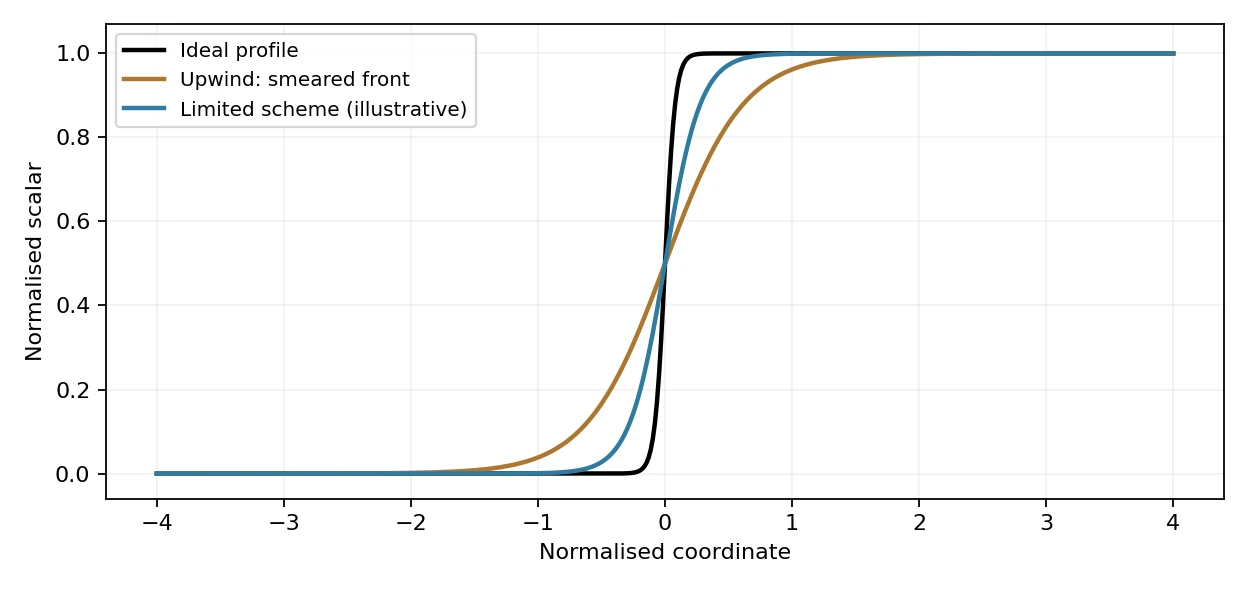
These are alternatives, not lines to enter simultaneously. First-order upwind typically smears gradients; linearUpwind is higher-order in smooth regions but may require more care; limited schemes aim to balance stability and resolution. The bounded form of the convection operator and a bounded interpolation limiter are distinct concepts.
Deep dive · The three schemes in the code: bounded, linearUpwind, upwind and limitedLinearV
bounded. In boundedConvectionScheme.C the bounded variant subtracts from the convection term the product of the flux divergence and the field:
return
    scheme_().fvmDiv(faceFlux, vf)
  - fvm::Sp(fvc::surfaceIntegrate(faceFlux), vf);
That is, it discretises ∇·(φU) − (∇·φ)U. At convergence ∇·φ = 0 and the term vanishes; during the iterations of a steady case, when continuity is not yet satisfied, it prevents the mass error from acting as a spurious momentum source. It is a stability device for the SIMPLE loop, independent of the interpolation scheme that follows.
linearUpwind. In linearUpwind.C the face value is that of the upstream cell plus an explicit gradient correction (here grad(U), computed with Gauss linear):
forAll(faceFlux, facei)
{
    const label celli =
        (faceFlux[facei] > 0) ? owner[facei] : neighbour[facei];

    sfCorr[facei] = (Cf[facei] - C[celli]) & gradVf[celli];
}- It is the second-order extrapolation of R. F. Warming, R. M. Beam, “Upwind second-order difference schemes and applications in aerodynamic flows”, AIAA Journal 14, 1241–1249, 1976, doi:10.2514/3.61457. The upwind part is implicit, the correction explicit: it is unlimited, so it can produce small over/undershoots where gradients change abruptly, such as in the shear layer after the step.
- upwind. The upstream value only: bounded and robust, but first-order, with a truncation error equivalent to a diffusivity |U|Δx/2 along the flow; in this case it is 1 to 30 times the inlet eddy viscosity (section 1). It typically shortens recirculation zones.
- limitedLinearV 1. Linear interpolation limited with the limitedLinear TVD limiter (coefficient 1 = strongest limiting, towards upwind); the “V” denotes the vector version, which computes the limiter once in the direction of maximum change of the vector instead of component by component, preserving the velocity direction. Limiter theory: P. K. Sweby, “High resolution schemes using flux limiters for hyperbolic conservation laws”, SIAM Journal on Numerical Analysis 21, 995–1011, 1984, doi:10.1137/0721062.
Practical tip · What to compare between the schemes, and where
- The reattachment point on the lower wall is the observable most sensitive to numerical diffusion:
observables.pyderives it from the wall shear stress at every write time (section 15). Withupwinda shorter recirculation is expected. - The pressure drop between inlet and outlet is an integral quantity, less sensitive; Ux profiles at sections x = 2h, 4h, 6h (Plot Over Line in ParaView) show where the schemes differ.
- Only the U scheme changes: k and ε remain
bounded Gauss limitedLinear 1in all cases, as in the tutorial.
5. Linear solvers, tolerances and SIMPLE
The solvers block in system/fvSolution specifies linear solution algorithms and stopping criteria. For example, the official tutorial uses GAMG for pressure. tolerance is an absolute threshold on the normalised linear residual; relTol controls the relative reduction demanded within one linear solve. By contrast, SIMPLE/residualControl (when enabled) is a stopping criterion for the overall steady iteration.
Implication: cases that stop at different iteration counts are not an apples-to-apples solver-timing comparison. The supplied scripts disable residualControl only in newly created exercise copies and request an equal number of numerical steps. Physical convergence must still be assessed before interpreting final flow predictions.
Deep dive · Tolerances and residuals in the OpenFOAM 14 code
The residual printed in the log is normalised in lduMatrixSolver.C: the sum of the magnitudes of b − Ax is divided by a factor depending on the solution itself, so the value does not change with the scale of the quantities:
// --- Calculate A dot reference value of psi
matrix_.sumA(tmpField, interfaceBouCoeffs_, interfaces_);

tmpField *= gAverage(psi, matrix_.lduMesh_.comm());

return
    gSum
    (
        (mag(Apsi - tmpField) + mag(source - tmpField))(),
        matrix_.lduMesh_.comm()
    )
  + solverPerformance::small_;
The linear solver stopping test, in SolverPerformance.C, is “final residual < tolerance” or “final residual < relTol × initial residual”:
if
(
    finalResidual_ < Tolerance
 || (
        RelTolerance
      > small_*pTraits<Type>::one
     && finalResidual_ < cmptMultiply(RelTolerance, initialResidual_)
    )
)
{
    converged_ = true;
}- With
relTol 0.1every p solution reduces the residual by a factor of 10 and stops: in the first iterations a few GAMG cycles suffice, towards convergence the initial residual is already small and the work per iteration changes. This is why the number of linear iterations (No Iterations) must be recorded:residual_history.pysums them per case. pcorr(relTol 0) is used only for the initial flux correction;GAMGis an algebraic multigrid (K. Stüben, “A review of algebraic multigrid”, Journal of Computational and Applied Mathematics 128, 281–309, 2001, doi:10.1016/S0377-0427(00)00516-1) with aGaussSeidelsmoother; for U, k and ε the tutorial usessmoothSolverwithsymGaussSeidel, suitable for asymmetric, diagonally dominant matrices.
residualControl. In singleRegionConvergenceControl.C the loop stops when, for all listed fields, the initial residual of the first solution in the iteration is below the threshold; for vectors the largest component counts (cmptMax in convergenceControlTemplates.C):
getInitialResiduals(mesh_, fieldName, 0, residual, residual);
...
const bool absCheck = residual < residualControl_[fieldi].absTol;
cs.satisfied = cs.satisfied && absCheck;

// convergenceControlTemplates.C
r0 = cmptMax(sp[0].initialResidual());
Deep dive · Additional script: residual_history.py, residual history and solver work from the log
The script reads log.foamRun of each case iteration by iteration and computes: the initial residual of the first solution of each field (the one used by residualControl), the iteration at which the tutorial criteria (p 10⁻², U 10⁻³, k and ε 10⁻³, changeable with --criteria) would have been met, total and mean linear iterations of p, the final continuity error and the mean cost per iteration from successive ExecutionTime values (excluding the first 10). It writes residual_history.csv and, with --plot, the plot of the Ux and p residuals.
#!/usr/bin/env python3
"""Residual and cost histories of the Guide 19 campaign from log.foamRun.

For every case listed in campaign_manifest.csv (or given on the command
line) the script parses log.foamRun step by step and reports:

  * the initial residual of the FIRST solution of each field in each step
    (the quantity used by SIMPLE/residualControl; for U the largest of the
    solved components, as cmptMax does in OpenFOAM 14);
  * the step at which the tutorial residualControl criteria
    (p 1e-2, U 1e-3, k/epsilon/omega/f/v2 1e-3, or --criteria) would have
    stopped the original tutorial;
  * linear-solver work: total and mean "No Iterations" of p and U;
  * the local continuity error at the last step;
  * the mean cost per step from consecutive ExecutionTime values,
    excluding the first 10 steps (start-up).

Outputs: a summary on screen, residual_history.csv (one row per case and
step) and, with --plot, residual_history.png (needs matplotlib). Existing
output files are never overwritten.

Usage:
  python3 residual_history.py CAMPAIGN_DIR [--cases reference upwind ...]
                              [--criteria "p=1e-2,U=1e-3,k=1e-3,epsilon=1e-3"] [--plot]
"""
import argparse, csv, math, os, re, sys

STEP = re.compile(r'^Time = ([0-9.eE+-]+)s?\s*$')
SOLVE = re.compile(r'^(\w+):\s+Solving for (\w+), Initial residual = ([0-9.eE+-]+), '
                   r'Final residual = ([0-9.eE+-]+), No Iterations (\d+)')
CONT = re.compile(r'time step continuity errors : sum local = ([0-9.eE+-]+), global = ([0-9.eE+-]+)')
TIMES = re.compile(r'^ExecutionTime = ([0-9.eE+-]+) s\s+ClockTime = ([0-9.eE+-]+) s')


def parse(log):
    steps = []
    cur = None
    for line in open(log, encoding='utf-8', errors='replace'):
        line = line.rstrip('\n')
        m = STEP.match(line)
        if m:
            cur = dict(step=float(m.group(1)), first={}, iters={}, cont=None, cpu=None, clock=None)
            steps.append(cur)
            continue
        if cur is None:
            continue
        m = SOLVE.match(line)
        if m:
            f = m.group(2)
            cur['first'].setdefault(f, float(m.group(3)))
            cur['iters'][f] = cur['iters'].get(f, 0) + int(m.group(5))
            continue
        m = CONT.search(line)
        if m:
            cur['cont'] = float(m.group(1))
            continue
        m = TIMES.match(line)
        if m:
            cur['cpu'], cur['clock'] = float(m.group(1)), float(m.group(2))
    return [s for s in steps if s['cpu'] is not None]


def field_residual(step, name):
    """Residual of a field as residualControl sees it (vector -> max component)."""
    if name in step['first']:
        return step['first'][name]
    comps = [v for k, v in step['first'].items() if k.startswith(name) and k[len(name):] in ('x', 'y', 'z')]
    return max(comps) if comps else None


def satisfied(step, crit):
    """residualControl test: every controlled field that is solved is below its tolerance."""
    checked = [(field_residual(step, f), tol) for f, tol in crit.items()]
    checked = [(r, tol) for r, tol in checked if r is not None]     # fields not solved (e.g. omega with kEpsilon) are ignored
    return bool(checked) and all(r < tol for r, tol in checked)


def main():
    ap = argparse.ArgumentParser(description=__doc__.split('\n')[0])
    ap.add_argument('campaign')
    ap.add_argument('--cases', nargs='*')
    ap.add_argument('--criteria', default='p=1e-2,U=1e-3,k=1e-3,epsilon=1e-3,omega=1e-3,f=1e-3,v2=1e-3')
    ap.add_argument('--plot', action='store_true')
    a = ap.parse_args()
    base = os.path.abspath(os.path.expanduser(a.campaign))
    if a.cases:
        cases = a.cases
    else:
        with open(os.path.join(base, 'campaign_manifest.csv'), encoding='utf-8') as f:
            cases = [r['case'] for r in csv.DictReader(f)]
    crit = {k: float(v) for k, v in (c.split('=') for c in a.criteria.split(','))}
    out_csv = os.path.join(base, 'residual_history.csv')
    out_png = os.path.join(base, 'residual_history.png')
    for p in (out_csv,) + ((out_png,) if a.plot else ()):
        if os.path.exists(p):
            sys.exit('refusing to overwrite ' + p)
    data = {}
    for c in cases:
        log = os.path.join(base, c, 'log.foamRun')
        if not os.path.isfile(log):
            print(f'{c:12s} no log.foamRun')
            continue
        st = parse(log)
        if not st:
            print(f'{c:12s} log without complete steps')
            continue
        data[c] = st
    fields = ['Ux', 'Uy', 'p', 'k', 'epsilon']
    print(f'{"case":12s} {"steps":>5s} ' + ' '.join(f'{f:>9s}' for f in fields) +
          f' {"stop@":>6s} {"p iters":>8s} {"p it/step":>9s} {"cont.loc":>9s} {"ms/step":>8s}')
    rows = []
    for c, st in data.items():
        last = st[-1]
        stop = next((int(s['step']) for s in st if satisfied(s, crit)), None)
        pit = sum(s['iters'].get('p', 0) for s in st)
        cpu = [s['cpu'] for s in st]
        k0 = min(10, len(cpu) - 2)
        ms = 1e3 * (cpu[-1] - cpu[k0]) / (len(cpu) - 1 - k0) if len(cpu) > k0 + 1 else float('nan')
        print(f'{c:12s} {int(last["step"]):5d} ' + ' '.join(f'{last["first"].get(f, float("nan")):9.2e}' for f in fields) +
              f' {str(stop) if stop else "-":>6s} {pit:8d} {pit / len(st):9.1f} {last["cont"] if last["cont"] is not None else float("nan"):9.2e} {ms:8.2f}')
        for s in st:
            rows.append([c, int(s['step'])] + [s['first'].get(f, '') for f in fields] +
                        [s['iters'].get('p', ''), s['iters'].get('Ux', ''), s['cont'], s['cpu'], s['clock']])
    print('stop@ = first step at which all residualControl criteria (' + a.criteria + ') hold, i.e. where the tutorial would stop;')
    print('        "-" = never within the run. Residuals are initial residuals of the first solution in each step.')
    with open(out_csv, 'x', newline='', encoding='utf-8') as f:
        w = csv.writer(f)
        w.writerow(['case', 'step'] + ['r0_' + x for x in fields] + ['p_iterations', 'Ux_iterations', 'continuity_local', 'ExecutionTime_s', 'ClockTime_s'])
        w.writerows(rows)
    print('Wrote', out_csv)
    if a.plot and data:
        import matplotlib
        matplotlib.use('Agg')
        import matplotlib.pyplot as plt
        fig, axs = plt.subplots(1, 2, figsize=(11, 4.2), dpi=150, sharey=True)
        for ax, f in zip(axs, ('Ux', 'p')):
            for c, st in data.items():
                if c.startswith('parallel'):
                    continue
                ax.semilogy([s['step'] for s in st], [s['first'].get(f, math.nan) for s in st], lw=1.2, label=c)
            ax.axhline(crit['U' if f.startswith('U') else f], color='gray', ls=':', lw=1)
            ax.set_title(f'initial residual of {f}', fontsize=10)
            ax.set_xlabel('SIMPLE iteration')
            ax.grid(alpha=0.3, which='both')
        axs[0].legend(fontsize=8)
        fig.tight_layout()
        fig.savefig(out_png)
        print('Wrote', out_png)


if __name__ == '__main__':
    main()
Test on the synthetic logs written by the test generator in the section 15 box (exponential models, not OpenFOAM results): the line format is that of the OpenFOAM 14 foamRun log (Time = 600s, Solving for Ux, Initial residual = …, ExecutionTime = … s ClockTime = … s).
$ python3 residual_history.py ~/OpenFOAM/guide19_run01 --plot
case         steps        Ux        Uy         p         k   epsilon  stop@  p iters p it/step  cont.loc  ms/step
reference      600  3.81e-05  4.31e-05  3.27e-04  2.82e-05  1.46e-05    417     5575       9.3  5.48e-04    19.40
upwind         600  2.50e-06  3.55e-06  1.69e-05  1.37e-06  1.19e-06    289     5575       9.3  2.03e-05    19.40
limited        600  9.75e-06  1.16e-05  1.04e-04  6.85e-06  3.92e-06    366     5575       9.3  1.68e-04    19.40
relax_06       600  3.84e-03  4.27e-03  1.17e-02  2.90e-03  1.45e-03      -     5575       9.3  1.98e-02    19.40
parallel_2     600  3.81e-05  4.31e-05  3.27e-04  2.82e-05  1.46e-05    417     5575       9.3  5.48e-04    11.45
parallel_4     600  3.81e-05  4.31e-05  3.27e-04  2.82e-05  1.46e-05    417     5575       9.3  5.48e-04     7.66
stop@ = first step at which all residualControl criteria (p=1e-2,U=1e-3,k=1e-3,epsilon=1e-3,omega=1e-3,f=1e-3,v2=1e-3) hold, i.e. where the tutorial would stop;
        "-" = never within the run. Residuals are initial residuals of the first solution in each step.
Wrote /home/user/OpenFOAM/guide19_run01/residual_history.csv
Wrote /home/user/OpenFOAM/guide19_run01/residual_history.png
6. Under-relaxation
Under-relaxation moderates changes between global iterations and can damp numerical oscillation. In the relax_06 variant, only the explicit U entry under relaxationFactors/equations changes from 0.9 to 0.6; all other settings match the reference case.
Smaller is not necessarily better: excessive relaxation may slow convergence. Compare residual histories and predefined physical observables versus iteration count, rather than relying on a final residual alone.
Deep dive · What the relaxation factor really does: the fvMatrix::relax code
For equations (relaxationFactors/equations) OpenFOAM applies implicit relaxation in fvMatrix.C: it makes the matrix diagonally dominant, divides the diagonal by α and adds the difference to the source, so that the relaxed solution remains consistent with the original equation at convergence:
// Ensure the matrix is diagonally dominant...
forAll(D, celli)
{
    D[celli] = max(mag(D[celli]), sumOff[celli]);
}

// ... then relax
D /= alpha;
...
// Finally add the relaxation contribution to the source.
S += (D - D0)*psi_.primitiveField();- At convergence U no longer changes between two iterations and the added term vanishes: implicit relaxation changes the path, not the final solution. A difference between
referenceandrelax_06after 600 iterations therefore measures only the different distance from convergence. - With SIMPLEC the consistent coefficient
rAtUis built from the relaxed matrix: lowering α from 0.9 to 0.6 also slows the pressure correction. A clearly higher number of iterations to reach the same residuals is expected;residual_history.pymeasures it with the “stop@” column. - The tutorial comment (“0.9 is more stable but 0.95 more convergent”) points the other way: with SIMPLEC one can go up towards 0.95 if the case is stable.
7. Mesh quality and solver robustness
Schemes should be assessed alongside skewness, non-orthogonality and cell aspect ratios. Poor mesh quality may appear as rising linear iterations, stalled residuals or failure to converge. Compare different schemes on exactly the same mesh, running checkMesh and preserving its report. A grid-refinement study is a different experiment (Guide 4).
Deep dive · Additional script: case_estimates.py, the pitzDaily mesh block by block
The script rebuilds the cell sizes with the blockMesh rules: for each block edge it reads the grading (simpleGrading or the 12 entries of edgeGrading, including multi-section “length fraction, cell fraction, ratio” gradings), computes the geometric progression of the cells and reports minima, maxima and the largest aspect ratio per block; then the physical inlet quantities and the upwind numerical diffusion. Python standard library only.
#!/usr/bin/env python3
"""A-priori numbers for the pitzDailySteady campaign (OpenFOAM 14).

Reads the blockMesh dictionary (vertices, macros, simpleGrading/edgeGrading
with multi-grading sections), 0/U, 0/k, 0/epsilon and
constant/physicalProperties of a case and prints:

  * cells per block and in total, cell sizes along every block edge
    (blockMesh grading rules), smallest/largest cells and aspect ratios;
  * step height, Reynolds number, inlet turbulence intensity, length scale
    and eddy viscosity from the inlet k and epsilon;
  * the numerical diffusivity of first-order upwind, |U| dx / 2, compared
    with the laminar and inlet eddy viscosities;
  * cells per MPI process for 1, 2, 4 and 8 processes.

Usage:
  python3 case_estimates.py CASE [--blockmesh FILE]
  (default FILE: $FOAM_TUTORIALS/resources/blockMesh/pitzDaily if it exists,
   otherwise CASE/system/blockMeshDict)
Only the Python standard library is needed.
"""
import argparse, math, os, re, sys

UNITS = {'m': 1.0, 'cm': 1e-2, 'mm': 1e-3, 'um': 1e-6}


def strip(t):
    return re.sub(r'//[^\n]*', ' ', re.sub(r'/\*.*?\*/', ' ', t, flags=re.S))


def balanced(text, start, o='(', c=')'):
    i = text.index(o, start)
    depth = 0
    for j in range(i, len(text)):
        if text[j] == o:
            depth += 1
        elif text[j] == c:
            depth -= 1
            if depth == 0:
                return text[i + 1:j], j + 1
    raise ValueError('unbalanced ' + o)


def parse_list(s):
    """Nested OpenFOAM list of numbers -> nested Python lists."""
    toks = re.findall(r'\(|\)|[-+0-9.eE]+', s)
    stack = [[]]
    for t in toks:
        if t == '(':
            stack.append([])
        elif t == ')':
            v = stack.pop()
            stack[-1].append(v)
        else:
            stack[-1].append(float(t))
    return stack[0]


def read_blockmesh(path):
    t = strip(open(path, encoding='utf-8').read())
    m = re.search(r'units\s+\[(\w+)\]\s*;', t)
    scale = UNITS[m.group(1)] if m else float((re.search(r'convertToMeters\s+([-+0-9.eE]+)', t) or [0, 1])[1])
    macros = {}
    for mm in re.finditer(r'(?m)^\s*(\w+)\s*\n?\s*\(', t):
        name = mm.group(1)
        if name in ('vertices', 'blocks', 'boundary', 'edges', 'faces', 'defaultPatch', 'mergePatchPairs'):
            continue
        body, _ = balanced(t, mm.end() - 1)
        macros[name] = '(' + body + ')'
    vb, _ = balanced(t, t.index('vertices'))
    V = [[scale * float(c) for c in v] for v in parse_list(vb)]
    bb, _ = balanced(t, t.index('blocks'))
    for k, v in macros.items():
        bb = bb.replace('$' + k, v)
    blocks = []
    for hm in re.finditer(r'hex\s*\(([^)]*)\)\s*\(([^)]*)\)\s*(simpleGrading|edgeGrading)', bb):
        verts = [int(x) for x in hm.group(1).split()]
        n = [int(float(x)) for x in hm.group(2).split()]
        g, _ = balanced(bb, hm.end())
        blocks.append(dict(verts=verts, n=n, kind=hm.group(3), grading=parse_list(g)))
    return V, blocks


def sections(spec):
    """Grading spec of one edge: number or list of (lengthFrac, cellFrac, ratio)."""
    if isinstance(spec, (int, float)):
        return [(1.0, 1.0, float(spec))]
    tl = sum(s[0] for s in spec)
    tc = sum(s[1] for s in spec)
    return [(s[0] / tl, s[1] / tc, s[2]) for s in spec]


def edge_cells(L, n, spec):
    secs = sections(spec)
    counts = [max(1, int(round(cf * n))) for _, cf, _ in secs]
    counts[-1] = n - sum(counts[:-1])
    out = []
    for (lf, _, r), nc in zip(secs, counts):
        ls = lf * L
        if nc == 1 or abs(r - 1) < 1e-12:
            out += [ls / nc] * nc
        else:
            q = r ** (1.0 / (nc - 1))
            d1 = ls * (1 - q) / (1 - q ** nc)
            out += [d1 * q ** i for i in range(nc)]
    return out


EDGES = [(0, 1), (3, 2), (7, 6), (4, 5), (0, 3), (1, 2), (5, 6), (4, 7), (0, 4), (1, 5), (2, 6), (3, 7)]


def block_sizes(V, b):
    res = []
    for d in range(3):
        sizes = []
        for e in range(4):
            i, j = EDGES[4 * d + e]
            p, q = V[b['verts'][i]], V[b['verts'][j]]
            L = math.dist(p, q)
            spec = b['grading'][d] if b['kind'] == 'simpleGrading' else b['grading'][4 * d + e]
            sizes.append(edge_cells(L, b['n'][d], spec))
        res.append(sizes)
    return res


def field_value(case, name, patch):
    t = strip(open(os.path.join(case, '0', name), encoding='utf-8').read())
    m = re.search(re.escape(patch) + r'\s*\{[^}]*?value\s+uniform\s+(\([^)]*\)|[-+0-9.eE]+)', t, re.S)
    v = m.group(1)
    if v.startswith('$'):
        v = re.search(r'internalField\s+uniform\s+([-+0-9.eE]+)', t).group(1)
    return [float(x) for x in v.strip('()').split()] if v.startswith('(') else float(v)


def main():
    ap = argparse.ArgumentParser(description=__doc__.split('\n')[0])
    ap.add_argument('case')
    ap.add_argument('--blockmesh')
    a = ap.parse_args()
    bm = a.blockmesh
    if not bm:
        tut = os.path.join(os.environ.get('FOAM_TUTORIALS', ''), 'resources', 'blockMesh', 'pitzDaily')
        bm = tut if os.environ.get('FOAM_TUTORIALS') and os.path.isfile(tut) else os.path.join(a.case, 'system', 'blockMeshDict')
    V, blocks = read_blockmesh(bm)
    print(f'blockMesh dictionary: {os.path.basename(bm)}  ({len(V)} vertices, {len(blocks)} blocks)')
    tot = 0
    dmin, dmax, armax = 1e9, 0, 0
    print('block  cells (nx x ny)   dx min-max [mm]     dy min-max [mm]     max aspect dx/dy or dy/dx')
    for k, b in enumerate(blocks):
        nc = b['n'][0] * b['n'][1] * b['n'][2]
        tot += nc
        sx, sy, _ = block_sizes(V, b)
        allx = [d for s in sx for d in s]
        ally = [d for s in sy for d in s]
        # aspect ratio estimated per edge pair: largest dx / smallest dy and vice versa
        ar = max(max(allx) / min(ally), max(ally) / min(allx))
        armax = max(armax, ar)
        dmin = min(dmin, min(allx), min(ally))
        dmax = max(dmax, max(allx), max(ally))
        print(f'{k:5d}  {nc:6d} ({b["n"][0]:3d} x {b["n"][1]:3d})   {1e3 * min(allx):6.3f} - {1e3 * max(allx):6.3f}     '
              f'{1e3 * min(ally):6.3f} - {1e3 * max(ally):6.3f}     {ar:8.1f}')
    print(f'total cells: {tot}   smallest cell edge {1e3 * dmin:.3f} mm, largest {1e3 * dmax:.3f} mm, '
          f'bounding aspect ratio <= {armax:.1f}')
    ys = [v[1] for v in V]
    xs = [v[0] for v in V]
    h = -min(ys)                      # step height: lower wall below y = 0
    Hin = max(ys)
    U = field_value(a.case, 'U', 'inlet')[0]
    k = field_value(a.case, 'k', 'inlet')
    eps = field_value(a.case, 'epsilon', 'inlet')
    t = strip(open(os.path.join(a.case, 'constant', 'physicalProperties'), encoding='utf-8').read())
    nu = float(re.search(r'nu\s+(?:\[[^\]]*\]\s*)?([-+0-9.eE]+)', t).group(1))
    Cmu = 0.09
    print(f'\ngeometry: inlet channel height {1e3 * Hin:.1f} mm, step height h = {1e3 * h:.1f} mm, '
          f'domain x from {1e3 * min(xs):.1f} to {1e3 * max(xs):.1f} mm ({(max(xs)) / h:.1f} h downstream of the step)')
    print(f'inlet velocity {U:g} m/s, nu = {nu:g} m2/s -> Re_h = U h / nu = {U * h / nu:.0f}, Re_H(inlet) = {U * Hin / nu:.0f}')
    I = math.sqrt(2 * k / 3) / U
    nut = Cmu * k * k / eps
    lm = Cmu ** 0.75 * k ** 1.5 / eps
    print(f'inlet turbulence: k = {k:g} m2/s2 -> intensity {100 * I:.1f} %; epsilon = {eps:g} m2/s3 -> '
          f'length scale Cmu^0.75 k^1.5/eps = {1e3 * lm:.2f} mm ({lm / Hin:.2f} H), nut = Cmu k^2/eps = {nut:.3e} m2/s ({nut / nu:.0f} nu)')
    print(f'consistency: omega = eps/(Cmu k) = {eps / (Cmu * k):.2f} 1/s (tutorial 0/omega uses 440.15)')
    print('\nfirst-order upwind numerical diffusivity |U| dx / 2 (flow aligned with the grid):')
    for dx in sorted({dmin, 0.5e-3, 1e-3, 2e-3, dmax}):
        nn = U * dx / 2
        print(f'  dx = {1e3 * dx:6.3f} mm  ->  {nn:.3e} m2/s = {nn / nu:7.0f} nu = {nn / nut:5.2f} x inlet nut')
    print('\ncells per MPI process (decomposition balance ignored):')
    for n in (1, 2, 4, 8):
        print(f'  {n} process(es): {tot / n:8.0f} cells each')


if __name__ == '__main__':
    main()
$ python3 case_estimates.py ~/OpenFOAM/guide19_run01/reference
blockMesh dictionary: pitzDaily (22 vertices, 5 blocks)
block cells (nx x ny) dx min-max [mm] dy min-max [mm] max aspect dx/dy or dy/dx
0 540 ( 18 x 30) 0.791 - 1.583 0.319 - 2.296 5.0
1 4860 (180 x 27) 0.528 - 2.114 0.360 - 1.201 5.9
2 5400 (180 x 30) 0.528 - 2.114 0.319 - 2.296 6.6
3 675 ( 25 x 27) 2.047 - 5.145 0.615 - 0.941 8.4
4 750 ( 25 x 30) 2.047 - 5.145 0.208 - 2.296 24.7
total cells: 12225 smallest cell edge 0.208 mm, largest 5.145 mm, bounding aspect ratio <= 24.7
geometry: inlet channel height 25.4 mm, step height h = 25.4 mm, domain x from -20.6 to 290.0 mm (11.4 h downstream of the step)
inlet velocity 10 m/s, nu = 1e-05 m2/s -> Re_h = U h / nu = 25400, Re_H(inlet) = 25400
inlet turbulence: k = 0.375 m2/s2 -> intensity 5.0 %; epsilon = 14.855 m2/s3 -> length scale Cmu^0.75 k^1.5/eps = 2.54 mm (0.10 H), nut = Cmu k^2/eps = 8.520e-04 m2/s (85 nu)
consistency: omega = eps/(Cmu k) = 440.15 1/s (tutorial 0/omega uses 440.15)
first-order upwind numerical diffusivity |U| dx / 2 (flow aligned with the grid):
dx = 0.208 mm -> 1.042e-03 m2/s = 104 nu = 1.22 x inlet nut
dx = 0.500 mm -> 2.500e-03 m2/s = 250 nu = 2.93 x inlet nut
dx = 1.000 mm -> 5.000e-03 m2/s = 500 nu = 5.87 x inlet nut
dx = 2.000 mm -> 1.000e-02 m2/s = 1000 nu = 11.74 x inlet nut
dx = 5.145 mm -> 2.572e-02 m2/s = 2572 nu = 30.19 x inlet nut
cells per MPI process (decomposition balance ignored):
1 process(es): 12225 cells each
2 process(es): 6112 cells each
4 process(es): 3056 cells each
8 process(es): 1528 cells each- The total, 12,225 cells, matches the sum of the dictionary blocks (540 + 4860 + 5400 + 675 + 750): it is the number to find in
log.checkMesh(“cells: 12225”). - The reported aspect ratio is an upper bound (longest cell over thinnest cell of the block); the actual one, cell by cell, is in the “Max aspect ratio” line of
checkMesh. Block 4, tapered and with the$posYRgrading, has the most elongated cells. - From
log.checkMeshrecord in the protocol: number of cells, “Max non-orthogonality”, “Max skewness”, “Max aspect ratio” and any “Failed … mesh checks” line. The faces of the tapered blocks are not orthogonal: theGauss linear correctedcorrection of the Laplacians compensates non-orthogonality, withnNonOrthogonalCorrectors 0.
Practical tip · Refining the mesh without touching the tutorial
run_case.sh always builds the mesh from the resources dictionary (blockMesh -dict $FOAM_TUTORIALS/resources/blockMesh/pitzDaily), so a refined mesh must be prepared in a new copy and launched by hand, using the case system/blockMeshDict:
cp -r ~/OpenFOAM/guide19_run01/reference ~/OpenFOAM/guide19_mesh2x     # copy BEFORE running reference
cd ~/OpenFOAM/guide19_mesh2x
sed -i 's/(18 30 1)/(36 60 1)/; s/(180 27 1)/(360 54 1)/; s/(180 30 1)/(360 60 1)/; s/(25 27 1)/(50 54 1)/; s/(25 30 1)/(50 60 1)/' system/blockMeshDict
grep -n "hex" -A1 system/blockMeshDict        # check the five blocks
blockMesh > log.blockMesh 2>&1
checkMesh > log.checkMesh 2>&1                 # expect cells: 48900
foamRun > log.foamRun 2>&1
The grading ratio is defined between the last and the first cell of the section: doubling the cells with the same ratio halves the end cells and keeps the progression geometrically similar. With 4 times the cells more SIMPLE iterations are needed to converge: 600 iterations are not enough in general, and the comparison with the base mesh must be made at iterative convergence (section 3).
8. Numerical iteration is not physical time
The pitzDailySteady case uses ddtSchemes { default steadyState; } and deltaT 1. Log lines such as Time = 100 and Time = 200 represent progress through the steady solution algorithm, not 100 or 200 physical seconds. Our default benchmark has 600 numerical steps (adjustable with --steps).
In a genuinely transient case, temporal discretisation requires independent time-step convergence checks. Do not draw conclusions about transient Courant limits from this steady benchmark.
Practical tip · The “time” of a steady case in the log and on disk
- In OpenFOAM 14
foamRunprintsTime =followed by the time name with its unit (foamRun.C,runTime.userTimeName()): the log reads “Time = 600s”. The scripts’ regular expressions accept both “600” and “600s”. - With
writeInterval 100and 600 iterations the folders 100…600 are written: they are iterations, not seconds.foamListTimeslists them; in parallel cases they are insideprocessorN/untilreconstructPar -latestTimerebuilds the last one. - The original tutorial, with
residualControlactive, stops by itself when the residuals fall below the thresholds and writes that last iteration; in the campaign copies the control is removed and all variants run exactly the same number of iterations.
9. Parallel execution by domain decomposition
OpenFOAM partitions the computational domain among MPI processes. A minimal decomposition file contains:
numberOfSubdomains 4;
method scotch;
The sequence is blockMesh → checkMesh → decomposePar → mpirun -np 4 foamRun -parallel → reconstructPar -latestTime. Our scripts measure the foamRun phase separately from meshing, decomposition and reconstruction. For total time to result, measure those other stages and storage overhead as well.
With a relatively small mesh, four MPI processes can be slower than one due to communication and I/O overhead.
Deep dive · Decomposition, processes and checks to make before measuring
scotchpartitions the cell graph minimising the boundary faces between processors, with no geometric coefficients (F. Pellegrini, J. Roman, “Scotch: a software package for static mapping by dual recursive bipartitioning of process and architecture graphs”, HPCN Europe 1996, LNCS 1067, 493–498, doi:10.1007/3-540-61142-8_588). The OpenFOAM 14 manual (section 3.4) also describes the geometricsimpleandhierarchicalmethods.- In
log.decomposeParread, for each processor, the number of cells and of processor faces: their sum relative to the internal faces indicates how much communication each iteration needs. With about 3000 cells per process (4 processes) a non-negligible fraction of the cells borders another subdomain. decomposePar -cellProcwrites thecellProcfield (processor number of each cell), to be viewed in ParaView to see the subdomains.- Use physical cores only:
lscpushows “Core(s) per socket” and “Thread(s) per core”. With Open MPI,--bind-to corepins each process to a core and reduces the variability between repetitions; “There are not enough slots available in the system” means more processes are requested than available cores (--oversubscribeforces it, but the measured time is no longer a meaningful speedup). - The parallel result must match the serial one within the solver tolerance: the initial residuals in the log may differ slightly because GAMG and the smoothers work per subdomain; pressure drop and reattachment point must stay equal to the chosen significant digits.
Practical tip · Viewing the decomposed case without reconstructing it
ParaView reads decomposed cases directly: in the OpenFOAM reader choose “Decomposed Case” in Case Type. This is useful to check the subdomains (with cellProc) and the intermediate times, which reconstructPar -latestTime does not rebuild. To rebuild everything: reconstructPar with no options, in a copy after the benchmark, not in the folder used for timing.
10. Speedup and efficiency
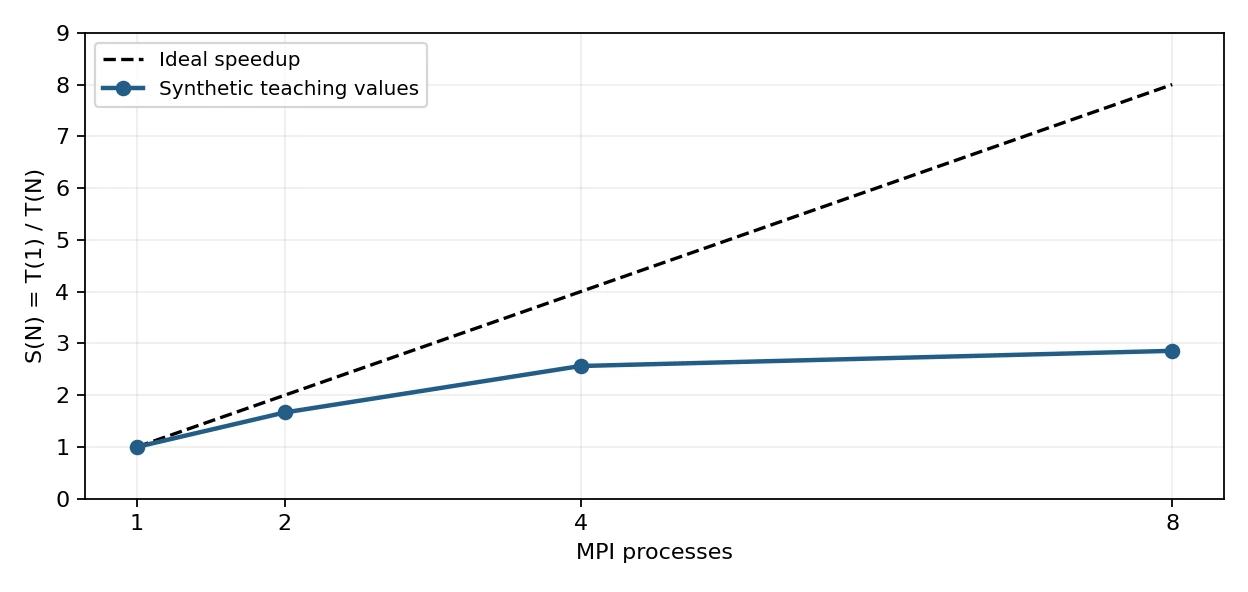
Let T₁ denote serial elapsed ClockTime and Tₙ denote the equivalent time using n processes. Then:
Speedup: S(n) = T₁ / Tₙ
Parallel efficiency: E(n) = S(n) / n.
Keep mesh, hardware, OpenFOAM release, numerical settings and iteration count identical. ExecutionTime is the CPU time of the master process only (not the sum over MPI processes) and can be misleading for MPI speedup; use elapsed ClockTime, which OpenFOAM 14 prints in whole seconds; for short runs measure the time with a finer resolution (boxes in this section). Repeat timed runs, report the median, and record CPU frequency/turbo behaviour, other server load, filesystem and available physical cores.
Deep dive · ExecutionTime and ClockTime in the code: what they measure and with what resolution
The line printed at the end of every iteration comes from foamRun.C:
Info<< "ExecutionTime = " << runTime.elapsedCpuTime() << " s"
    << "  ClockTime = " << runTime.elapsedClockTime() << " s"
    << nl << endl;
ExecutionTime is the CPU time of the process: cpuTime.C uses the C library clock(). Info writes only from the master process, so in a parallel run it is the CPU time of rank 0, not the sum over processes (the guide has been corrected on this point). With MPI it can approach the elapsed time, because busy-waiting for messages consumes CPU.
// src/OSspecific/POSIX/cpuTime/cpuTime.C
double Foam::cpuTime::elapsedCpuTime() const
{
    curTime_ = clock();
    return timeDifference(startTime_, curTime_);   // (cur - prev)/CLOCKS_PER_SEC
}

// src/OpenFOAM/global/clock/clock.C
time_t Foam::clock::elapsedClockTime() const
{
    newTime_ = getTime();
    return newTime_ - startTime_;
}
ClockTime is a time_t: whole seconds since foamRun started (clock.C). On a 10 s run the rounding error reaches 10 %, and a speedup computed from two integer values can vary a lot from one test to the next. analyze_campaign.py uses exactly this value; for accurate measurements extra/benchmark_repeats.py measures the elapsed time of each phase with time.perf_counter() and repeats the runs.
The laws for reading the numbers. Amdahl’s law, S(n) = 1/(f + (1 − f)/n) with f the non-parallelisable fraction (G. M. Amdahl, “Validity of the single processor approach to achieving large scale computing capabilities”, AFIPS Spring Joint Computer Conference, 483–485, 1967, doi:10.1145/1465482.1465560); scaling with growing workload (J. L. Gustafson, “Reevaluating Amdahl’s law”, Communications of the ACM 31, 532–533, 1988, doi:10.1145/42411.42415): for a fixed-size problem Amdahl applies, for meshes that grow with the processes the “weak scaling” efficiency matters; Karp–Flatt metric, e(n) = (1/S − 1/n)/(1 − 1/n), serial fraction derived from measurements (A. H. Karp, H. P. Flatt, “Measuring parallel processor performance”, Communications of the ACM 33, 539–543, 1990, doi:10.1145/78607.78614): if e grows with n the limit is not serial code but communication cost.
Deep dive · Additional scripts: benchmark_repeats.py and benchmark_stats.py, repetitions, median and speedup
benchmark_repeats.py takes a prepared, never-run case (for example parallel_4), copies it N times into a new folder and repeats the same sequence as run_case.sh, measuring the elapsed time of each phase (blockMesh, checkMesh, decomposePar, solver, reconstructPar). In timing.csv it also records the last ExecutionTime/ClockTime of the log, the number of iterations, the server load average before each run, the number of cores and the CPU model. The source case is not touched; an error stops the repetitions.
#!/usr/bin/env python3
"""Repeated, timed runs of one prepared Guide 19 case (OpenFOAM 14).

The ClockTime printed by foamRun is an integer number of seconds (time_t in
src/OpenFOAM/global/clock), too coarse for short runs, and a single run
does not give the median the guide asks for. This script takes a prepared,
never-run case (for example parallel_4 made by prepare_campaign.py), copies
it N times into a NEW directory and runs each copy with the same sequence
as run_case.sh, timing every phase with a sub-millisecond wall clock:

  blockMesh -dict $FOAM_TUTORIALS/resources/blockMesh/pitzDaily
  checkMesh
  decomposePar                      (only with more than one process)
  foamRun | mpirun -np N foamRun -parallel
  reconstructPar -latestTime        (only with more than one process)

Each copy keeps its own logs. timing.csv records, per repetition, the wall
time of every phase, the last ExecutionTime/ClockTime of the log, the number
of steps, the 1-minute load average before the run and the host data
(cores, CPU model). The source case is never modified.

Usage:
  python3 benchmark_repeats.py CASE --repeats 3 [--out CASE_bench] [--mpirun-args "--bind-to core"]
"""
import argparse, csv, glob, os, re, shlex, shutil, subprocess, sys, time


def host():
    model = ''
    try:
        for line in open('/proc/cpuinfo'):
            if line.startswith('model name'):
                model = line.split(':', 1)[1].strip()
                break
    except OSError:
        pass
    return os.cpu_count(), model


def pristine(case):
    bad = [f for f in ('log.blockMesh', 'log.foamRun', 'RUN_STARTED', 'postProcessing') if os.path.exists(os.path.join(case, f))]
    bad += glob.glob(os.path.join(case, 'processor*'))
    if os.path.isdir(os.path.join(case, 'constant', 'polyMesh')):
        bad.append('constant/polyMesh')
    return bad


def run(cmd, cwd, log):
    t0 = time.perf_counter()
    with open(os.path.join(cwd, log), 'w') as f:
        rc = subprocess.call(cmd, cwd=cwd, stdout=f, stderr=subprocess.STDOUT)
    return rc, time.perf_counter() - t0


def main():
    ap = argparse.ArgumentParser(description=__doc__.split('\n')[0])
    ap.add_argument('case')
    ap.add_argument('--repeats', type=int, default=3)
    ap.add_argument('--out')
    ap.add_argument('--mpirun-args', default='', help='extra mpirun options, e.g. "--bind-to core"')
    a = ap.parse_args()
    case = os.path.abspath(os.path.expanduser(a.case))
    out = os.path.abspath(os.path.expanduser(a.out or case.rstrip('/') + '_bench'))
    tut = os.environ.get('FOAM_TUTORIALS')
    if not tut:
        sys.exit('source the OpenFOAM 14 environment first (FOAM_TUTORIALS is not set)')
    for c in ('blockMesh', 'checkMesh', 'foamRun'):
        if not shutil.which(c):
            sys.exit('missing command: ' + c)
    if not os.path.isdir(os.path.join(case, 'system')):
        sys.exit('not an OpenFOAM case: ' + case)
    bad = pristine(case)
    if bad:
        sys.exit('the source case has already been run or meshed (' + ', '.join(os.path.basename(b) for b in bad) + '): use a fresh prepared case')
    if os.path.exists(out):
        sys.exit('refusing to overwrite ' + out)
    if not 1 <= a.repeats <= 50:
        sys.exit('--repeats must be between 1 and 50')
    dp = os.path.join(case, 'system', 'decomposeParDict')
    n = 1
    if os.path.isfile(dp):
        m = re.search(r'numberOfSubdomains\s+(\d+)\s*;', open(dp).read())
        n = int(m.group(1)) if m else 1
    if n > 1:
        for c in ('decomposePar', 'reconstructPar', 'mpirun'):
            if not shutil.which(c):
                sys.exit('missing command: ' + c)
    cores, model = host()
    os.makedirs(out)
    fields = ['case', 'repeat', 'processes', 'status', 'load1_before', 't_blockMesh_s', 't_checkMesh_s', 't_decomposePar_s',
              't_solver_wall_s', 't_reconstructPar_s', 'log_ExecutionTime_s', 'log_ClockTime_s', 'steps', 'host_cores', 'cpu_model']
    with open(os.path.join(out, 'timing.csv'), 'x', newline='', encoding='utf-8') as f:
        w = csv.DictWriter(f, fieldnames=fields)
        w.writeheader()
        for r in range(1, a.repeats + 1):
            rep = os.path.join(out, f'rep{r:02d}')
            shutil.copytree(case, rep)
            row = dict(case=os.path.basename(case), repeat=r, processes=n, load1_before=round(os.getloadavg()[0], 2),
                       host_cores=cores, cpu_model=model)
            steps = [('t_blockMesh_s', ['blockMesh', '-dict', os.path.join(tut, 'resources', 'blockMesh', 'pitzDaily')], 'log.blockMesh'),
                     ('t_checkMesh_s', ['checkMesh'], 'log.checkMesh')]
            if n > 1:
                steps += [('t_decomposePar_s', ['decomposePar'], 'log.decomposePar'),
                          ('t_solver_wall_s', ['mpirun', '-np', str(n)] + shlex.split(a.mpirun_args) + ['foamRun', '-parallel'], 'log.foamRun'),
                          ('t_reconstructPar_s', ['reconstructPar', '-latestTime'], 'log.reconstructPar')]
            else:
                steps += [('t_solver_wall_s', ['foamRun'], 'log.foamRun')]
            status = 'ok'
            for key, cmd, log in steps:
                rc, dt = run(cmd, rep, log)
                row[key] = f'{dt:.4f}'
                if rc != 0:
                    status = f'failed in {cmd[0] if cmd[0] != "mpirun" else "foamRun"} (exit {rc})'
                    break
            lt = open(os.path.join(rep, 'log.foamRun'), errors='replace').read() if os.path.isfile(os.path.join(rep, 'log.foamRun')) else ''
            tm = re.findall(r'ExecutionTime = ([0-9.eE+-]+) s\s+ClockTime = ([0-9.eE+-]+) s', lt)
            st = re.findall(r'(?m)^Time = ([0-9.eE+-]+)', lt)
            if tm:
                row['log_ExecutionTime_s'], row['log_ClockTime_s'] = tm[-1]
            row['steps'] = st[-1] if st else ''
            if status == 'ok' and not re.search(r'(?m)^End\s*$', lt):
                status = 'foamRun log without End'
            row['status'] = status
            w.writerow(row)
            f.flush()
            print(f'repeat {r}: {status}, solver wall time {row.get("t_solver_wall_s", "-")} s, ClockTime {row.get("log_ClockTime_s", "-")} s')
            if status != 'ok':
                sys.exit(2)
    print('Wrote', os.path.join(out, 'timing.csv'))


if __name__ == '__main__':
    main()
benchmark_stats.py merges the timing.csv files, checks that all runs have the same number of iterations and, for each number of processes, reports median, min–max, spread, milliseconds per iteration, the log ClockTime, total time with all phases, speedup, efficiency, the Karp–Flatt metric and the Amdahl serial fraction fitted to the data, with predictions for 8 and 16 processes.
#!/usr/bin/env python3
"""Speedup statistics from the timing.csv files of benchmark_repeats.py.

For every number of processes n it takes the successful repetitions and
reports the median, minimum and maximum solver wall time, the time per
iteration, the median "time to solution" (all phases, including blockMesh,
checkMesh, decomposePar and reconstructPar), and, relative to the serial
median T1:

  speedup        S(n) = T1 / Tn
  efficiency     E(n) = S(n) / n
  Karp-Flatt     e(n) = (1/S - 1/n) / (1 - 1/n)   experimentally determined
                 serial fraction (Karp & Flatt, 1990); e growing with n
                 points to parallel overhead rather than serial code
  Amdahl         serial fraction f fitted by least squares on
                 1/S = f + (1 - f)/n, and the speedups it predicts for 8 and
                 16 processes (an upper bound: overhead is not modelled).

It also reports the spread of the repetitions, (max - min)/median, and
compares the medians with the integer ClockTime of the logs.

Usage: python3 benchmark_stats.py reference_bench/timing.csv parallel_2_bench/timing.csv parallel_4_bench/timing.csv [--plot speedup_repeats.png]
"""
import argparse, csv, os, statistics, sys


def main():
    ap = argparse.ArgumentParser(description=__doc__.split('\n')[0])
    ap.add_argument('timing', nargs='+')
    ap.add_argument('--plot')
    a = ap.parse_args()
    runs = {}
    for t in a.timing:
        for r in csv.DictReader(open(t, encoding='utf-8')):
            if r['status'] != 'ok':
                continue
            runs.setdefault(int(r['processes']), []).append(r)
    if 1 not in runs:
        sys.exit('a successful serial run (1 process) is required')
    steps = {float(r['steps']) for rr in runs.values() for r in rr}
    if len(steps) != 1:
        sys.exit(f'runs with different numbers of iterations: {sorted(steps)}')
    nsteps = steps.pop()
    stat = {}
    for n, rr in sorted(runs.items()):
        ts = [float(r['t_solver_wall_s']) for r in rr]
        tot = [sum(float(r[k] or 0) for k in ('t_blockMesh_s', 't_checkMesh_s', 't_decomposePar_s', 't_solver_wall_s', 't_reconstructPar_s')) for r in rr]
        ck = [float(r['log_ClockTime_s']) for r in rr if r['log_ClockTime_s']]
        stat[n] = dict(k=len(ts), med=statistics.median(ts), lo=min(ts), hi=max(ts), tot=statistics.median(tot),
                       clock=statistics.median(ck) if ck else float('nan'), load=max(float(r['load1_before']) for r in rr))
    T1 = stat[1]['med']
    print(f'iterations per run: {nsteps:g}; host: {runs[1][0]["host_cores"]} cores, {runs[1][0]["cpu_model"] or "CPU model n/a"}')
    print(f'{"n":>3s} {"runs":>4s} {"median s":>9s} {"min-max s":>15s} {"spread":>7s} {"ms/iter":>8s} {"ClockTime":>9s} {"total s":>8s} '
          f'{"S(n)":>6s} {"E(n)":>6s} {"Karp-Flatt":>10s} {"load1":>6s}')
    xs, ys = [], []
    for n, s in stat.items():
        S = T1 / s['med']
        E = S / n
        kf = (1 / S - 1 / n) / (1 - 1 / n) if n > 1 else float('nan')
        if n > 1:
            xs.append(1 / n)
            ys.append(1 / S)
        s.update(S=S, E=E)
        print(f'{n:3d} {s["k"]:4d} {s["med"]:9.3f} {s["lo"]:7.3f}-{s["hi"]:<7.3f} {(s["hi"] - s["lo"]) / s["med"]:7.1%} '
              f'{1e3 * s["med"] / nsteps:8.3f} {s["clock"]:9.0f} {s["tot"]:8.3f} {S:6.2f} {E:6.1%} '
              + (f'{kf:10.3f}' if n > 1 else f'{"-":>10s}') + f' {s["load"]:6.2f}')
    if xs:
        # 1/S = f + (1 - f)/n  ->  1/S - 1/n = f (1 - 1/n): least squares through the origin
        num = sum((y - x) * (1 - x) for x, y in zip(xs, ys))
        den = sum((1 - x) ** 2 for x in xs)
        f = num / den
        print(f'Amdahl serial fraction fitted on n > 1: f = {f:.3f}; predicted S(8) = {1 / (f + (1 - f) / 8):.2f}, '
              f'S(16) = {1 / (f + (1 - f) / 16):.2f}, limit 1/f = {1 / f if f > 0 else float("inf"):.1f}')
    print('Speedup and efficiency use the median solver wall time; "total" includes mesh, checks, decomposition and reconstruction.')
    if a.plot:
        if os.path.exists(a.plot):
            sys.exit('refusing to overwrite ' + a.plot)
        import matplotlib
        matplotlib.use('Agg')
        import matplotlib.pyplot as plt
        ns = sorted(stat)
        fig, ax = plt.subplots(figsize=(6.8, 4.2), dpi=150)
        ax.plot(ns, [stat[n]['S'] for n in ns], 'o-', label='median speedup')
        ax.vlines(ns, [T1 / stat[n]['hi'] for n in ns], [T1 / stat[n]['lo'] for n in ns], color='C0', alpha=0.5, label='range of repetitions')
        ax.plot(ns, ns, '--', color='gray', label='ideal')
        ax.set(xlabel='MPI processes', ylabel='S(n) = T1 / Tn', title='Repeated runs, same mesh and iterations')
        ax.grid(alpha=0.3)
        ax.legend(fontsize=8)
        fig.tight_layout()
        fig.savefig(a.plot)
        print('Wrote', a.plot)


if __name__ == '__main__':
    main()
Test with the OpenFOAM commands replaced by placeholders that write synthetic logs and wait for a time proportional to an imposed cost per iteration (section 15): the numbers show how the scripts work and the difference between the integer log ClockTime and the measured time, not OpenFOAM performance.
$ python3 prepare_campaign.py --out ~/OpenFOAM/guide19_bench --steps 600
Created six independent cases: /home/user/OpenFOAM/guide19_bench
[exit 0]
$ python3 benchmark_repeats.py ~/OpenFOAM/guide19_run01/reference --repeats 3
the source case has already been run or meshed (log.blockMesh, log.foamRun, RUN_STARTED, polyMesh): use a fresh prepared case
[exit 1]
$ python3 benchmark_repeats.py ~/OpenFOAM/guide19_bench/reference --repeats 3
repeat 1: ok, solver wall time 1.2339 s, ClockTime 12 s
repeat 2: ok, solver wall time 1.2350 s, ClockTime 12 s
repeat 3: ok, solver wall time 1.2409 s, ClockTime 12 s
Wrote /home/user/OpenFOAM/guide19_bench/reference_bench/timing.csv
[exit 0]
$ python3 benchmark_repeats.py ~/OpenFOAM/guide19_bench/parallel_2 --repeats 3
repeat 1: ok, solver wall time 0.7437 s, ClockTime 7 s
repeat 2: ok, solver wall time 0.7439 s, ClockTime 7 s
repeat 3: ok, solver wall time 0.7439 s, ClockTime 7 s
Wrote /home/user/OpenFOAM/guide19_bench/parallel_2_bench/timing.csv
[exit 0]
$ python3 benchmark_repeats.py ~/OpenFOAM/guide19_bench/parallel_4 --repeats 3 --mpirun-args "--bind-to core"
repeat 1: ok, solver wall time 0.5082 s, ClockTime 5 s
repeat 2: ok, solver wall time 0.5093 s, ClockTime 5 s
repeat 3: ok, solver wall time 0.5107 s, ClockTime 5 s
Wrote /home/user/OpenFOAM/guide19_bench/parallel_4_bench/timing.csv
[exit 0]
$ ls ~/OpenFOAM/guide19_bench ~/OpenFOAM/guide19_bench/parallel_4_bench ~/OpenFOAM/guide19_bench/parallel_4_bench/rep01
/home/user/OpenFOAM/guide19_bench:
campaign_manifest.csv
limited
parallel_2
parallel_2_bench
parallel_4
parallel_4_bench
reference
reference_bench
relax_06
upwind

/home/user/OpenFOAM/guide19_bench/parallel_4_bench:
rep01
rep02
rep03
timing.csv

/home/user/OpenFOAM/guide19_bench/parallel_4_bench/rep01:
0
EXPERIMENT.txt
constant
log.blockMesh
log.checkMesh
log.decomposePar
log.foamRun
log.reconstructPar
processor0
processor1
processor2
processor3
system
[exit 0]
$ cut -d, -f1-12 ~/OpenFOAM/guide19_bench/parallel_4_bench/timing.csv
case,repeat,processes,status,load1_before,t_blockMesh_s,t_checkMesh_s,t_decomposePar_s,t_solver_wall_s,t_reconstructPar_s,log_ExecutionTime_s,log_ClockTime_s
parallel_4,1,4,ok,0.12,0.0030,0.0015,0.0083,0.5082,0.0015,5.76251,5
parallel_4,2,4,ok,0.12,0.0032,0.0014,0.0093,0.5093,0.0016,5.76251,5
parallel_4,3,4,ok,0.12,0.0036,0.0014,0.0092,0.5107,0.0017,5.76251,5
[exit 0]
$ python3 benchmark_stats.py ~/OpenFOAM/guide19_bench/*_bench/timing.csv --plot ~/OpenFOAM/guide19_bench/speedup_repeats.png
iterations per run: 600; host: 2 cores, Intel(R) Xeon(R) Processor @ 2.10GHz
  n runs  median s       min-max s  spread  ms/iter ClockTime  total s   S(n)   E(n) Karp-Flatt  load1
  1    3     1.235   1.234-1.241      0.6%    2.058        12    1.241   1.00 100.0%          -   0.15
  2    3     0.744   0.744-0.744      0.0%    1.240         7    0.757   1.66  83.0%      0.205   0.14
  4    3     0.509   0.508-0.511      0.5%    0.849         5    0.525   2.42  60.6%      0.217   0.12
Amdahl serial fraction fitted on n > 1: f = 0.213; predicted S(8) = 3.21, S(16) = 3.82, limit 1/f = 4.7
Speedup and efficiency use the median solver wall time; "total" includes mesh, checks, decomposition and reconstruction.
Wrote /home/user/OpenFOAM/guide19_bench/speedup_repeats.png
[exit 0]
11. Preparing six variants safely
Upload the exercises/ folder using FileZilla to a new server directory, for example ~/OpenFOAM/guide19_tools, and connect from PowerShell through SSH:
ssh USER@SERVER
source /opt/OpenFOAM-14/etc/bashrc
cd ~/OpenFOAM/guide19_tools
python3 prepare_campaign.py --out ~/OpenFOAM/guide19_run01 --steps 600
This creates six separate case directories:
| Case | Single change | MPI processes |
|---|---|---|
reference | Unmodified convection scheme | 1 |
upwind | Convection scheme only | 1 |
limited | Convection scheme only | 1 |
relax_06 | U equation relaxation only | 1 |
parallel_2 | Same as reference | 2 |
parallel_4 | Same as reference | 4 |
The source tutorial is never modified; pre-existing output directories are rejected. campaign_manifest.csv records the variations. Before execution, inspect the generated fvSchemes, fvSolution, controlDict and decomposeParDict in Notepad++.
Deep dive · Package script: prepare_campaign.py, tested on the version 14 tutorial
#!/usr/bin/env python3
# SPDX-License-Identifier: GPL-3.0-or-later
"""Prepare isolated OpenFOAM 14 numerical-method and MPI experiments.

The source tutorial is never changed. Existing output directories are never replaced.
"""
import argparse
import csv
import os
from pathlib import Path
import re
import shutil
import sys

STUDIES = [
    ("reference", "bounded Gauss linearUpwind grad(U)", 1, "Reference scheme"),
    ("upwind", "bounded Gauss upwind", 1, "First-order upwind"),
    ("limited", "bounded Gauss limitedLinearV 1", 1, "Limited vector scheme"),
    ("relax_06", "bounded Gauss linearUpwind grad(U)", 1, "U relaxation 0.6"),
    ("parallel_2", "bounded Gauss linearUpwind grad(U)", 2, "Reference MPI 2"),
    ("parallel_4", "bounded Gauss linearUpwind grad(U)", 4, "Reference MPI 4"),
]


def replace_single_line(text, pattern, replacement, label):
    value, count = re.subn(pattern, replacement, text, flags=re.M)
    if count != 1:
        raise ValueError(f"Expected exactly one {label} match, found {count}")
    return value


def strip_residual_control(text):
    """Remove one balanced residualControl dictionary for fixed-step benchmarks."""
    matches = list(re.finditer(r"(?m)^\s*residualControl\s*\{", text))
    if len(matches) != 1:
        raise ValueError("Expected exactly one residualControl block")
    match = matches[0]
    open_idx = text.find("{", match.start())
    depth = 0
    end = None
    for idx in range(open_idx, len(text)):
        if text[idx] == "{":
            depth += 1
        elif text[idx] == "}":
            depth -= 1
            if depth == 0:
                end = idx + 1
                break
    if end is None:
        raise ValueError("Unbalanced residualControl block")
    return text[:match.start()] + "\n    // residualControl disabled for equal-step benchmarking.\n" + text[end:]


def prepare_case(src: Path, dst: Path, scheme: str, np: int, relaxation: bool, steps: int):
    if dst.exists():
        raise FileExistsError(f"Refusing to replace existing directory: {dst}")
    dst.mkdir(parents=True)
    try:
        for sub in ("0", "constant", "system"):
            if not (src / sub).is_dir():
                raise FileNotFoundError(f"Tutorial folder missing: {src/sub}")
            shutil.copytree(src / sub, dst / sub)

        schemes = dst / "system/fvSchemes"
        original = schemes.read_text(encoding="utf-8")
        modified = replace_single_line(
            original, r"^\s*div\(phi,U\)\s+[^;]+;",
            f"    div(phi,U)      {scheme};", "div(phi,U)"
        )
        schemes.write_text(modified, encoding="utf-8")

        control = dst / "system/controlDict"
        v = control.read_text(encoding="utf-8")
        v = replace_single_line(v, r"^\s*endTime\s+[^;]+;", f"endTime         {steps};", "endTime")
        v = replace_single_line(v, r"^\s*writeInterval\s+[^;]+;", "writeInterval   100;", "writeInterval")
        control.write_text(v, encoding="utf-8")

        solution = dst / "system/fvSolution"
        v = strip_residual_control(solution.read_text(encoding="utf-8"))
        if relaxation:
            v = replace_single_line(v, r"^\s*U\s+0\.9;[^\n]*$", "        U               0.6; // Method experiment", "relaxation U")
        solution.write_text(v, encoding="utf-8")

        if np > 1:
            (dst / "system/decomposeParDict").write_text(
                "FoamFile\n{\n    format ascii;\n    class dictionary;\n    object decomposeParDict;\n}\n"
                f"numberOfSubdomains {np};\nmethod scotch;\n", encoding="utf-8")
        (dst / "EXPERIMENT.txt").write_text(
            "OpenFOAM 14. Isolated teaching case, derived from "
            "tutorials/incompressibleFluid/pitzDailySteady.\n"
            f"Scheme: {scheme}\nMPI processes: {np}\nFixed pseudo-iterations: {steps}\n"
            "In fvSolution, SIMPLE/residualControl is removed to permit fixed-step timing.\n"
            "The numerical time index is NOT a physical time in this steady case.\n"
            "Real CFD solver execution required for scientific claims.\n", encoding="utf-8")
    except Exception:
        # Only remove a directory created by this invocation; source is untouched.
        shutil.rmtree(dst)
        raise


def main():
    ap = argparse.ArgumentParser(description=__doc__)
    ap.add_argument("--out", required=True, help="New directory that does not exist yet")
    ap.add_argument("--source", default=None, help="Override source tutorial directory")
    ap.add_argument("--steps", type=int, default=600, help="Fixed pseudo-iterations (default 600)")
    args = ap.parse_args()
    if args.steps < 10 or args.steps > 100000:
        ap.error("--steps must be between 10 and 100000")
    default_src = Path(os.environ.get("FOAM_TUTORIALS", "")) / "incompressibleFluid" / "pitzDailySteady"
    src = Path(args.source) if args.source else default_src
    if not args.source and not os.environ.get("FOAM_TUTORIALS"):
        ap.error("Set FOAM_TUTORIALS in your OpenFOAM shell, or supply --source")
    src = src.expanduser().resolve()
    out = Path(args.out).expanduser().resolve()
    if not src.is_dir():
        ap.error(f"Source tutorial not found: {src}")
    if out.exists():
        ap.error(f"Refusing to overwrite existing output: {out}")
    out.mkdir(parents=True)
    try:
        with (out / "campaign_manifest.csv").open("w", newline="", encoding="utf-8") as f:
            writer = csv.writer(f)
            writer.writerow(["case", "scheme", "mpi_processes", "steps", "notes"])
            for name, scheme, np, note in STUDIES:
                prepare_case(src, out / name, scheme, np, name == "relax_06", args.steps)
                writer.writerow([name, scheme, np, args.steps, note])
        print(f"Created six independent cases: {out}")
    except Exception as exc:
        # Existing directory was checked before creation; remove only our new tree.
        shutil.rmtree(out)
        print(f"Preparation failed safely: {exc}", file=sys.stderr)
        raise SystemExit(2)


if __name__ == "__main__":
main()- It copies only
0/,constant/andsystem/of the tutorial; every substitution must find exactly one line (div(phi,U),endTime,writeInterval, the U factor at 0.9) and a singleresidualControlblock, otherwise it stops and deletes only the folder it created. - The
diffwith the tutorial shows only the expected changes, plus a cosmetic side effect: the^\s*expression withre.Malso captures the preceding empty lines, which are removed in front ofendTimeandwriteInterval. The dictionary content does not change. writeIntervalstays 100 (as in the tutorial): with--stepsnot a multiple of 100 the last iteration may not be written to disk; use multiples of 100.
Test with the version 14 tutorial (FOAM_TUTORIALS set as etc/bashrc does):
$ python3 prepare_campaign.py --out ~/OpenFOAM/guide19_run01 --steps 600
Created six independent cases: /home/user/OpenFOAM/guide19_run01
[exit 0]
$ ls ~/OpenFOAM/guide19_run01 ~/OpenFOAM/guide19_run01/parallel_4/system
/home/user/OpenFOAM/guide19_run01:
campaign_manifest.csv
limited
parallel_2
parallel_4
reference
relax_06
upwind

/home/user/OpenFOAM/guide19_run01/parallel_4/system:
blockMeshDict
controlDict
decomposeParDict
functions
fvSchemes
fvSolution
[exit 0]
$ cat ~/OpenFOAM/guide19_run01/campaign_manifest.csv
case,scheme,mpi_processes,steps,notes
reference,bounded Gauss linearUpwind grad(U),1,600,Reference scheme
upwind,bounded Gauss upwind,1,600,First-order upwind
limited,bounded Gauss limitedLinearV 1,1,600,Limited vector scheme
relax_06,bounded Gauss linearUpwind grad(U),1,600,U relaxation 0.6
parallel_2,bounded Gauss linearUpwind grad(U),2,600,Reference MPI 2
parallel_4,bounded Gauss linearUpwind grad(U),4,600,Reference MPI 4
[exit 0]
$ cat ~/OpenFOAM/guide19_run01/parallel_4/EXPERIMENT.txt
OpenFOAM 14. Isolated teaching case, derived from tutorials/incompressibleFluid/pitzDailySteady.
Scheme: bounded Gauss linearUpwind grad(U)
MPI processes: 4
Fixed pseudo-iterations: 600
In fvSolution, SIMPLE/residualControl is removed to permit fixed-step timing.
The numerical time index is NOT a physical time in this steady case.
Real CFD solver execution required for scientific claims.
[exit 0]
$ diff -r "$FOAM_TUTORIALS/incompressibleFluid/pitzDailySteady/system" ~/OpenFOAM/guide19_run01/reference/system
diff -r /opt/OpenFOAM-14/tutorials/incompressibleFluid/pitzDailySteady/system/controlDict /home/user/OpenFOAM/guide19_run01/reference/system/controlDict
24,25c24
<
< endTime         2000;
---
> endTime         600;
30d28
<
diff -r /opt/OpenFOAM-14/tutorials/incompressibleFluid/pitzDailySteady/system/fvSolution /home/user/OpenFOAM/guide19_run01/reference/system/fvSolution
49,54c49,50
<     residualControl
<     {
<         p               1e-2;
<         U               1e-3;
<         "(k|epsilon|omega|f|v2)" 1e-3;
<     }
---
>     // residualControl disabled for equal-step benchmarking.
>
[exit 1]
$ diff ~/OpenFOAM/guide19_run01/reference/system/fvSchemes ~/OpenFOAM/guide19_run01/upwind/system/fvSchemes
30c30
<     div(phi,U)      bounded Gauss linearUpwind grad(U);
---
>     div(phi,U)      bounded Gauss upwind;
[exit 1]
$ diff ~/OpenFOAM/guide19_run01/reference/system/fvSchemes ~/OpenFOAM/guide19_run01/limited/system/fvSchemes
30c30
<     div(phi,U)      bounded Gauss linearUpwind grad(U);
---
>     div(phi,U)      bounded Gauss limitedLinearV 1;
[exit 1]
$ diff ~/OpenFOAM/guide19_run01/reference/system/fvSolution ~/OpenFOAM/guide19_run01/relax_06/system/fvSolution
57c57
<         U               0.9; // 0.9 is more stable but 0.95 more convergent
---
>         U               0.6; // Method experiment
[exit 1]
$ cat ~/OpenFOAM/guide19_run01/parallel_4/system/decomposeParDict
FoamFile
{
    format ascii;
    class dictionary;
    object decomposeParDict;
}
numberOfSubdomains 4;
method scotch;
[exit 0]
$ python3 prepare_campaign.py --out ~/OpenFOAM/guide19_run01 --steps 600
usage: prepare_campaign.py [-h] --out OUT [--source SOURCE] [--steps STEPS]
prepare_campaign.py: error: Refusing to overwrite existing output: /home/user/OpenFOAM/guide19_run01
[exit 2]
Deep dive · Additional script: add_observables.py, the physical measurements to record during the run
Physical quantities must be defined before the test (section 13). The script adds to the tutorial system/functions, kept as it is (copy in functions.tutorial), standard functions from etc/caseDicts/functions with the #includeFunc argument syntax: inlet and outlet flow rates, mean pressure on both sections, three probes of U and p, the wall shear stress and its profile along x on the lower wall (graphPatchCutLayerAverage). It refuses cases already started, meshed or with a functions different from the tutorial; it checks all cases before changing any.
#!/usr/bin/env python3
"""Add the Guide 19 physical observables to NEW, never-run pitzDailySteady copies.

The tutorial system/functions (streamlines) is kept verbatim and saved as
system/functions.tutorial; the following OpenFOAM 14 functions are
appended, all from etc/caseDicts/functions:

  patchFlowRate   inlet and outlet volumetric flow rate (sum of phi) [m3/s]
  patchAverage    area-averaged kinematic pressure p on inlet and outlet
                  -> pressure drop [m2/s2]; multiply by rho for Pa
  probes          U and p at three points: recirculation, reattachment
                  region, downstream channel
  wallShearStress + graphPatchCutLayerAverage on lowerWall along x
                  -> wall shear stress profile, from which observables.py
                  finds the reattachment point

Flow rates, pressures and probes are written at every iteration, the wall
shear stress graph at every write time. The physics of the case is not
changed. Cases with logs, RUN_STARTED, a mesh, processor directories or a
modified system/functions are refused.

Usage: python3 add_observables.py CASE [CASE ...]   (or CAMPAIGN_DIR/*)
       python3 add_observables.py --print            (show the appended block)
"""
import glob, os, sys

MARK = '// Guide 19 observables (added by add_observables.py)'
BLOCK = MARK + '''
// Volumetric flow rates [m3/s]: inlet negative (entering), outlet positive.
#includeFunc patchFlowRate(name=inletFlowRate, patch=inlet)
#includeFunc patchFlowRate(name=outletFlowRate, patch=outlet)

// Area-averaged kinematic pressure [m2/s2] on inlet and outlet.
#includeFunc patchAverage(name=inletPressure, patch=inlet, p)
#includeFunc patchAverage(name=outletPressure, patch=outlet, p)

// Probes: recirculation (x = 50 mm, y = -12.5 mm), reattachment region
// (x = 150 mm, y = -20 mm) and downstream channel (x = 250 mm, y = 0).
#includeFunc probes(name=probes, points=((0.05 -0.0125 0) (0.15 -0.02 0) (0.25 0 0)), U, p)

// Wall shear stress on the lower wall, averaged in 200 layers along x.
#includeFunc wallShearStress
#includeFunc graphPatchCutLayerAverage(name=lowerWallShearStress, patch=lowerWall, direction=(1 0 0), nPoints=200, wallShearStress)
'''


def check(case):
    if not all(os.path.isdir(os.path.join(case, d)) for d in ('0', 'constant', 'system')):
        return 'not an OpenFOAM case'
    bad = [f for f in ('log.blockMesh', 'log.foamRun', 'RUN_STARTED', 'RUN_SUCCESS', 'postProcessing') if os.path.exists(os.path.join(case, f))]
    bad += [os.path.basename(p) for p in glob.glob(os.path.join(case, 'processor*'))]
    if os.path.isdir(os.path.join(case, 'constant', 'polyMesh')):
        bad.append('constant/polyMesh')
    if bad:
        return 'already started or meshed (' + ', '.join(bad) + ')'
    fn = os.path.join(case, 'system', 'functions')
    if not os.path.isfile(fn):
        return 'system/functions missing'
    t = open(fn, encoding='utf-8').read()
    if MARK in t:
        return 'observables already installed'
    if 'streamlinesLine' not in t:
        return 'system/functions differs from the pitzDailySteady tutorial'
    if os.path.exists(fn + '.tutorial'):
        return 'system/functions.tutorial already exists'
    return None


def main():
    args = sys.argv[1:]
    if args == ['--print']:
        sys.stdout.write(BLOCK)
        return
    if not args:
        sys.exit(__doc__)
    cases = [c for c in args if os.path.isdir(c)]
    errors = {c: check(c) for c in cases}
    errors.update({c: 'not a directory' for c in args if c not in cases})
    for c, e in errors.items():
        if e:
            print(f'{c}: {e}')
    if any(errors.values()):
        sys.exit('nothing changed')
    for c in cases:
        fn = os.path.join(c, 'system', 'functions')
        t = open(fn, encoding='utf-8').read()
        os.rename(fn, fn + '.tutorial')
        end = '// ************************************************************************* //'
        body = t.rsplit(end, 1)[0].rstrip('\n') if end in t else t.rstrip('\n')
        with open(fn, 'w', encoding='utf-8') as f:
            f.write(body + '\n\n' + BLOCK + '\n' + end + '\n')
        print(f'{c}: observables installed (original kept as system/functions.tutorial)')


if __name__ == '__main__':
    main()
The resulting file (extra/functions_guide19 in the archive):
#includeFunc streamlinesLine
(
    name=streamlines,
    start=(-0.0205 0.001 0.00001),
    end=(-0.0205 0.0251 0.00001),
    nPoints=10,
    fields=(p k U)
)

// Guide 19 observables (added by add_observables.py)
// Volumetric flow rates [m3/s]: inlet negative (entering), outlet positive.
#includeFunc patchFlowRate(name=inletFlowRate, patch=inlet)
#includeFunc patchFlowRate(name=outletFlowRate, patch=outlet)

// Area-averaged kinematic pressure [m2/s2] on inlet and outlet.
#includeFunc patchAverage(name=inletPressure, patch=inlet, p)
#includeFunc patchAverage(name=outletPressure, patch=outlet, p)

// Probes: recirculation (x = 50 mm, y = -12.5 mm), reattachment region
// (x = 150 mm, y = -20 mm) and downstream channel (x = 250 mm, y = 0).
#includeFunc probes(name=probes, points=((0.05 -0.0125 0) (0.15 -0.02 0) (0.25 0 0)), U, p)

// Wall shear stress on the lower wall, averaged in 200 layers along x.
#includeFunc wallShearStress
#includeFunc graphPatchCutLayerAverage(name=lowerWallShearStress, patch=lowerWall, direction=(1 0 0), nPoints=200, wallShearStress)
Test on a new campaign (the first command refuses the list because it contains an already computed case and changes nothing):
$ python3 prepare_campaign.py --out ~/OpenFOAM/guide19_run02 --steps 600
Created six independent cases: /home/user/OpenFOAM/guide19_run02
[exit 0]
$ python3 add_observables.py ~/OpenFOAM/guide19_run02/reference ~/OpenFOAM/guide19_run01/upwind
/home/user/OpenFOAM/guide19_run01/upwind: already started or meshed (log.blockMesh, log.foamRun, RUN_STARTED, RUN_SUCCESS, constant/polyMesh)
nothing changed
[exit 1]
$ python3 add_observables.py ~/OpenFOAM/guide19_run02/reference ~/OpenFOAM/guide19_run02/upwind ~/OpenFOAM/guide19_run02/limited ~/OpenFOAM/guide19_run02/relax_06
/home/user/OpenFOAM/guide19_run02/reference: observables installed (original kept as system/functions.tutorial)
/home/user/OpenFOAM/guide19_run02/upwind: observables installed (original kept as system/functions.tutorial)
/home/user/OpenFOAM/guide19_run02/limited: observables installed (original kept as system/functions.tutorial)
/home/user/OpenFOAM/guide19_run02/relax_06: observables installed (original kept as system/functions.tutorial)
[exit 0]
$ python3 add_observables.py ~/OpenFOAM/guide19_run02/reference
/home/user/OpenFOAM/guide19_run02/reference: observables already installed
nothing changed
[exit 1]
12. Exercise A: convection scheme comparison
Start with the serial variants:
bash run_case.sh ~/OpenFOAM/guide19_run01/reference 1
bash run_case.sh ~/OpenFOAM/guide19_run01/upwind 1
bash run_case.sh ~/OpenFOAM/guide19_run01/limited 1
Each run creates log.blockMesh, log.checkMesh, log.foamRun, plus RUN_SUCCESS only on successful completion. A normal program exit is not proof of convergence. Record residuals, linear iteration counts, continuity and time. In ParaView, apply identical cross-section locations, axes and colour scales to compare U, pressure and recirculation regions. Enter measured differences into measurements_template.csv.
Deep dive · Package script: run_case.sh and its safeguards
#!/usr/bin/env bash
# SPDX-License-Identifier: GPL-3.0-or-later
# Run an unexecuted prepared case. Never clean or replace earlier data.
set -Eeuo pipefail
if (( $# < 1 || $# > 2 )); then
  echo "Usage: $0 /path/to/CASE [number-of-MPI-processes]" >&2
  exit 64
fi
CASE_DIR="$(realpath "$1")"
NPROC="${2:-1}"
[[ -d "$CASE_DIR/0" && -d "$CASE_DIR/system" && -d "$CASE_DIR/constant" ]] || { echo "Not an OpenFOAM case" >&2; exit 64; }
[[ "$NPROC" =~ ^(1|2|4)$ ]] || { echo "MPI count must be 1, 2, or 4" >&2; exit 64; }
[[ -n "${FOAM_TUTORIALS:-}" ]] || { echo "Source OpenFOAM environment first" >&2; exit 64; }
for cmd in blockMesh checkMesh foamRun; do command -v "$cmd" >/dev/null || { echo "Missing: $cmd" >&2; exit 69; }; done
if (( NPROC > 1 )); then
  for cmd in decomposePar reconstructPar mpirun; do command -v "$cmd" >/dev/null || { echo "Missing: $cmd" >&2; exit 69; }; done
  [[ -f "$CASE_DIR/system/decomposeParDict" ]] || { echo "Missing decomposeParDict" >&2; exit 64; }
  grep -Eq "numberOfSubdomains[[:space:]]+$NPROC;" "$CASE_DIR/system/decomposeParDict" || { echo "MPI count mismatch" >&2; exit 64; }
fi
[[ ! -e "$CASE_DIR/log.blockMesh" && ! -e "$CASE_DIR/log.foamRun" && ! -e "$CASE_DIR/RUN_STARTED" ]] || { echo "Case has already been started; refusing to overwrite" >&2; exit 73; }
shopt -s nullglob
procs=("$CASE_DIR"/processor[0-9]*)
(( ${#procs[@]} == 0 )) || { echo "Processor directories already exist" >&2; exit 73; }
[[ ! -d "$CASE_DIR/constant/polyMesh" ]] || { echo "Mesh already exists; refusing to overwrite" >&2; exit 73; }
cd "$CASE_DIR"
printf 'Started UTC: %s\nMPI processes: %s\n' "$(date -u +%FT%TZ)" "$NPROC" > RUN_STARTED
trap 'rc=$?; printf "Exit: %s\nFinished UTC: %s\n" "$rc" "$(date -u +%FT%TZ)" >> RUN_STARTED; exit "$rc"' EXIT
blockMesh -dict "$FOAM_TUTORIALS/resources/blockMesh/pitzDaily" > log.blockMesh 2>&1
checkMesh > log.checkMesh 2>&1
if (( NPROC == 1 )); then
  foamRun > log.foamRun 2>&1
else
  decomposePar > log.decomposePar 2>&1
  mpirun -np "$NPROC" foamRun -parallel > log.foamRun 2>&1
  # Reconstruction takes place after the measured solver run.
  reconstructPar -latestTime > log.reconstructPar 2>&1
fi
printf 'SUCCESS\n' > RUN_SUCCESS- Exit codes: 64 for usage errors (folder, number of processes other than 1, 2, 4 or different from the
decomposeParDict), 69 for missing commands, 73 if the case has already been started, has a mesh orprocessor*folders. RUN_STARTEDreceives the exit code and end time on exit even on error;RUN_SUCCESSis written only if all commands succeed (set -Eeuo pipefail).- As in the previous guide,
checkMeshalways exits with code 0 even when checks fail (checkMesh.C): check by handgrep -E "Mesh OK|Failed" log.checkMeshand thatlog.foamRunends with “End”.
Test with the OpenFOAM commands replaced by placeholders (same sequence of files and checks; the second launch of reference and parallel_2 with 4 processes show the refusals):
$ bash run_case.sh ~/OpenFOAM/guide19_run01/reference 1
[exit 0]
$ ls ~/OpenFOAM/guide19_run01/reference
0
EXPERIMENT.txt
RUN_STARTED
RUN_SUCCESS
constant
log.blockMesh
log.checkMesh
log.foamRun
system
[exit 0]
$ cat ~/OpenFOAM/guide19_run01/reference/RUN_STARTED ~/OpenFOAM/guide19_run01/reference/RUN_SUCCESS
Started UTC: 2026-10-31T16:39:11Z
MPI processes: 1
Exit: 0
Finished UTC: 2026-10-31T16:39:11Z
SUCCESS
[exit 0]
$ bash run_case.sh ~/OpenFOAM/guide19_run01/reference 1
Case has already been started; refusing to overwrite
[exit 73]
$ bash run_case.sh ~/OpenFOAM/guide19_run01/upwind 1
[exit 0]
$ bash run_case.sh ~/OpenFOAM/guide19_run01/limited 1
[exit 0]
$ bash run_case.sh ~/OpenFOAM/guide19_run01/relax_06 1
[exit 0]
$ bash run_case.sh ~/OpenFOAM/guide19_run01/parallel_2 4
MPI count mismatch
[exit 64]
$ bash run_case.sh ~/OpenFOAM/guide19_run01/parallel_2 2
[exit 0]
$ bash run_case.sh ~/OpenFOAM/guide19_run01/parallel_4 4
[exit 0]
$ ls ~/OpenFOAM/guide19_run01/parallel_4
0
EXPERIMENT.txt
RUN_STARTED
RUN_SUCCESS
constant
log.blockMesh
log.checkMesh
log.decomposePar
log.foamRun
log.reconstructPar
processor0
processor1
processor2
processor3
system
[exit 0]
13. Exercise B: under-relaxation sensitivity
bash run_case.sh ~/OpenFOAM/guide19_run01/relax_06 1Compare relax_06 and reference: residual decay at the same step number, total runtime and a predefined physical observable. If the solution is still changing substantially after 600 steps, prepare a new version with more iterations; avoid quietly extending an archived benchmark case.
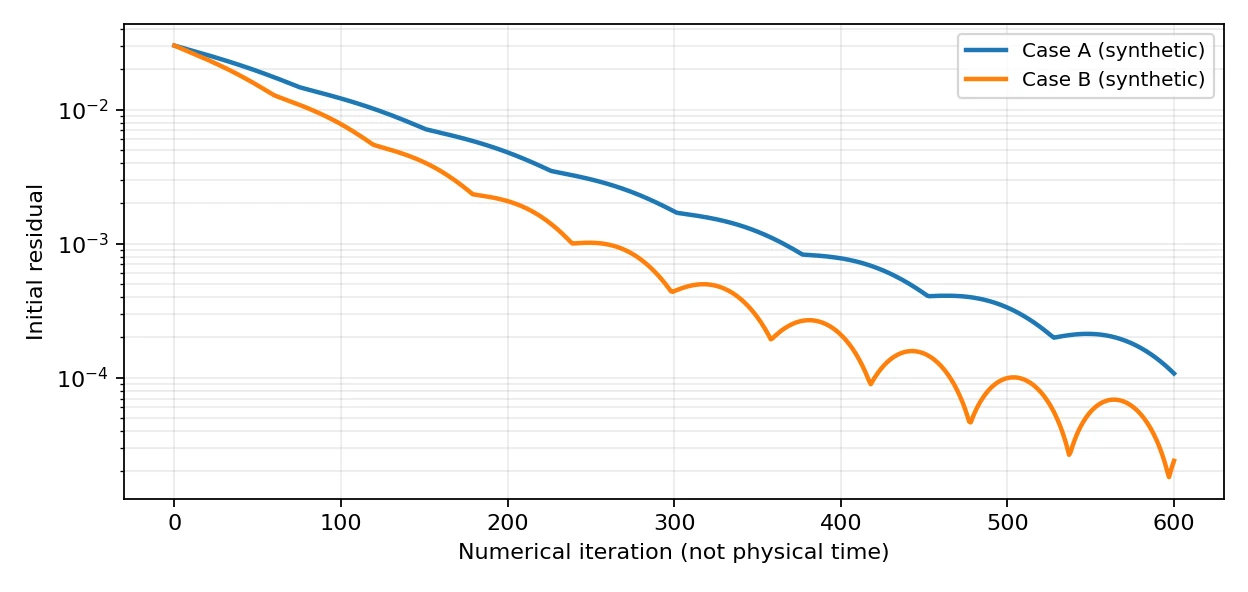
Practical tip · The reference / relax_06 comparison step by step
- Before the test write down which quantities decide the comparison and with what tolerance, for example: pressure drop to 4 significant digits, xr/h to 2 decimals, flow balance within 10⁻⁴. Install the monitors with
add_observables.pyon both copies before the run. - After the run:
python3 residual_history.py ~/OpenFOAM/guide19_run01 --cases reference relax_06 --plot(residuals at the same iteration and the “stop@” column) andpython3 observables.py ~/OpenFOAM/guide19_run01 --cases reference relax_06 --plot(variation of the observables over the last 100 iterations and xr at every write time). - If the observables in
relax_06are still changing, prepare a new campaign with more iterations, for examplepython3 prepare_campaign.py --out ~/OpenFOAM/guide19_run02 --steps 2000, instead of restarting the cases already used. At convergence both variants must give the same values (section 6): a persistent difference indicates a convergence problem, not a physical effect of the relaxation.
14. Exercise C: MPI solver speedup
Run at different times with no competing heavy server workloads:
bash run_case.sh ~/OpenFOAM/guide19_run01/parallel_2 2
bash run_case.sh ~/OpenFOAM/guide19_run01/parallel_4 4
python3 analyze_campaign.py ~/OpenFOAM/guide19_run01 --plot
The analysis tool writes results_summary.csv and writes speedup.png only when reference, parallel_2 and parallel_4 completed and reached the requested iteration count. Missing logs never turn into fabricated numbers. Solver time excludes meshing, decomposition and reconstruction; their logs remain available separately.
Deep dive · Package script: analyze_campaign.py, tested on synthetic logs
#!/usr/bin/env python3
# SPDX-License-Identifier: GPL-3.0-or-later
"""Parse solver logs and optionally plot MPI speedup; no CFD execution performed."""
import argparse
import csv
from pathlib import Path
import re

TIME_RE = re.compile(r"(?:^|\n)\s*Time\s*=\s*([0-9.eE+-]+)")
CLOCK_RE = re.compile(r"ExecutionTime\s*=\s*([0-9.eE+-]+)\s*s\s+ClockTime\s*=\s*([0-9.eE+-]+)\s*s")
RESID_RE = re.compile(r"Solving for\s+([^,]+),\s+Initial residual\s*=\s*([0-9.eE+-]+)")
CONT_RE = re.compile(r"time step continuity errors\s*:\s*sum local\s*=\s*([0-9.eE+-]+)")


def parse_case(base, row):
    name = row['case']
    p = base / name
    result = dict(row)
    result.update(success=str((p/'RUN_SUCCESS').exists()), last_step='', clock_s='', cpu_s='',
                  last_Ux_initial='', last_p_initial='', last_continuity_local='', log_present='false')
    log = p/'log.foamRun'
    if not log.is_file():
        return result
    s = log.read_text(errors='replace')
    result['log_present']='true'
    times = TIME_RE.findall(s)
    clocks = CLOCK_RE.findall(s)
    resids = RESID_RE.findall(s)
    conts = CONT_RE.findall(s)
    if times:
        result['last_step'] = times[-1]
    if clocks:
        result['cpu_s'], result['clock_s'] = clocks[-1]
    for name_field, key in [('Ux','last_Ux_initial'),('p','last_p_initial')]:
        values = [res for field,res in resids if field.strip() == name_field]
        if values:
            result[key] = values[-1]
    if conts:
        result['last_continuity_local'] = conts[-1]
    return result


def main():
    ap = argparse.ArgumentParser(description=__doc__)
    ap.add_argument('campaign', type=Path)
    ap.add_argument('--plot', action='store_true', help='Requires matplotlib')
    args = ap.parse_args()
    base = args.campaign.expanduser().resolve()
    with (base/'campaign_manifest.csv').open(newline='', encoding='utf-8') as f:
        manifest = list(csv.DictReader(f))
    rows = [parse_case(base, row) for row in manifest]
    out=base/'results_summary.csv'
    if out.exists():
        ap.error('Refusing to overwrite results_summary.csv; rename or archive it first')
    with out.open('w',newline='',encoding='utf-8') as f:
        wr=csv.DictWriter(f,fieldnames=list(rows[0]));wr.writeheader();wr.writerows(rows)
    print('Wrote:',out)
    if args.plot:
        try:
            import matplotlib.pyplot as plt
        except ImportError as exc:
            ap.error(f'matplotlib is required for --plot: {exc}')
        pts = []
        for r in rows:
            if r['case'] in ('reference','parallel_2','parallel_4') and r['success']=='True' and r['clock_s']:
                pts.append((int(r['mpi_processes']),float(r['clock_s']),r['last_step'],int(r['steps'])))
        if len(pts) == 3 and all(float(x[2]) >= x[3] for x in pts):
            pts.sort()
            t1=next(t for n,t,_,_ in pts if n==1)
            fig,ax=plt.subplots(figsize=(6.8,4.2))
            ax.plot([p[0] for p in pts],[t1/p[1] for p in pts],marker='o',label='Measured speedup')
            ax.plot([1,2,4],[1,2,4],ls='--',color='gray',label='Ideal speedup')
            ax.set(xlabel='MPI processes',ylabel='S(n) = T(1)/T(n)',title='OpenFOAM 14: fixed-mesh MPI study')
            ax.grid(alpha=.25);ax.legend();fig.tight_layout()
            png=base/'speedup.png'
            if png.exists():
                ap.error('Refusing to overwrite speedup.png')
            fig.savefig(png,dpi=180)
            print('Wrote:',png)
        else:
            print('Speedup plot skipped: need 3 successful runs at the requested step count.')

if __name__ == '__main__':
main()- It reads the last
Time, the last ExecutionTime/ClockTime pair, the last initial residuals of Ux and p and the last local continuity error; it writesresults_summary.csvand plots the speedup only if the three cases of the MPI comparison succeeded and reached the requested iterations. - The speedup uses
ClockTime, which OpenFOAM 14 prints in whole seconds (section 10), and a single run per case: read it as an indication; for the median and millisecond resolution usebenchmark_repeats.pyandbenchmark_stats.py. - The summary is written before the plot and never overwritten: to also get
speedup.pnguse--ploton the first run, otherwise renameresults_summary.csvand repeat.
Test on the synthetic logs produced by the placeholders (the integer ClockTime of the synthetic log reproduces the resolution of the real one):
$ python3 analyze_campaign.py ~/OpenFOAM/guide19_run01 --plot
Wrote: /home/user/OpenFOAM/guide19_run01/results_summary.csv
Wrote: /home/user/OpenFOAM/guide19_run01/speedup.png
[exit 0]
$ cat ~/OpenFOAM/guide19_run01/results_summary.csv
case,scheme,mpi_processes,steps,notes,success,last_step,clock_s,cpu_s,last_Ux_initial,last_p_initial,last_continuity_local,log_present
reference,bounded Gauss linearUpwind grad(U),1,600,Reference scheme,True,600,12,12.2238,3.80923e-05,0.000327463,0.000547599,true
upwind,bounded Gauss upwind,1,600,First-order upwind,True,600,12,12.2238,2.49677e-06,1.69327e-05,2.02735e-05,true
limited,bounded Gauss limitedLinearV 1,1,600,Limited vector scheme,True,600,12,12.2238,9.74942e-06,0.000103747,0.000167696,true
relax_06,bounded Gauss linearUpwind grad(U),1,600,U relaxation 0.6,True,600,12,12.2238,0.00384015,0.0116862,0.0198363,true
parallel_2,bounded Gauss linearUpwind grad(U),2,600,Reference MPI 2,True,600,7,7.69173,3.80923e-05,0.000327463,0.000547599,true
parallel_4,bounded Gauss linearUpwind grad(U),4,600,Reference MPI 4,True,600,5,5.76251,3.80923e-05,0.000327463,0.000547599,true
[exit 0]
$ python3 analyze_campaign.py ~/OpenFOAM/guide19_run01 --plot
usage: analyze_campaign.py [-h] [--plot] campaign
analyze_campaign.py: error: Refusing to overwrite results_summary.csv; rename or archive it first
[exit 2]
15. Retrieving and analysing results from Windows
Use FileZilla/SFTP to download log.*, campaign_manifest.csv, results_summary.csv, speedup.png and any ParaView CSV exports. Open tables in Excel/Calc or process them with local Python. Store each campaign separately and preserve its manifest.
Where available, the parser extracts the last Time, ExecutionTime, ClockTime, final initial residuals for p and Ux, and the last local continuity error. These are diagnostic, not sufficient for physical validation. Any pressure comparison must use identical measurement surfaces and proper conversion of kinematic pressure.
Deep dive · Additional script: observables.py, pressure drop, flow rates, probes and reattachment point
The script reads the files of the add_observables.py monitors and reports, at the last iteration and as relative variation over the last --window iterations: inlet and outlet flow rates and their imbalance, kinematic pressure drop (in Pa with --rho), Ux at the three probes, and the reattachment point xr on the lower wall at every write time. xr is the last sign change of the x component of the wall shear stress before the region with the downstream sign: the computation does not depend on the sign convention of wallShearStress and excludes the small corner eddy near the step. The columns of the .xy file are recognised from the header written by setWriter.C, which shortens names that are too long with “…”.
#!/usr/bin/env python3
"""Physical observables of the Guide 19 campaign from the add_observables.py monitors.

For every case (campaign_manifest.csv or --cases) it reads postProcessing/
and reports at the last iteration, and their variation over the last
--window iterations (default 100):

  * inlet and outlet volumetric flow rates and their imbalance;
  * pressure drop between inlet and outlet (kinematic, and in Pa with --rho);
  * Ux at the three probes;
  * reattachment point x_r of the separated flow on the lower wall, found
    where the x-wall-shear-stress changes sign for the last time
    (independent of the sign convention), and x_r/h with h = --h;
    x_r is reported for every write time, to show whether it is still moving.

Outputs observables_summary.csv and, with --plot, observables.png.
Existing outputs are never overwritten.

Usage: python3 observables.py CAMPAIGN_DIR [--cases ...] [--rho 1.2] [--h 0.0254] [--window 100] [--plot]
"""
import argparse, csv, glob, math, os, re, sys


def read_dat(case, name):
    out = []
    for d in sorted(glob.glob(os.path.join(case, 'postProcessing', name, '*')), key=lambda p: float(os.path.basename(p))):
        for f in glob.glob(os.path.join(d, '*.dat')):
            for line in open(f, encoding='utf-8'):
                if line.startswith('#') or not line.strip():
                    continue
                v = line.split()
                out.append((float(v[0]), float(v[1])))
    return sorted(out)


def read_probe(case, field='U'):
    rows = []
    for d in sorted(glob.glob(os.path.join(case, 'postProcessing', 'probes', '*')), key=lambda p: float(os.path.basename(p))):
        f = os.path.join(d, field)
        if not os.path.isfile(f):
            continue
        for line in open(f, encoding='utf-8'):
            if line.startswith('#') or not line.strip():
                continue
            t = float(line.split()[0])
            vecs = re.findall(r'\(([^)]*)\)', line)
            rows.append((t, [[float(c) for c in v.split()] for v in vecs]))
    return rows


def reattachment(xyfile, h):
    head, data = None, []
    for line in open(xyfile, encoding='utf-8'):
        if line.startswith('#'):
            head = line[1:].split()
            continue
        if line.strip():
            data.append([float(v) for v in line.split()])
    ix, it = 1, 4
    if head:
        if 'x' in head:
            ix = head.index('x')
        cand = [i for i, h_ in enumerate(head) if h_.startswith('wallShe')]
        if cand:
            it = cand[0]
    pts = sorted((r[ix], r[it]) for r in data if r[ix] > 1e-3)
    if len(pts) < 5:
        return None
    xmax = pts[-1][0]
    tail = [t for x, t in pts if x > 0.9 * xmax]
    sd = 1 if sum(tail) > 0 else -1
    xr = None
    for (x0, t0), (x1, t1) in zip(pts[:-1], pts[1:]):
        if t0 * sd < 0 <= t1 * sd:
            xr = x0 + (x1 - x0) * (-t0) / (t1 - t0) if t1 != t0 else x0
    return xr


def variation(series, window):
    if not series:
        return None, None
    tl = series[-1][0]
    w = [v for t, v in series if t >= tl - window]
    mean = sum(w) / len(w)
    return series[-1][1], (max(w) - min(w)) / abs(mean) if mean else float('inf')


def main():
    ap = argparse.ArgumentParser(description=__doc__.split('\n')[0])
    ap.add_argument('campaign')
    ap.add_argument('--cases', nargs='*')
    ap.add_argument('--rho', type=float, help='density [kg/m3] to convert the kinematic pressure drop to Pa')
    ap.add_argument('--h', type=float, default=0.0254, help='step height [m]')
    ap.add_argument('--window', type=float, default=100)
    ap.add_argument('--plot', action='store_true')
    a = ap.parse_args()
    base = os.path.abspath(os.path.expanduser(a.campaign))
    if a.cases:
        cases = a.cases
    else:
        with open(os.path.join(base, 'campaign_manifest.csv'), encoding='utf-8') as f:
            cases = [r['case'] for r in csv.DictReader(f)]
    out_csv = os.path.join(base, 'observables_summary.csv')
    out_png = os.path.join(base, 'observables.png')
    for p in (out_csv,) + ((out_png,) if a.plot else ()):
        if os.path.exists(p):
            sys.exit('refusing to overwrite ' + p)
    rows, hist = [], {}
    for c in cases:
        cd = os.path.join(base, c)
        qi, qo = read_dat(cd, 'inletFlowRate'), read_dat(cd, 'outletFlowRate')
        pi, po = read_dat(cd, 'inletPressure'), read_dat(cd, 'outletPressure')
        if not (qi and qo and pi and po):
            print(f'{c}: observables not found (were they installed with add_observables.py before the run?)')
            continue
        po_d = dict(po)
        dp = [(t, v - po_d[t]) for t, v in pi if t in po_d]
        dp_last, dp_var = variation(dp, a.window)
        imb = (qo[-1][1] + qi[-1][1]) / abs(qi[-1][1])
        pr = read_probe(cd, 'U')
        probes = []
        for k in range(len(pr[-1][1]) if pr else 0):
            last, var = variation([(t, v[k][0]) for t, v in pr], a.window)
            probes.append((last, var))
        xr = []
        for d in sorted(glob.glob(os.path.join(cd, 'postProcessing', 'lowerWallShearStress', '*')), key=lambda p: float(os.path.basename(p))):
            files = glob.glob(os.path.join(d, '*.xy'))
            if files:
                xr.append((float(os.path.basename(d)), reattachment(files[0], a.h)))
        hist[c] = dict(dp=dp, xr=xr)
        row = dict(case=c, last_iteration=int(dp[-1][0]), Q_inlet_m3_s=qi[-1][1], Q_outlet_m3_s=qo[-1][1], imbalance=imb,
                   dp_kinematic_m2_s2=dp_last, dp_Pa=(dp_last * a.rho if a.rho else ''), dp_rel_variation=dp_var)
        for k, (last, var) in enumerate(probes):
            row[f'Ux_probe{k}'] = last
            row[f'Ux_probe{k}_rel_variation'] = var
        row['x_r_m'] = xr[-1][1] if xr else ''
        row['x_r_over_h'] = xr[-1][1] / a.h if xr and xr[-1][1] else ''
        row['x_r_history'] = ' '.join(f'{int(t)}:{(v / a.h):.3f}' for t, v in xr if v)
        rows.append(row)
    if not rows:
        sys.exit('no observables found')
    print(f'variations are (max - min)/|mean| over the last {a.window:g} iterations')
    print(f'{"case":12s} {"it":>4s} {"Q_in m3/s":>11s} {"imbal.":>9s} {"dp m2/s2":>9s} {"var":>8s}'
          + (f' {"dp Pa":>8s}' if a.rho else '') + f' {"Ux0":>7s} {"Ux1":>7s} {"Ux2":>7s} {"x_r/h":>6s}  x_r/h at write times')
    for r in rows:
        print(f'{r["case"]:12s} {r["last_iteration"]:4d} {r["Q_inlet_m3_s"]:11.4e} {r["imbalance"]:9.2e} {r["dp_kinematic_m2_s2"]:9.4f} {r["dp_rel_variation"]:8.1e}'
              + (f' {r["dp_Pa"]:8.3f}' if a.rho else '')
              + ''.join(f' {r.get(f"Ux_probe{k}", float("nan")):7.3f}' for k in range(3))
              + f' {r["x_r_over_h"] if r["x_r_over_h"] == "" else format(r["x_r_over_h"], "6.3f"):>6}  {r["x_r_history"]}')
    keys = list(dict.fromkeys(k for r in rows for k in r))
    with open(out_csv, 'x', newline='', encoding='utf-8') as f:
        w = csv.DictWriter(f, fieldnames=keys)
        w.writeheader()
        w.writerows(rows)
    print('Wrote', out_csv)
    if a.plot:
        import matplotlib
        matplotlib.use('Agg')
        import matplotlib.pyplot as plt
        fig, axs = plt.subplots(1, 2, figsize=(11, 4.2), dpi=150)
        for c, hh in hist.items():
            if c.startswith('parallel'):
                continue
            axs[0].plot([t for t, _ in hh['dp']], [v for _, v in hh['dp']], lw=1.2, label=c)
            axs[1].plot([t for t, v in hh['xr'] if v], [v / a.h for t, v in hh['xr'] if v], marker='o', label=c)
        axs[0].set(xlabel='SIMPLE iteration', ylabel='p_inlet - p_outlet [m2/s2]', title='pressure drop (kinematic)')
        axs[1].set(xlabel='SIMPLE iteration (write times)', ylabel='x_r / h', title='reattachment point on the lower wall')
        for ax in axs:
            ax.grid(alpha=0.3)
            ax.legend(fontsize=8)
        fig.tight_layout()
        fig.savefig(out_png)
        print('Wrote', out_png)


if __name__ == '__main__':
    main()
To test the scripts without a run, make_synthetic_campaign.py writes logs and monitor files with OpenFOAM 14 names and format from analytic models (exponential decays, a moving reattachment point); it is also the generator used by the foamRun placeholders in the tests on this page. Synthetic data, not OpenFOAM results.
#!/usr/bin/env python3
"""SYNTHETIC test data for the Guide 19 parsers - NOT OpenFOAM results.

  log CASE    print to stdout a foamRun-style log for a prepared case,
              using endTime, div(phi,U), the U relaxation factor and
              numberOfSubdomains of that case to vary an imposed residual
              decay and an imposed cost per iteration;
  post CASE   write CASE/postProcessing files with the names and layout
              of the Guide 19 observables (add_observables.py): flow rates,
              mean pressures, probes and the wall-shear-stress graph.

All numbers come from analytic toy models (exponential decays, a moving
reattachment point); they only exercise residual_history.py,
observables.py and benchmark_stats.py. Every file states SYNTHETIC.
"""
import math, os, re, sys


def rd(case, rel):
    p = os.path.join(case, rel)
    return open(p, encoding='utf-8').read() if os.path.isfile(p) else ''


def case_params(case):
    cd, fs, fv, dp = (rd(case, 'system/' + f) for f in ('controlDict', 'fvSchemes', 'fvSolution', 'decomposeParDict'))
    steps = int(float(re.search(r'(?m)^\s*endTime\s+([0-9.eE+-]+)', cd).group(1)))
    scheme = re.search(r'div\(phi,U\)\s+([^;]+);', fs).group(1)
    relax = float(re.search(r'(?m)^\s*U\s+([0-9.]+);', fv).group(1))
    m = re.search(r'numberOfSubdomains\s+(\d+)', dp)
    n = int(m.group(1)) if m else 1
    tau = 60.0
    if 'upwind;' in scheme + ';' and 'linearUpwind' not in scheme:
        tau = 42.0
    elif 'limitedLinearV' in scheme:
        tau = 52.0
    tau *= 0.9 / relax * (1.0 if relax >= 0.9 else 1.25)
    return steps, scheme, relax, n, tau


def log(case):
    steps, scheme, relax, n, tau = case_params(case)
    cost = {1: 0.0200, 2: 0.0118, 4: 0.0079, 8: 0.0068}.get(n, 0.02 / n)
    w = sys.stdout.write
    w('/*---------------------------------------------------------------------------*\\\n'
      '  SYNTHETIC foamRun log written by make_synthetic_campaign.py - NOT OpenFOAM output\n'
      '\\*---------------------------------------------------------------------------*/\n')
    w(f'Build  : 14 (synthetic)\nExec   : foamRun{" -parallel" if n > 1 else ""}\nnProcs : {n}\n\n'
      'Create time\n\nCreate mesh for time = 0\n\nSelecting solver incompressibleFluid\n\nStarting time loop\n\n')
    wall = 0.6 * n ** 0.5
    cum = 0.0
    for it in range(1, steps + 1):
        e = math.exp(-it / tau)
        osc = 1 + 0.15 * math.sin(it / 7.0)
        rUx = min(1.0, 0.9 * e * osc + 2e-6)
        rUy = min(1.0, 1.0 * e * osc + 3e-6)
        rp = min(1.0, 0.8 * math.exp(-it / (1.3 * tau)) * osc + 5e-6)
        re_ = min(1.0, 0.3 * e + 1e-6)
        rk = min(1.0, 0.6 * e + 1e-6)
        nUx = 1 if it > 20 else 2
        nP = max(2, int(17 * math.exp(-it / 400.0)) + (it % 3))
        cont = 1.2 * math.exp(-it / (1.3 * tau)) + 1e-8
        cum += 0.4 * cont
        wall += cost * (1 + 0.05 * math.sin(it))
        w(f'Time = {it}s\n\n')
        w(f'smoothSolver:  Solving for Ux, Initial residual = {rUx:.6g}, Final residual = {0.05 * rUx:.6g}, No Iterations {nUx}\n')
        w(f'smoothSolver:  Solving for Uy, Initial residual = {rUy:.6g}, Final residual = {0.05 * rUy:.6g}, No Iterations {nUx + 1}\n')
        w(f'GAMG:  Solving for p, Initial residual = {rp:.6g}, Final residual = {0.08 * rp:.6g}, No Iterations {nP}\n')
        w(f'time step continuity errors : sum local = {cont:.6g}, global = {0.1 * cont:.6g}, cumulative = {cum:.6g}\n')
        w(f'smoothSolver:  Solving for epsilon, Initial residual = {re_:.6g}, Final residual = {0.05 * re_:.6g}, No Iterations 3\n')
        w(f'smoothSolver:  Solving for k, Initial residual = {rk:.6g}, Final residual = {0.05 * rk:.6g}, No Iterations 3\n')
        w(f'ExecutionTime = {0.97 * wall:.6g} s  ClockTime = {int(wall)} s\n\n')
    w('End\n\n')
    if os.environ.get('SYNTH_SLEEP'):
        import time
        time.sleep(float(os.environ['SYNTH_SLEEP']) * cost * steps)   # imitate the run time (test harness only)


def post(case):
    steps, scheme, relax, n, tau = case_params(case)
    pp = os.path.join(case, 'postProcessing')
    os.makedirs(pp, exist_ok=False)
    tag = '# SYNTHETIC data written by make_synthetic_campaign.py - NOT OpenFOAM output\n'
    xr_final = {42.0: 0.150, 52.0: 0.163}.get(round(tau / (0.9 / relax * (1.0 if relax >= 0.9 else 1.25)), 1), 0.168)

    def series(name, typ, cols, fun):
        d = os.path.join(pp, name, '0')
        os.makedirs(d)
        with open(os.path.join(d, typ + '.dat'), 'w') as f:
            f.write(tag + '# Time        \t' + '\t'.join(cols) + '\n')
            for it in range(1, steps + 1):
                f.write(f'{it}\t' + '\t'.join(f'{v:.8e}' for v in fun(it)) + '\n')

    Q = 2.54e-4
    series('inletFlowRate', 'surfaceFieldValue', ['sum(phi)'], lambda it: [-Q])
    series('outletFlowRate', 'surfaceFieldValue', ['sum(phi)'], lambda it: [Q * (1 + 0.3 * math.exp(-it / (1.3 * tau)))])
    series('inletPressure', 'surfaceFieldValue', ['areaAverage(p)'], lambda it: [9.6 + 4.0 * math.exp(-it / tau) * math.cos(it / 9.0)])
    series('outletPressure', 'surfaceFieldValue', ['areaAverage(p)'], lambda it: [0.0])
    d = os.path.join(pp, 'probes', '0')
    os.makedirs(d)
    pts = [(0.05, -0.0125, 0.0), (0.15, -0.02, 0.0), (0.25, 0.0, 0.0)]
    with open(os.path.join(d, 'U'), 'w') as f:
        f.write(tag)
        for i, p in enumerate(pts):
            f.write(f'# Probe {i} ({p[0]:g} {p[1]:g} {p[2]:g})\n')
        f.write('#       Probe' + ''.join(f'{i:>27d}' for i in range(len(pts))) + '\n#        Time\n')
        for it in range(1, steps + 1):
            e = math.exp(-it / tau)
            vals = [(-1.6 + 1.5 * e, 0.1, 0), (-0.4 + 2.0 * e, 0.05, 0), (6.1 - 3.0 * e, 0.0, 0)]
            f.write(f'{it:>13d}' + ''.join(f'    ({u:.6g} {v:.6g} {z:g})' for u, v, z in vals) + '\n')
    for it in range(100, steps + 1, 100):
        d = os.path.join(pp, 'lowerWallShearStress', str(it))
        os.makedirs(d)
        xr = xr_final - 0.08 * math.exp(-it / (1.5 * tau))
        with open(os.path.join(d, 'patchCutLayerAverage.xy'), 'w') as f:
            f.write('#     distance            x            y            z    wallShe...    wallShe...    wallShe...\n')
            for i in range(120):
                x = -0.0206 + (0.29 + 0.0206) * i / 119
                if x < 0:
                    tau_x = -0.30
                elif x < 0.012:
                    tau_x = -0.02 * math.sin(math.pi * x / 0.012)          # corner eddy
                else:
                    tau_x = 0.25 * math.sin(math.pi * (x - 0.012) / (xr - 0.012)) if x < xr else -0.35 * (1 - math.exp(-(x - xr) / 0.02))
                y = 0.0 if x < 0 else -0.0254
                f.write(f'{x + 0.0206:13.6g}{x:13.6g}{y:13.6g}{0:13.6g}{tau_x:13.6g}{0:13.6g}{0:13.6g}\n')


if __name__ == '__main__':
    if len(sys.argv) != 3 or sys.argv[1] not in ('log', 'post'):
        sys.exit('usage: make_synthetic_campaign.py log|post CASE')
    (log if sys.argv[1] == 'log' else post)(sys.argv[2])
$ for c in reference upwind limited relax_06; do bash run_case.sh ~/OpenFOAM/guide19_run02/$c 1; done
[exit 0]
$ ls ~/OpenFOAM/guide19_run02/reference/postProcessing ~/OpenFOAM/guide19_run02/reference/postProcessing/lowerWallShearStress
/home/user/OpenFOAM/guide19_run02/reference/postProcessing:
inletFlowRate
inletPressure
lowerWallShearStress
outletFlowRate
outletPressure
probes
/home/user/OpenFOAM/guide19_run02/reference/postProcessing/lowerWallShearStress:
100
200
300
400
500
600
[exit 0]
$ head -4 ~/OpenFOAM/guide19_run02/reference/postProcessing/lowerWallShearStress/600/patchCutLayerAverage.xy
# distance x y z wallShe... wallShe... wallShe...
0 -0.0206 0 0 -0.3 0 0
0.00261008 -0.0179899 0 0 -0.3 0 0
0.00522017 -0.0153798 0 0 -0.3 0 0
[exit 0]
$ python3 observables.py ~/OpenFOAM/guide19_run02 --cases parallel_2
parallel_2: observables not found (were they installed with add_observables.py before the run?)
no observables found
[exit 1]
$ python3 observables.py ~/OpenFOAM/guide19_run02 --cases reference upwind limited relax_06 --rho 1.2 --plot
variations are (max - min)/|mean| over the last 100 iterations
case it Q_in m3/s imbal. dp m2/s2 var dp Pa Ux0 Ux1 Ux2 x_r/h x_r/h at write times
reference 600 -2.5400e-04 1.37e-04 9.5999 1.4e-04 11.520 -1.600 -0.400 6.100 6.596 100:5.567 200:6.261 300:6.491 400:6.559 500:6.592 600:6.596
upwind 600 -2.5400e-04 5.07e-06 9.6000 3.5e-06 11.520 -1.600 -0.400 6.100 5.885 100:5.256 200:5.769 300:5.872 400:5.882 500:5.884 600:5.885
limited 600 -2.5400e-04 4.19e-05 9.6000 3.8e-05 11.520 -1.600 -0.400 6.100 6.396 100:5.524 200:6.171 300:6.321 400:6.388 500:6.394 600:6.396
relax_06 600 -2.5400e-04 4.96e-03 9.5851 8.1e-03 11.502 -1.593 -0.390 6.086 6.501 100:4.857 200:5.635 300:6.077 400:6.297 500:6.422 600:6.501
Wrote /home/user/OpenFOAM/guide19_run02/observables_summary.csv
Wrote /home/user/OpenFOAM/guide19_run02/observables.png
[exit 0]Deep dive · The reattachment point: why it is the right observable and what to expect
- The tutorial geometry is that of the experiment of R. W. Pitz, J. W. Daily, “Combustion in a turbulent mixing layer formed at a rearward-facing step”, AIAA Journal 21, 1565–1570, 1983, doi:10.2514/3.8290. A quantitative comparison with the measurements requires their inlet conditions, different from the 10 m/s of the tutorial: here xr/h serves as a numerical observable to compare schemes and convergence.
- In backward-facing step flows the standard k–ε model tends to underpredict the recirculation length compared with measurements (a classic reference for the reattachment of a shear layer is D. M. Driver, H. L. Seegmiller, “Features of a reattaching turbulent shear layer in divergent channel flow”, AIAA Journal 23, 163–171, 1985, doi:10.2514/3.8890); the numerical diffusion of upwind acts in the same direction. The two causes add up: a shorter xr with
upwindis not a sign of higher accuracy. - The pressure of
incompressibleFluidis kinematic (p/ρ, m²/s²): to obtain Pa multiply by the density of the fluid being represented (--rho 1.2for air); the case only defines ν = 10⁻⁵ m²/s.
16. Benchmark acceptance criteria
| Check | Meaning |
|---|---|
| All cases reach the requested step count | Comparable numerical workload; not necessarily converged |
No fatal checkMesh errors | Usable mesh; quality still needs assessment |
| Small residuals and stable physical observables | Evidence of convergence, not validation |
| Inlet/outlet fluxes balance | Mass conservation check |
| Serial and MPI predictions agree within a stated tolerance | Numerical reproducibility check |
| Runs use the same server under similar load | Better performance comparability |
| Repeated timings and median reported | Reduced sensitivity to timing fluctuations |
Practical tip · Acceptance criteria with numerical thresholds and verification tool
| Check | Proposed threshold (to be set before the test) | Tool |
|---|---|---|
| iterations performed | all equal to the requested value | analyze_campaign.py, residual_history.py |
| mesh | «Mesh OK.», 12 225 cells | log.checkMesh |
| flow balance | |Qout + Qin|/|Qin| < 10⁻⁴ | observables.py |
| observable stability | variation < 10⁻³ over the last 100 iterations | observables.py |
| serial and MPI consistent | pressure drop and xr/h equal to the chosen digits | observables.py |
| timing repeatability | spread (max − min)/median < 5 % | benchmark_stats.py |
| server conditions | load average before the run close to 0; same cores | timing.csv |
The thresholds are a starting point to adapt to how the result will be used; they must be written in the protocol before seeing the data.
17. Troubleshooting
Missing FOAM_TUTORIALS: OpenFOAM 14 environment was not sourced. Mesh dictionary missing: verify $FOAM_TUTORIALS/resources/blockMesh/pitzDaily. MPI fails: verify mpirun, domain decomposition and process count. Four processes slower than one: parallel overhead may dominate. Residual divergence: check mesh, boundaries, schemes and relaxation. RUN_STARTED without RUN_SUCCESS: the run is incomplete; inspect the log and create a new case rather than rerunning over archived data.
Scientific use still requires spatial convergence and, where applicable, time-step convergence; equal-step benchmark cases do not replace those studies.
Practical tip · Other frequent problems and their cause
- “There are not enough slots available in the system”: Open MPI sees fewer cores than the requested processes; reduce
-npor check withnprocandlscpu. - Open MPI refuses to start as the root user: use a normal user, as the package also recommends.
MPI count mismatchfromrun_case.sh: the number of processes passed does not match the casenumberOfSubdomains(test in section 12).analyze_campaign.pystops with “Refusing to overwrite results_summary.csv”: rename the previous file (section 14).- Scripts edited on Windows that fail with
$'\r': command not found: convert the line endings to LF (Notepad++: Edit › EOL Conversion › Unix). - Very different times between two identical repetitions: other processes on the server, frequency scaling, processes not pinned to cores;
timing.csvrecords the load average before each run.
18. Reproducible reporting checklist
Record exact OpenFOAM version, physical model, configuration file hash/commit, hardware and physical core count, mesh and checkMesh, numerical schemes, tolerances, step count, physical measurements, timings, machine load, convergence criteria and rationale for numerical choices. Preserve scripts, manifests and raw logs, not only presentation figures.
Practical tip · A protocol to fill in for every campaign
Campaign: guide19_run01            Date: ____    Operator: ____
OpenFOAM: Foundation 14, commit/package: ____   (foamVersion)
Server: ____ physical cores, CPU ____, RAM ____, filesystem ____
Case: pitzDailySteady, kEpsilon, nu 1e-05, inlet U 10 m/s
Mesh: resources/blockMesh/pitzDaily, 12225 cells, checkMesh: ____
Variants: campaign_manifest.csv (attached), sha256sum of system/* (attached)
Iterations: 600, residualControl disabled
Observables defined beforehand: dp [m2/s2], x_r/h, flow balance, probe Ux
Acceptance thresholds: ____ (section 16)
Timings: benchmark_repeats.py, N = __ repetitions, median, load average before
Results: results_summary.csv, residual_history.csv, observables_summary.csv,
         timing.csv, plots (attached)
Conclusions and limits: ____
The fingerprints of the configuration files are obtained with sha256sum ~/OpenFOAM/guide19_run01/*/system/* > config_sha256.txt: they document that the cases did not change between preparation and run.
Deep dive · Annotated bibliography and OpenFOAM 14 sources consulted
Finite volumes and pressure–velocity coupling
- J. H. Ferziger, M. Perić, R. L. Street, Computational Methods for Fluid Dynamics, Springer, 2020, doi:10.1007/978-3-319-99693-6.
- F. Moukalled, L. Mangani, M. Darwish, The Finite Volume Method in Computational Fluid Dynamics, Springer, 2016, doi:10.1007/978-3-319-16874-6.
- S. V. Patankar, D. B. Spalding, Int. J. Heat Mass Transfer 15, 1787–1806, 1972, doi:10.1016/0017-9310(72)90054-3.
- J. P. Van Doormaal, G. D. Raithby, Numer. Heat Transfer 7, 147–163, 1984, doi:10.1080/01495728408961817.
- C. M. Rhie, W. L. Chow, AIAA J. 21, 1525–1532, 1983, doi:10.2514/3.8284.
Convection schemes
- R. F. Warming, R. M. Beam, AIAA J. 14, 1241–1249, 1976, doi:10.2514/3.61457.
- P. K. Sweby, SIAM J. Numer. Anal. 21, 995–1011, 1984, doi:10.1137/0721062.
Linear solvers and parallel computing
- K. Stüben, J. Comput. Appl. Math. 128, 281–309, 2001, doi:10.1016/S0377-0427(00)00516-1.
- F. Pellegrini, J. Roman, LNCS 1067, 493–498, 1996, doi:10.1007/3-540-61142-8_588.
- G. M. Amdahl, AFIPS 1967, 483–485, doi:10.1145/1465482.1465560.
- J. L. Gustafson, Commun. ACM 31, 532–533, 1988, doi:10.1145/42411.42415.
- A. H. Karp, H. P. Flatt, Commun. ACM 33, 539–543, 1990, doi:10.1145/78607.78614.
Turbulence, case and verification
- B. E. Launder, D. B. Spalding, Comput. Methods Appl. Mech. Eng. 3, 269–289, 1974, doi:10.1016/0045-7825(74)90029-2.
- R. W. Pitz, J. W. Daily, AIAA J. 21, 1565–1570, 1983, doi:10.2514/3.8290.
- D. M. Driver, H. L. Seegmiller, AIAA J. 23, 163–171, 1985, doi:10.2514/3.8890.
- P. J. Roache, J. Fluids Eng. 116, 405–413, 1994, doi:10.1115/1.2910291.
- I. B. Celik et al., J. Fluids Eng. 130, 078001, 2008, doi:10.1115/1.2960953.
OpenFOAM 14 sources cited in the boxes
- applications/modules/incompressibleFluid/momentumPredictor.C
- applications/modules/incompressibleFluid/correctPressure.C
- applications/solvers/foamRun/foamRun.C
- src/finiteVolume/…/boundedConvectionScheme.C
- src/finiteVolume/…/linearUpwind.C
- src/finiteVolume/fvMatrices/fvMatrix/fvMatrix.C
- src/OpenFOAM/matrices/lduMatrix/lduMatrix/lduMatrixSolver.C
- src/OpenFOAM/matrices/LduMatrix/LduMatrix/SolverPerformance.C
- src/finiteVolume/…/singleRegionConvergenceControl.C
- src/OSspecific/POSIX/cpuTime/cpuTime.C
- src/OpenFOAM/global/clock/clock.C
- src/sampling/sampledSet/writers/setWriter.C
Official references
- OpenFOAM Foundation 14: pitzDailySteady tutorial
- OpenFOAM 14: numerical schemes
- OpenFOAM 14: solution control
- OpenFOAM 14: parallel execution
- OpenFOAM 14: foamDictionary
Licence for original bundle scripts: GNU GPL-3.0-or-later. All figures are schematic or based on synthetic data.
Related guides: Linux server from Windows, monitoring and convergence, ParaView for quantitative analysis, verification and validation, parameter sweeps, mesh generation and quality checks, boundary conditions and physical models, transient simulations, turbulence and RANS models, heat transfer and natural convection, conjugate heat transfer, species transport, diffusion and mixing, multiphase flows and VOF interfaces, porous media and pressure loss, rotating machinery, MRF and fans, dynamic meshes and moving walls, dispersed particles and wall interaction, chemical reactions and coupled transport and the Learning OpenFOAM 14 path.
Download: scripts and files of the guide
The archive OpenFOAM14_Guida19_script.zip (40 kB compressed, 12 files) contains every script and data file reproduced or cited in this article, with the same content as the boxes: the scripts/, examples/ and similar folders hold the guide package files, extra/ the additional scripts and files presented in the deep dives. README_IT_EN.txt lists the contents with SHA-256 checksums; files marked SYNTHETIC are illustrative data, not CFD results. Licence GNU GPL v3 or later (COPYING_GPLv3.txt).
Recommended order: python3 scripts/prepare_campaign.py --out ~/OpenFOAM/guide19_run01 --steps 600, then, before the run, python3 extra/add_observables.py on the cases to compare (flow rates, pressures, probes, wall shear stress for the reattachment point, section 11) and finally bash scripts/run_case.sh <case> <processes>. Analysis: scripts/analyze_campaign.py (section 14), extra/residual_history.py (section 5), extra/observables.py (section 15). For speedup with median and millisecond timings: extra/benchmark_repeats.py on prepared, never-run cases and extra/benchmark_stats.py (section 10).
Archive contents:
examples/measurements_template.csv— empty template for the ParaView measurements of the six cases (package file)extra/add_observables.py— Add the Guide 19 physical observables to NEW, never-run pitzDailySteady copies.extra/benchmark_repeats.py— Repeated, timed runs of one prepared Guide 19 case (OpenFOAM 14).extra/benchmark_stats.py— Speedup statistics from the timing.csv files of benchmark_repeats.py.extra/case_estimates.py— A-priori numbers for the pitzDailySteady campaign (OpenFOAM 14).extra/functions_guide19— system/functions of pitzDailySteady after add_observables.py: tutorial streamlines + flow rates, pressures, probes, wall shear stress graphextra/make_synthetic_campaign.py— SYNTHETIC test data for the Guide 19 parsers – NOT OpenFOAM results.extra/observables.py— Physical observables of the Guide 19 campaign from the add_observables.py monitors.extra/residual_history.py— Residual and cost histories of the Guide 19 campaign from log.foamRun.scripts/analyze_campaign.py— Parse solver logs and optionally plot MPI speedup; no CFD execution performed.scripts/prepare_campaign.py— Prepare isolated OpenFOAM 14 numerical-method and MPI experiments.scripts/run_case.sh— Run an unexecuted prepared case. Never clean or replace earlier data.